
Market Overview
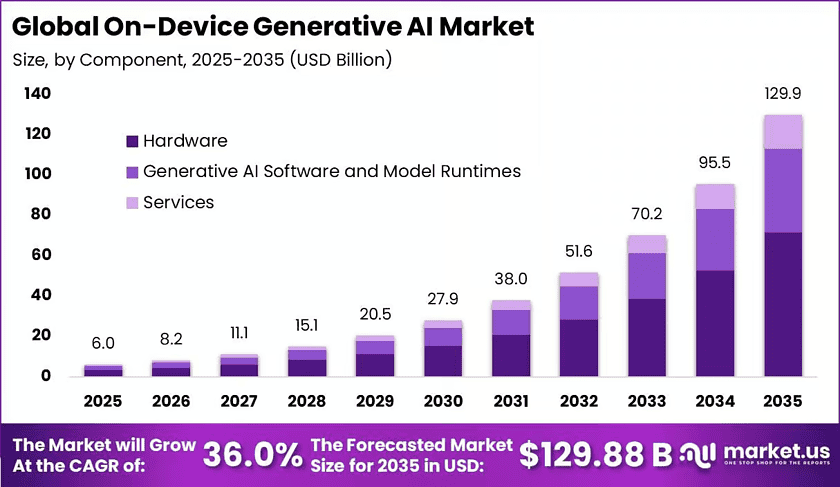
New York, NY – October 26, 2026 – The Global On-Device Generative AI Market reached USD 6.0 billion in 2025. The report projects it will reach USD 129.8 billion by 2035, growing at a CAGR of 36.0%. Consequently, local AI processing is becoming a core feature of modern consumer devices.
North America led the global market in 2025 with more than 37.0% share and about USD 2.2 billion in revenue. According to the Semiconductor Industry Association (SIA), Americas-based chip sales rose 30.5% in 2025. Moreover, this growth strengthens the region’s supply of AI-ready processors.
According to the SIA, global semiconductor sales reached a record USD 791.7 billion in 2025, up 25.6% from 2024. Additionally, logic chip sales grew 39.9% to USD 301.9 billion. This growth gives device makers wider access to processors that run AI models locally.
However, chip momentum shows no sign of slowing. The SIA expects global sales to exceed USD 1 trillion in 2026. Fourth-quarter 2025 sales already rose 37.1% to USD 236.6 billion. Therefore, chipmakers can expand their supply of neural processing units for smartphones, laptops, and wearables.
Furthermore, the mobile ecosystem gives on-device intelligence a massive user base. According to GSMA, the world counted 8.82 billion mobile connections and nearly 8 billion unique subscribers in 2025. Consequently, brands can deliver translation, voice help, and photo editing directly on phones. This reach supports more than 20 times market growth over a decade.
Key Takeaways
- The On-Device Generative AI Market was valued at USD 6.0 billion in 2025 and is projected to reach USD 129.8 billion by 2035 at a 36.0% CAGR.
- Hardware dominated the market with a 55.2% share in 2025.
- Smartphones and Tablets led the market with a 59.1% share in 2025.
- Small and Compact Language Models captured a leading 43.3% share in 2025.
- Text Modality accounted for a dominant 39.0% share in 2025.
- Hybrid Device-Cloud Deployment dominated deployment models with more than a 60.5% share in 2025.
- AI Assistants and Productivity held a dominant 36.1% share in 2025.
- Consumer Electronics led all end-use segments with a 66.0% share in 2025.
- North America led the market in 2025 with more than 37.0% share and USD 2.2 billion in revenue.
➤ Download the Detailed Sample Report with TOC, Tables, and Visual Figures – https://market.us/report/on-device-generative-ai-market/request-sample/
Market Segmentation
By Component
Hardware led the component segment with a 55.2% share in 2025. According to SEMI, chip equipment sales hit a record USD 135.1 billion in 2025, up 15%. This spending shows that manufacturers keep building the processors and memory that local AI needs. Meanwhile, software and model runtimes held 31.9%, while services held 12.9%.
By Device Type
Smartphones and tablets captured a 59.1% share in 2025. According to the ITU, 82% of people aged 10 and above own a mobile phone. Therefore, phone makers can push new AI features to billions of users through simple software updates. Moreover, AI PCs and laptops followed with 14.5%, while automotive systems held 10.0%.
By Model Type
Small and compact language models held a leading 43.3% share in 2025. According to the IEA, electricity use from AI-focused data centres rose about 50% in 2025. Consequently, developers shift suitable tasks to devices to save energy. Additionally, Counterpoint reported an average smartphone memory of 8.4 GB, which helps compact models run locally.
By Modality
Text modality accounted for a 39.0% share in 2025. Users rely on text for search, chat, and messaging, and text tasks need less battery power. According to UNESCO, global adult literacy reached about 88% in 2024, which lets more people use AI writing tools. Meanwhile, multimodal models followed at 21.1%.
By Deployment Model
Hybrid device-cloud deployment dominated with a 60.5% share in 2025. According to the ITU, 5G covered only 55% of the global population, and just 4% in low-income countries. Therefore, device makers run simple tasks locally and send heavy work to the cloud. Fully on-device deployment held the remaining 39.5%.
By Application
AI assistants and productivity tools held a 36.1% share in 2025. According to the U.S. Bureau of Labor Statistics, software publishers raised labor productivity by 12.9%, versus 2.2% for the wider business sector. This gap shows how software tools boost output. Consequently, workers adopt on-device assistants for writing, summaries, and scheduling.
By End Use
Consumer electronics led end-use segments with a 66.0% share in 2025. High shipment volumes of phones, tablets, and laptops create a large base of AI-ready hardware. According to China’s General Administration of Customs, China exported around 68.3 million mobile phones in December 2025. Moreover, regular replacement cycles keep expanding this installed base.
Regional Analysis
North America held more than a 37.0% share in 2025, generating about USD 2.2 billion. According to the U.S. Census Bureau, 17% to 20% of U.S. businesses used AI between December 2025 and May 2026. Consequently, firms buy more AI-ready laptops and phones. Moreover, the region hosts leading chip and software companies.
Asia Pacific accounted for an estimated 26.9% share and shows strong growth potential. China, India, Japan, and South Korea combine large device production with huge consumer demand. Additionally, South Korea’s Ministry of Science and ICT allocated around KRW 1 trillion for AI research in 2025. This funding strengthens local chip and AI skills.
Market Drivers
AI-ready device refresh acts as the strongest growth driver, adding about +5.2% to the baseline CAGR. Consumers replace older phones and PCs with models that include neural processors and more memory. Therefore, manufacturers raise device value and sell premium AI features. Moreover, this upgrade cycle delivers its impact within 2 years.
Local privacy processing adds an estimated +3.8% to market growth, mainly in North America and Europe. Users and businesses want personal data to stay on their own devices. Consequently, on-device models gain favor because they keep sensitive data away from outside servers. Additionally, this preference supports faster adoption across regulated industries.
Key Use Cases
Workplace productivity stands out as a leading use case for on-device generative AI. Employees use built-in assistants to draft emails, summarize documents, and manage schedules on laptops and phones. Moreover, local processing cuts response delays and keeps company files private. Therefore, businesses gain faster workflows without full dependence on cloud services.
Real-time translation and photo editing also drive daily usage on smartphones. Travelers translate conversations instantly, even with weak network signals. Additionally, creators enhance images and remove unwanted objects directly on their devices. Consequently, phone brands use these features to stand out and encourage customers to upgrade to newer AI-ready models.
Business Opportunities
Industrial edge copilots offer a strong opportunity as AI moves into factories, warehouses, and field services. Workers can ask equipment questions and receive repair guidance on rugged devices. However, this market remains early because it needs special training, safety testing, and partnerships. Therefore, early movers can build lasting positions with industrial clients.
Automotive in-cabin intelligence creates another promising path for growth. Carmakers add local AI assistants that handle navigation, voice commands, and driver support without constant connectivity. Moreover, buyers in China, Europe, Japan, and North America show rising interest in smarter cabins. Consequently, chip and software vendors can win long supply contracts with automakers.
Major Challenges
Power and thermal limits remain a major challenge for device makers. Generative models demand heavy computing, which drains batteries and creates heat in compact devices. Therefore, vendors must improve chip efficiency, memory use, and cooling designs. However, these upgrades raise development costs and can slow the launch of advanced AI features.
Advanced-chip export controls also create serious pressure across the supply chain. Trade rules limit access to leading processors and memory in certain markets. Consequently, manufacturers face higher purchase costs and delayed product launches. Additionally, new AI compliance rules in the European Union add legal and testing expenses for model developers.
Top Key Players in the Market
- Apple
- Microsoft
- Qualcomm
- Samsung
- NVIDIA
- Modular
- Nexa AI
- VinAI
- MovianAI
- Edge Impulse
Conclusion
The on-device generative AI market is entering a period of rapid expansion. Strong chip investment, a vast mobile user base, and rising demand for private, fast AI tools support this growth. Moreover, hardware, smartphones, and hybrid deployment are driving current adoption. However, power limits, export controls, and compliance costs require careful planning. Therefore, companies that balance efficiency, privacy, and affordability will capture the greatest long-term value.
Discuss your needs with our analyst
Please share your requirements with more details so our analyst can check if they can solve your problem(s)