
Market Overview
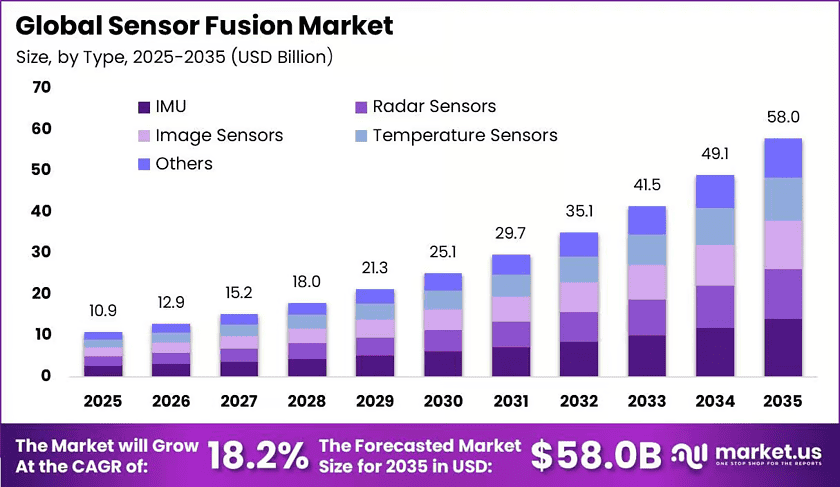
New York, NY – November 02, 2026 – The Global Sensor Fusion Market reached USD 10.9 billion in 2025. Analysts project it will reach about USD 58.0 billion by 2035, growing at a CAGR of 18.2%. This steady growth shows that industries now treat combined sensing as a core technology. Consequently, suppliers are gaining a long and dependable demand cycle.
Sensor fusion systems combine data from cameras, radar, lidar, inertial sensors, and ultrasonic sensors. These multi-sensor platforms help machines make faster and safer real-time decisions. Moreover, automakers remain the largest buyers of this technology. According to the report data, global vehicle production rose from 92.7 million units in 2024 to 96.4 million units in 2025, which widens the hardware base.
Modern vehicles use fused sensing for emergency braking, adaptive cruise control, parking help, and driver monitoring. Additionally, electric and connected cars need better control of batteries, vehicle motion, and road information. Therefore, each new vehicle platform carries more sensing content. As a result, perception suppliers can earn more value from every car they help build.
China produced 16.626 million new-energy vehicles in 2025, up 29%. This rapid rise expands the installed base for advanced sensing in electric cars. Furthermore, factories are adding automation at a fast pace. Manufacturers installed 542,000 industrial robots in 2024. Consequently, robot makers need precise motion and position data for safe operation.
The global stock of working robots reached 4.664 million units, up 9% year over year. Meanwhile, the Americas installed 50,100 robots in 2024, which shows strong regional adoption. Additionally, electronics, aerospace, medical-device, logistics, and defense buyers support demand for intelligent sensing solutions. Therefore, the market rests on a broad and varied customer base.
Key Takeaways
- The Sensor Fusion Market was valued at USD 10.9 billion in 2025 and will reach USD 58.0 billion by 2035, growing at a CAGR of 18.2%.
- The IMU segment held a leading 24.3% share by type, supported by its role in navigation, drones, vehicles, and industrial equipment.
- The MEMS segment held a leading 62.4% share by technology, driven by compact, low-power, and cost-effective sensor manufacturing.
- The consumer electronics segment held a leading 27.5% share by industry vertical, supported by high smartphone and wearable shipments.
- North America led the market in 2025 with a 36.5% share, generating about USD 4.0 billion in revenue.
Market Segmentation
By Type
The IMU segment holds a leading 24.3% share of the market. Inertial measurement units combine accelerometers and gyroscopes to track tilt, rotation, and movement. Moreover, IMUs keep supplying motion data when cameras, radar, or GPS signals fail. Therefore, drones, robots, vehicles, and navigation systems depend on them for steady and reliable operation.
According to the U.S. Federal Aviation Administration, the U.S. small-drone fleet reached about 1.8 million units in 2024. The agency expects nearly 1.9 million units by 2029. This growth matters because drones use IMUs to fly steadily and land safely. Consequently, drone makers create lasting demand for motion sensors.
By Technology
The MEMS segment holds a leading 62.4% share of the market. Micro-electromechanical systems make sensors small, low-power, and cheap to mass-produce. Additionally, chipmakers can place several sensing functions on one small silicon chip. Therefore, smartphones, earbuds, wearables, drones, and smart-home devices widely use MEMS accelerometers, gyroscopes, and pressure sensors.
According to GSMA, around 4.7 billion people used smartphones in 2024, and the number may reach 5.5 billion by 2030. This large user base keeps MEMS demand strong. Moreover, GSMA estimates mobile services added about USD 6.5 trillion to the global economy. Consequently, the digital device market gives MEMS suppliers a huge sales channel.
By Industry Vertical
The Consumer Electronics segment holds a leading 27.5% share of the market. According to IDC, global smartphone shipments will reach about 1.2 billion units in 2025. Each phone combines motion, light, proximity, camera, and biometric sensors. Therefore, phone makers use fusion software to improve navigation, image stabilization, gaming, and facial recognition.
Wearable devices also need compact and power-saving sensing systems. According to IDC, wrist-worn device shipments reached 45.6 million units in the first quarter of 2025, up 10.5%. This rise shows that consumers value health tracking. Additionally, automotive, healthcare, military and defense, and industrial users broaden the market beyond personal devices.
Regional Analysis
North America led the market in 2025 with a 36.5% share, or about USD 4.0 billion. The region has strong skills in automotive engineering, aerospace, healthcare technology, and AI development. Moreover, U.S. real GDP grew 2.2% in 2025, which reflects strong spending on equipment and research. Consequently, regional buyers keep investing in advanced perception systems.
Asia Pacific will likely be the fastest-growing region. China, Japan, South Korea, and India produce large volumes of smartphones, electric vehicles, drones, and industrial machines. Furthermore, the region’s deep manufacturing base lowers the cost of combining MEMS sensors, processors, and cameras. Therefore, Asian suppliers can offer affordable sensing modules to global customers.
Growth Drivers
Mandatory vehicle safety rules are a major growth driver. According to NHTSA, FMVSS No. 127 requires automatic emergency braking on nearly all U.S. light vehicles by September 2029. Moreover, Europe has required intelligent speed assistance on new vehicles since July 2024. Consequently, automakers now treat sensor fusion as standard equipment rather than a premium option.
Edge AI device integration is another key driver. Chipmakers now add built-in AI to small smart sensors. For example, Bosch Sensortec’s BHI385 runs sensor fusion at below 500 μA, which helps batteries last longer. Therefore, device makers can add smarter features to wearables and phones without raising power use.
Use Cases
Driver-assistance systems are a leading use case. Cars combine camera, radar, and inertial data to spot pedestrians, keep lanes, and brake in emergencies. Moreover, fused data gives a clearer view than any single sensor in rain or darkness. Consequently, automakers use these systems to improve road safety and meet tougher safety rules.
Smart factories and warehouses form another strong use case. Mobile robots merge lidar, cameras, and motion sensors to find routes and avoid obstacles. Additionally, warehouse operators use these fleets to move goods faster with fewer errors. Therefore, logistics and manufacturing firms gain better output, safer workplaces, and lower daily operating costs.
Business Opportunities
Software-defined vehicles create a promising opportunity. Automakers are moving toward central computers that run many vehicle functions through software. Moreover, chipmakers are buying Ethernet and safety software businesses to support this shift. Consequently, suppliers can sell fusion software, regular updates, and paid safety features that build recurring revenue over the life of each vehicle.
Medical monitoring wearables offer another growth path. Smartwatches and health bands combine heart-rate, motion, and location data to track sleep, exercise, and falls. Additionally, hospitals and insurers value continuous patient data outside the clinic. Therefore, device makers can build trusted health products and partner with care providers for remote monitoring services.
Major Challenges
Multi-sensor validation remains a serious challenge. Fusion systems must work safely across changing light, weather, road conditions, and component quality. Moreover, regulators demand testing in both daylight and darkness across many speeds. Consequently, suppliers spend heavily on simulation, fleet data, and hardware testing, which slows product launches and raises engineering budgets.
Automotive production cycles create another key challenge. Carmakers often delay model launches and cut sensor orders when demand weakens. Additionally, leading chipmakers reported lower revenue during the latest downturn. Therefore, sensor suppliers face uneven order flow, and some may postpone factory expansion even though long-term safety demand stays strong.
Top Key Players in the Market
- Analog Devices Inc.
- NXP Semiconductor
- Renesas Electronics Corporation
- Bosch Sensortec GmbH
- InvenSense Inc.
- Infineon Technologies
- STMicroelectronics
- Asahi Kasei Microdevices
- Baselabs
- Maxim Integrated
Conclusion
The sensor fusion market is set for strong long-term growth. Safety rules for vehicles, rising smartphone and wearable use, and more factory automation drive this demand. Moreover, MEMS technology and IMU products lead the market, and North America holds the largest regional share. However, testing complexity and uneven car production remain challenges. Consequently, suppliers that invest in software platforms and efficient smart sensors will gain an edge.
Discuss your needs with our analyst
Please share your requirements with more details so our analyst can check if they can solve your problem(s)