
Market Overview
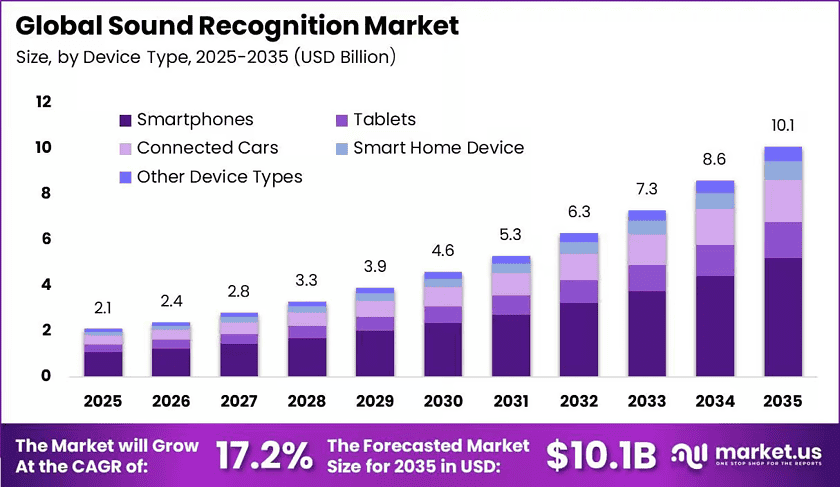
New York, NY – November 04, 2026 – The Global Sound Recognition Market reached USD 2.1 billion in 2025. Analysts expect it to grow at a CAGR of 17.2% from 2026 to 2035 and reach about USD 10.1 billion. This pace points to strong long-term demand for AI-based audio detection across many industries. North America led the market in 2025 with a share of more than 38.9% and about USD 0.82 billion in revenue.
Additionally, sound recognition technology identifies speech, alarms, machine vibration, glass breaking, and battery venting sounds. Businesses turn these sounds into useful alerts. Automotive, consumer electronics, industrial, security, and healthcare users now depend on these audio analysis tools. Therefore, the technology moves from a niche feature to a core safety and convenience layer.
However, electric vehicles create one of the strongest demand bases. According to the International Energy Agency, global electric-car sales passed 17 million units in 2024, rising more than 25%. This growth expands the need for in-vehicle sound alerts. Furthermore, NIST showed that AI detects overheating lithium-ion battery sounds with 94% accuracy, which supports battery safety uses.
Furthermore, according to UNCTAD, corporate AI investment rose from USD 15 billion in 2013 to USD 189 billion in 2023. This spending funds better audio AI models. Meanwhile, the World Health Organization estimates that over 1.5 billion people live with hearing loss. Consequently, healthcare offers a large market for captions and sound alert tools.
Key Takeaways
- The Sound Recognition Market is valued at USD 2.1 billion in 2025 and should reach USD 10.1 billion by 2035 at a CAGR of 17.2% (2026–2035).
- Smartphones lead the market with a 51.5% share, driven by wide device use and built-in audio features.
- Healthcare and fitness holds a 32.7% share, supported by rising demand for continuous audio-based health monitoring.
- North America led the market in 2025 with over 38.9% share and about USD 0.82 billion in revenue.
➤ Download Exclusive Sample of This Premium Report (Including Full TOC, Table & Figures)- https://market.us/report/sound-recognition-market/request-sample/
Market Segmentation
By Device Type
Smartphones dominate the device segment with a 51.5% share. Built-in microphones, processors, and internet links make phones a ready platform for audio AI. According to the International Telecommunication Union, about 5.5 billion people used the internet in 2024. Therefore, this huge user base gives phone makers a direct channel for voice features.
Moreover, according to GSMA, smartphones made up nearly 80% of global mobile connections in 2024, about 5.8 billion connections. Global 5G connections also passed 2 billion. Consequently, phones support voice search, live translation, call transcription, and emergency sound alerts. Tablets, connected cars, and smart home devices complete the device segment.
By Application
Healthcare and fitness lead the application segment with a 32.7% share. According to the World Health Organization, about 1.8 billion adults, or 31% of adults, did not meet activity goals in 2022. This gap creates demand for digital health tools. Therefore, voice-guided coaching, fall detection, and cough monitoring are gaining wider use.
Additionally, WHO estimates that about 1.4 billion people will be aged 60 or older by 2030. Older users need hands-free health recording and safety alerts. Consequently, population ageing opens a major growth path for audio-based care. Meanwhile, smart homes, automotive, and other applications broaden the market beyond healthcare.
Regional Analysis
North America held 38.9% of global revenue in 2025, worth about USD 0.82 billion. The region benefits from a strong AI ecosystem and advanced healthcare systems. Moreover, the National Science Foundation requested USD 729.1 million for AI under its FY2025 budget. This funding strengthens research in machine perception and trustworthy AI.
However, Asia Pacific should grow the fastest during the forecast period. The region has a large smartphone base, expanding 5G networks, and strong electronics manufacturing. Additionally, multilingual voice interfaces, wearables, and factory acoustic monitoring gain traction there. Consequently, Asia Pacific will likely drive faster unit demand than mature Western markets.
Growth Drivers
Smartphone audio AI integration adds about 3.2% to the market CAGR. Phone makers now ship sound recognition as a built-in feature, not a separate purchase. According to Alphabet, Circle to Search reached over 580 million Android devices by 2026. Therefore, device makers can deliver transcription and sound detection at massive scale.
Moreover, enterprise call analytics adoption adds about 2.4% to the CAGR, mainly in North America and Europe. Companies use speech tools to review calls, detect fraud, and automate workflows. According to Statistics Canada, 20.6% of AI-using businesses used speech recognition in Q2 2026. Consequently, voice analytics is becoming a standard business tool.
Key Use Cases
Electric vehicle makers use sound recognition to detect battery venting and overheating sounds. These early alerts help drivers and service teams act before damage spreads. Moreover, battery storage sites and factories apply the same acoustic monitoring. Therefore, the technology supports safer operations wherever lithium-ion batteries power critical equipment.
Additionally, accessibility tools help people with hearing loss notice doorbells, alarms, and appliance beeps. Smartphones and wearables recognize these sounds on the device and send visual or vibration alerts. Consequently, users gain more independence at home and work. Furthermore, live captions make calls and meetings easier to follow.
Business Opportunities
Ambient clinical documentation offers a strong future opportunity. Doctors can record patient visits, and AI tools turn conversations into clinical notes. However, wider use needs secure health-record links and validated models. Consequently, providers could shift toward per-clinician subscriptions and earn steady recurring revenue as hospitals adopt these tools.
Moreover, predictive industrial audio creates fresh growth paths in Asia Pacific and Europe. Factories use acoustic sensors to catch machine faults before breakdowns occur. Therefore, plant owners cut downtime and repair costs. Additionally, multilingual voice commerce opens new customer groups across Asia Pacific, Latin America, and Africa.
Major Challenges
Multilingual model accuracy remains a key operational hurdle. Sound recognition models must handle many accents, local words, background noise, and microphone quality. Moreover, supporting this variety needs larger datasets, constant testing, and human review. Consequently, development costs rise, and providers may slow their expansion into new countries.
Additionally, chip supply concentration exposes vendors to trade and shipping risks. Microphones, processors, and batteries depend on a few producing countries. However, export controls, tariffs, and route disruptions can delay parts and raise costs. Therefore, suppliers adopt dual sourcing, regional production, and long-term component agreements to reduce risk.
Top Key Players in the Market
- Google LLC
- Amazon Web Services, Inc.
- Microsoft Corporation
- IBM Corporation
- NVIDIA Corporation
- 3M
- Koninklijke Philips N.V.
- LumenVox
- Vivoka
- SpeechWrite
Conclusion
The sound recognition market is moving steadily from niche software to a core feature in phones, vehicles, homes, and healthcare. Smartphones and health monitoring lead demand, while North America holds the top position and Asia Pacific grows fastest. However, privacy rules, language diversity, and supply risks still slow progress. Consequently, vendors that invest in accurate, secure, on-device audio intelligence will gain the strongest long-term advantage.
Discuss your needs with our analyst
Please share your requirements with more details so our analyst can check if they can solve your problem(s)