
Market Overview
New York, NY – October 22, 2026 – The Global Virtual Extensible LAN (VXLAN) Market reached USD 1.8 billion in 2025. The market should grow at a CAGR of 12.9% from 2026 to 2035 and reach about USD 6.0 billion. This steady growth shows strong demand for network virtualization in modern data centers.
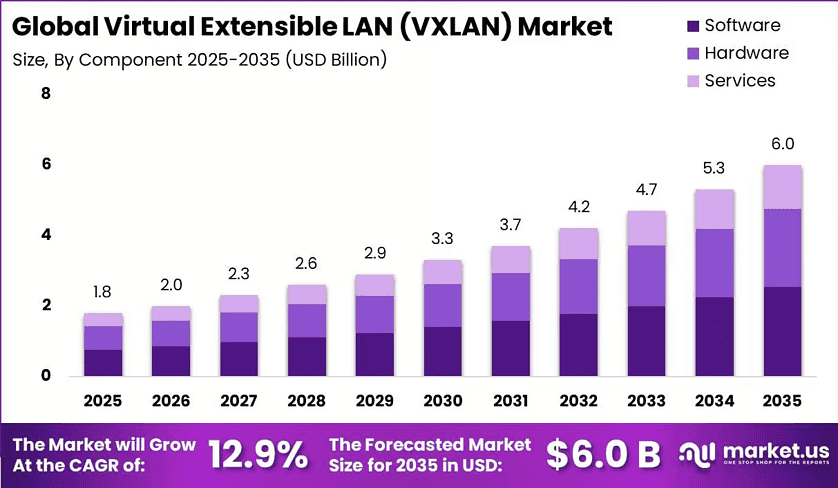
Moreover, data center growth and cloud computing drive this demand. VXLAN technology lets companies build thousands of virtual networks inside one physical facility. Consequently, hyperscale operators use this overlay technology to split traffic and serve many tenants as they grow. Cloud providers treat it as a core part of their scaling plans.
According to the U.S. Bureau of Economic Analysis and Federal Reserve research, U.S. hyperscale construction spending rose from about USD 10 billion in 2021 to USD 40 billion in the first half of 2025. This jump points to heavy facility buildouts. Therefore, network operators need more virtual segments to manage growing internal traffic.
Additionally, according to PwC, data centers added USD 727 billion to U.S. GDP in 2023. That figure was up 105% from 2017, and the sector supported 4.7 million jobs. These numbers show how central data centers have become to the economy. Consequently, more servers create more traffic that overlay networks must organize.
However, internet growth also puts pressure on network infrastructure. According to the International Telecommunication Union, about 6 billion people, or 74% of the world, used the internet in 2025. That share was 60% in 2020, so more users now create more data. Therefore, providers need flexible overlays to handle heavier loads.
Key Takeaways
- The Virtual Extensible LAN (VXLAN) market was worth USD 1.8 billion in 2025. It should grow at a CAGR of 12.9% and reach USD 6.0 billion by 2035.
- By component, the software segment led the market with 42.5% of total share.
- By enterprise size, the large enterprises segment led the market with 58.7% of total share.
- By application, the Software Defined Networking (SDN) Overlays segment led the market with 32.6% of total share.
- By end-use industry, the IT and Telecommunication segment led the market with 24.2% of total share.
- North America led the VXLAN market with 38.6% of total share, worth about USD 0.69 billion.
➤ Preview Key Insights with an Exclusive Sample Report Download – https://market.us/report/virtual-extensible-lan-vxlan-market/request-sample/
VXLAN Market Segmentation
By Component
Software led the component segment in 2025 with more than 42.5% share. Software handles virtual network creation, policy setting, and traffic routing across network fabrics. Consequently, operators value software because it adds flexibility without new physical gear. Moreover, usage-based licensing lets buyers scale software spending as demand grows.
Additionally, hardware remains essential because VTEP-capable switches form the physical network underneath the overlay. Services also grow as companies look for help with design, setup, and ongoing support. Therefore, vendors increasingly bundle software, hardware, and services into complete fabric packages for data center buyers.
By Enterprise Size
Large Enterprises held more than a 58.7% share in 2025. These firms run large, complex data centers with many business units and tenants. Moreover, they have bigger budgets and stronger IT teams to manage advanced overlays. Consequently, large enterprises adopt VXLAN-EVPN fabrics faster than smaller firms.
However, SMEs are a growing customer base. Managed services and cloud-based options lower the cost and skill barriers for smaller companies. Therefore, SMEs can get secure network segmentation without building large in-house teams. This shift should widen adoption across mid-sized businesses over the forecast period.
By Application
Software Defined Networking (SDN) Overlays led the application segment with more than 32.6% share in 2025. SDN overlays separate virtual networks from physical hardware, which makes control simpler. Moreover, these overlays keep links stable and fast for cloud services. Consequently, operators use VXLAN as the main building block for SDN designs.
Additionally, multi-tenancy, workload mobility, network function virtualization, and disaster recovery add steady demand. Multi-tenancy lets providers keep customers separate on shared systems. Workload mobility lets virtual machines move between sites without changing addresses. Therefore, each application strengthens the business case for overlay networking.
By End-Use Industry
IT and Telecommunications led the end-use segment with more than 24.2% share in 2025. Telecom operators and cloud providers run large networks that need deep segmentation. Moreover, 5G core rollouts and network function virtualization depend on overlay technology. Consequently, this industry remains the largest buyer of VXLAN solutions.
However, BFSI, healthcare, retail, manufacturing, media, and government are also expanding adoption. Banks and hospitals need strict data separation to meet security and privacy rules. Retailers and manufacturers connect stores, plants, and cloud systems. Therefore, overlay networking is spreading well beyond traditional technology companies.
Regional Analysis of the VXLAN Market
North America led the VXLAN market in 2025 with a 38.6% share, worth about USD 0.69 billion. Cloud adoption and hyperscale data center growth support this lead. Moreover, U.S. and Canadian enterprises use VXLAN-EVPN designs to support zero-trust security and links between multiple data center sites.
Meanwhile, Asia Pacific is the fastest-growing region, with a projected CAGR of about 15.6% to 18.8%. This fast pace reflects strong economic growth and digital investment. Additionally, 5G-advanced networks, edge computing, and new hyperscale facilities boost demand. Consequently, regional operators need scalable overlays to handle rising traffic.
Key Growth Drivers
Multi-tenant cloud scaling drives strong demand for VXLAN. Traditional VLANs support only 4,094 segments, while VXLAN supports up to 16.7 million. This gap matters because hyperscalers often go past the VLAN limit. According to the report, this driver adds about 3.1% to the baseline CAGR.
Moreover, standardization of the EVPN-BGP control plane is speeding up adoption worldwide. A common standard makes it easier for operators to connect equipment from different vendors. Consequently, buyers face less vendor lock-in and lower deployment risk. According to the report, this driver adds about 2.4% to the CAGR in the short term.
Major Use Cases
Cloud providers use VXLAN to host many customers on shared infrastructure. Each tenant gets a separate virtual network with its own policies. Consequently, providers improve security while making better use of physical hardware. Moreover, this approach lets them add new customers quickly without redesigning the network.
Additionally, enterprises use VXLAN for workload mobility and disaster recovery. Virtual machines can move between data centers and keep their network settings. Therefore, companies can keep applications running during maintenance or outages. This flexibility also supports hybrid cloud plans that link private facilities with public cloud services.
Business Opportunities
Edge and micro data centers offer a large untapped opportunity. Most VXLAN activity has focused on large hyperscale sites, while many edge sites still run older networks. Consequently, vendors can sell compact overlay-ready switches and software licenses to these locations. Asia Pacific and Latin America show especially strong potential.
Moreover, managed VXLAN-as-a-service creates new revenue streams for vendors and service providers. SMEs want secure segmentation but often lack skilled network staff. Therefore, subscription-based managed offerings can remove complexity and upfront costs. This model also builds recurring revenue and long-term customer relationships for providers.
Major Challenges
A shortage of skilled network engineers slows market growth. Many companies struggle to hire staff with BGP-EVPN expertise. Consequently, large fabric projects face delays and higher training costs. However, vendors are responding with automation tools and certification programs that help teams manage overlays with fewer specialists.
Additionally, mixing equipment from multiple vendors creates a heavy testing burden. Equipment from different suppliers may handle overlay features in slightly different ways. Therefore, operators spend extra time checking designs before deployment. Underlay congestion and packet size tuning also add complexity, which raises project risk for less experienced teams.
Top Key Players in the Market
- H3C
- Cisco
- Juniper Networks
- Arista Networks
- NVIDIA Corporation
- Dell Technologies Inc
- Nokia Corporation
- Red Hat, Inc.
- Extreme Networks, Inc.
- Versa Networks
Conclusion
The Global VXLAN Market shows strong growth as data centers, cloud services, and internet use expand. Software, large enterprises, SDN overlays, and the IT and telecom sector lead demand today. Moreover, North America holds the top position, while Asia Pacific grows fastest. However, skill gaps and compatibility issues remain. Consequently, vendors offering automation, managed services, and edge-ready solutions will capture future growth.
Discuss your needs with our analyst
Please share your requirements with more details so our analyst can check if they can solve your problem(s)