Market Overview
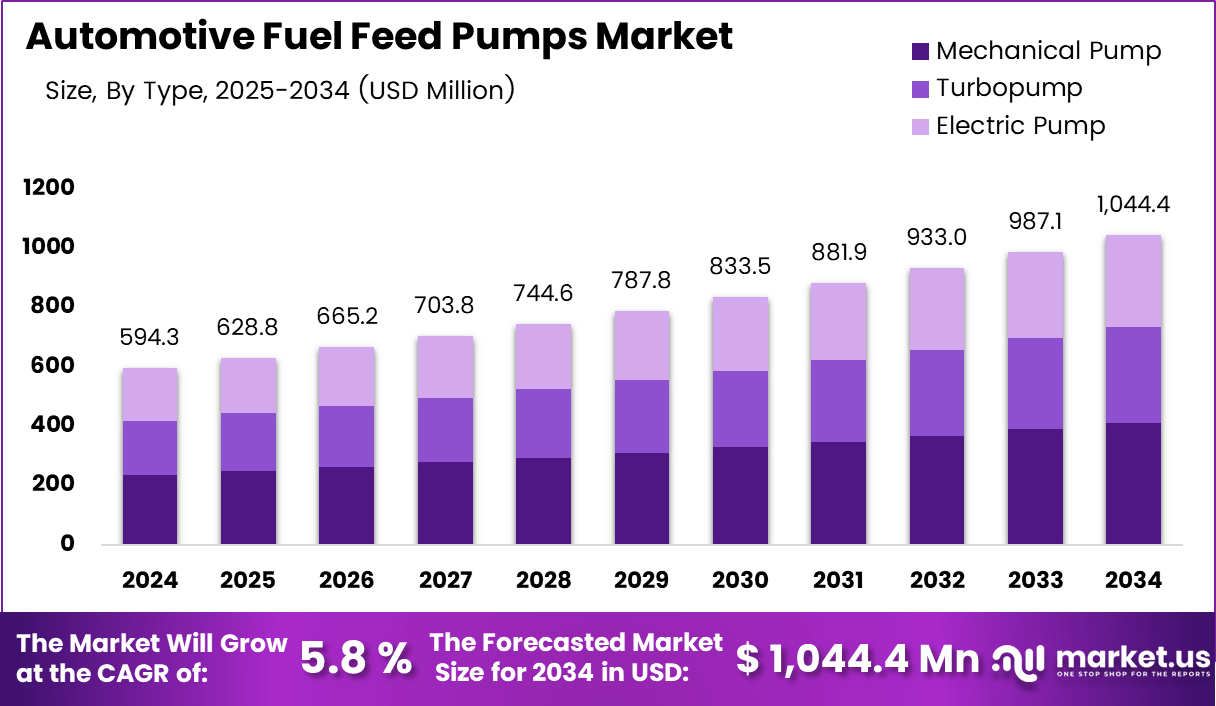
The Global Automotive Fuel Feed Pumps Market was valued at USD 594.3 Million in 2024 and is projected to reach USD 1,044.4 Million by 2034. The market is forecast to grow at a CAGR of 5.8% during 2025–2034. Rising demand for fuel-efficient automotive systems continues supporting long-term market expansion globally.
Automotive fuel feed pumps regulate fuel delivery from the fuel tank to vehicle engines under varying pressure conditions. These pumps ensure smooth engine performance and reliable fuel flow during vehicle operation. Passenger cars, commercial fleets, and hybrid vehicle manufacturers widely depend on these systems for efficient engine functionality.
Passenger vehicle manufacturers, logistics operators, and commercial transportation companies continue driving demand for advanced fuel delivery systems. Passenger car brands use high-performance pumps to improve fuel efficiency and engine responsiveness. Moreover, commercial fleet operators rely on durable fuel feed systems for long-distance transportation and heavy-duty vehicle applications.
Get further insight into the global trends shaping the future of the Automotive Fuel Feed Pumps industry: Request Free Sample
Manufacturers increasingly integrate electric pump technologies, lightweight materials, and IoT-enabled monitoring systems into automotive fuel systems. These technologies improve fuel efficiency, enhance diagnostic capabilities, and support predictive maintenance functions. Consequently, automakers adopt advanced pump systems to meet evolving consumer expectations for connected and efficient vehicle technologies.
Governments worldwide continue enforcing stricter emission regulations and fuel efficiency standards across automotive manufacturing industries. Regulatory agencies encourage automakers to adopt cleaner and more efficient fuel delivery technologies. Additionally, government support for hybrid vehicle production and green transportation programs further strengthens investment in advanced automotive fuel pump systems.
Recent automotive surveys demonstrate growing consumer interest in connected vehicle technologies. Around 55% of Chinese respondents and 57% of battery electric vehicle users would switch brands for better connectivity features. Additionally, 49% of U.S. respondents preferred superior connected-car services, highlighting rising demand for technology-driven automotive innovations.
Key Takeaways
- The global Automotive Fuel Feed Pumps Market is expected to reach USD 1,044.4 Million by 2034 from USD 594.3 Million in 2024.
- The market is projected to expand at a CAGR of 5.8% during the forecast period from 2025 to 2034.
- Turbopump technology dominated the type segment with a leading 39.4% market share in 2024.
- Gasoline engines accounted for the highest engine segment share at 59.3% in 2024.
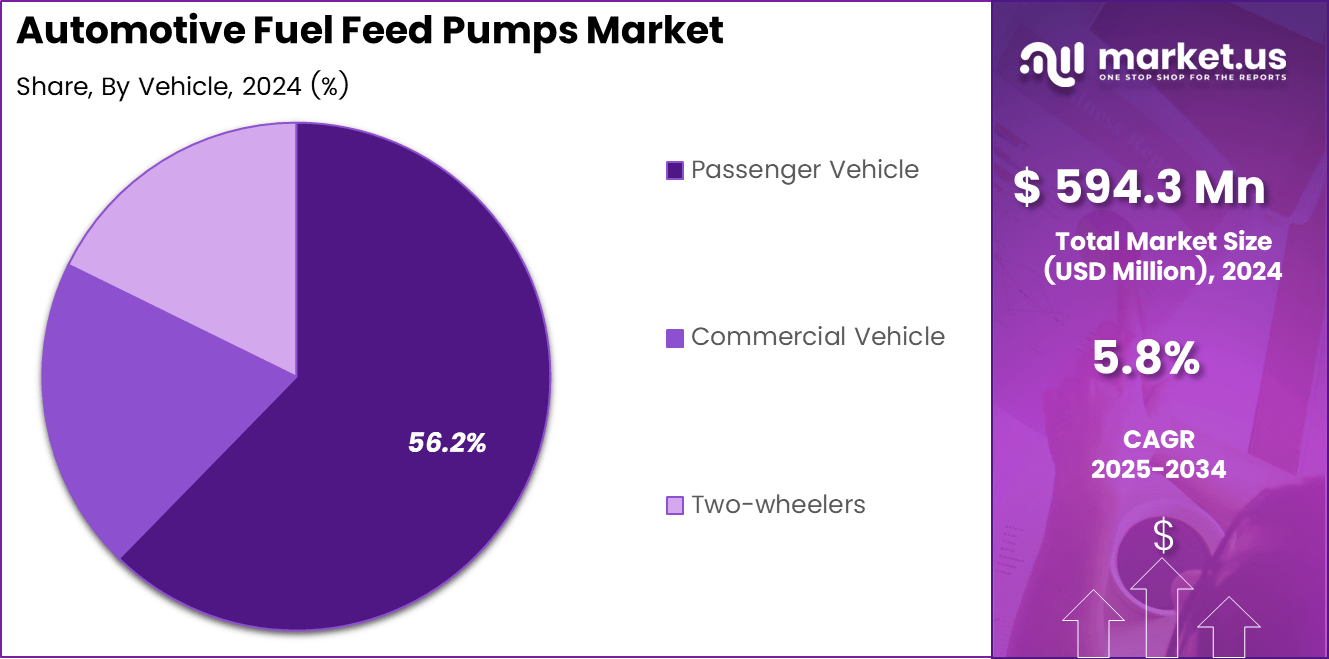
- Passenger Vehicles led the vehicle segment with a dominant 56.2% share in 2024.
- North America held the largest regional market share at 46.2%, valued at USD 274.5 Million.
- Increasing adoption of hybrid vehicles continues supporting demand for advanced electric fuel feed pump technologies.
- IoT-enabled fuel pump monitoring systems are emerging as a major innovation trend across connected automotive platforms.
Market Segmentation Overview
Turbopumps dominated the type segment with a 39.4% share in 2024 due to their superior fuel delivery efficiency and pressure management capabilities. Automotive manufacturers widely use these systems across modern fuel architectures for reliable engine performance. Consequently, turbopumps continue gaining preference within passenger and commercial vehicle applications globally.
Mechanical pumps maintained a strong market presence because of their durability and simple operating structure in traditional engine systems. Meanwhile, electric pumps steadily gained momentum through expanding hybrid and electric vehicle production. Moreover, automakers increasingly adopt electric fuel delivery technologies for improved precision and compatibility with advanced vehicle platforms.
Gasoline engines accounted for a dominant 59.3% market share in 2024 because passenger vehicles remain heavily dependent on gasoline-powered systems worldwide. Strong consumer demand for gasoline vehicles continues supporting fuel feed pump installations. Therefore, automotive manufacturers prioritize efficient fuel delivery systems to improve mileage and engine performance.
Passenger Vehicles held the leading vehicle segment share at 56.2% in 2024 due to strong global automotive sales volumes. Consumers continue prioritizing fuel-efficient and high-performance passenger cars across developed and emerging economies. Additionally, commercial vehicles and two-wheelers contribute steadily to market demand through logistics expansion and urban mobility adoption.
Drivers
Growing consumer demand for fuel-efficient and high-performance vehicles strongly drives the Automotive Fuel Feed Pumps Market. Automakers increasingly develop advanced fuel systems that improve engine responsiveness and reduce fuel consumption. Consequently, manufacturers continue investing in reliable fuel pump technologies to support evolving automotive performance standards worldwide.
Hybrid vehicle adoption and stricter environmental regulations continue accelerating market expansion across major automotive economies. Governments enforce tighter fuel efficiency standards to reduce emissions and improve sustainability. Moreover, automotive manufacturers integrate advanced fuel delivery systems into hybrid powertrains to comply with regulations and satisfy changing consumer preferences.
Use Cases
Passenger vehicle manufacturers use advanced fuel feed pumps to maintain consistent fuel pressure and optimize engine efficiency during daily driving operations. These systems improve combustion performance and reduce fuel wastage. Consequently, automakers strengthen vehicle reliability and support consumer demand for better mileage and smoother engine functionality.
Commercial transportation companies depend on heavy-duty fuel feed pump systems for logistics fleets and long-haul transportation vehicles. These pumps ensure uninterrupted fuel delivery under demanding operational conditions. Additionally, hybrid vehicle manufacturers use electric fuel pumps to support dual powertrain systems and enhance overall vehicle energy efficiency.
Major Challenges
Fluctuating prices of raw materials such as steel, aluminum, and rubber continue creating manufacturing cost pressures for automotive fuel pump producers. These price changes affect supply chain stability and profit margins. Consequently, manufacturers face difficulties maintaining cost-efficient production while meeting global quality and performance standards.
Increasing complexity in modern fuel pump design creates technological and operational challenges for automotive manufacturers. Hybrid and electric vehicle systems require advanced fuel delivery architectures compatible with evolving engine technologies. Moreover, companies must invest heavily in research and development to address regulatory compliance and advanced engineering requirements.
Business Opportunities
Growing demand for fuel-efficient commercial vehicles creates strong business opportunities for advanced automotive fuel feed pump manufacturers. Logistics operators increasingly prioritize systems that lower operating costs and improve vehicle efficiency. Consequently, companies developing durable and energy-efficient fuel pumps can strengthen market competitiveness across commercial transportation industries.
Alternative fuel technologies and hybrid powertrains present major long-term growth opportunities within the automotive fuel systems industry. Manufacturers increasingly develop fuel feed pumps compatible with hydrogen, biofuels, and hybrid engines. Additionally, expanding adoption of electric and hybrid vehicles supports demand for highly precise and intelligent fuel delivery technologies.
Regional Analysis
North America dominated the Automotive Fuel Feed Pumps Market with a 46.2% share valued at USD 274.5 Million in 2024. Strong automotive manufacturing capabilities, strict environmental regulations, and rising fuel efficiency requirements supported regional leadership. Consequently, automakers across the United States and Canada accelerated adoption of advanced fuel pump technologies.

Asia Pacific emerged as a key growth region due to rising automotive production and increasing consumer demand for fuel-efficient vehicles. China, India, Japan, and South Korea continue investing heavily in advanced automotive technologies and hybrid mobility systems. Moreover, expanding urbanization and industrialization strengthen long-term market growth across regional automotive industries.
Recent Developments
- October 2024 — Alliant Power acquired Oregon Fuel Injection to strengthen diesel fuel injection capabilities and expand regional market presence.
- January 2025 — Cummins introduced its 6.7-liter turbo diesel pickup engine for the 2025 Ram Heavy Duty truck lineup.
- January 2025 — Cummins and Stellantis extended their strategic partnership agreement through 2030 to support diesel engine innovation.
- Automotive manufacturers increasingly integrated IoT-enabled monitoring technologies into fuel delivery systems to improve maintenance and operational efficiency.
Conclusion
The Automotive Fuel Feed Pumps Market demonstrates steady long-term growth driven by rising demand for fuel-efficient vehicles and stricter environmental regulations. Automotive manufacturers continue investing in advanced fuel delivery technologies to improve engine performance and reduce emissions. Consequently, demand for efficient and durable fuel pump systems will continue expanding globally.
Turbopumps and gasoline engine applications remain dominant across the industry due to strong passenger vehicle demand and widespread gasoline engine adoption. North America continues leading the regional landscape through advanced automotive technologies and strong regulatory frameworks. Meanwhile, Asia Pacific offers strong future growth opportunities supported by rising automotive production.
Manufacturers must prioritize lightweight materials, IoT-enabled diagnostics, and hybrid vehicle compatibility to remain competitive in evolving automotive markets. Strategic innovation and investment in alternative fuel technologies will further strengthen market positioning. The global Automotive Fuel Feed Pumps Market is projected to reach USD 1,044.4 Million by 2034.
Looking for data tailored to your specific market, region, or business need? Request a custom report or consultation — write to us at sales@market.us
Discuss your needs with our analyst
Please share your requirements with more details so our analyst can check if they can solve your problem(s)