
Market Overview
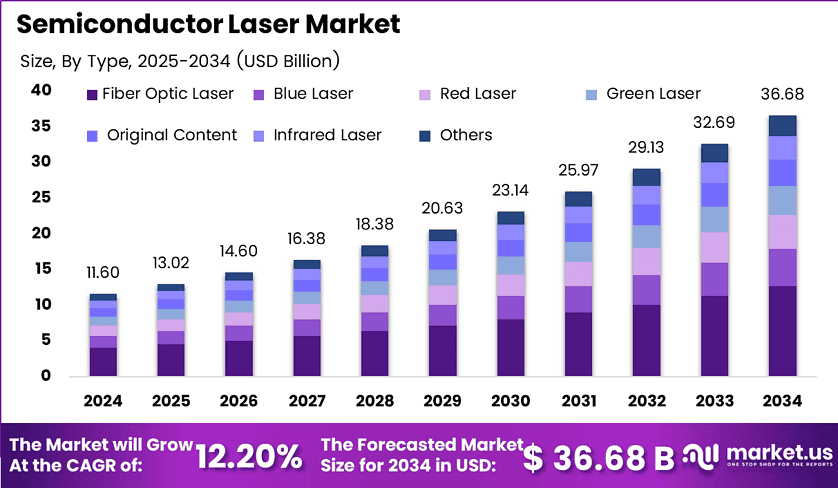
New York, NY – August 31, 2026 – The Global Semiconductor Laser Market reached USD 11.6 billion in 2024. Analysts expect the market to reach USD 36.7 billion by 2034, growing at a 12.2% CAGR. Rising data traffic explains this climb. Therefore, laser diode suppliers gain strong long-term revenue visibility.
According to the ITU, 5.5 billion people used the internet in 2024, an increase of 227 million within one year. More users push carriers to add fibre capacity. Consequently, operators purchase more laser diodes for optical communication links.
Fixed broadband traffic reached 6 zettabytes, up from 5.1 ZB, while mobile broadband traffic approached 1.3 ZB. Heavier traffic forces network upgrades. Additionally, data centres consumed about 415 TWh of electricity in 2024, near 1.5% of global demand, expanding roughly 12% each year.
Public money strengthens this pipeline further. The U.S. NTIA is distributing USD 42.45 billion through the BEAD program to connect around 8.5 million unserved locations, with Texas receiving nearly USD 3.3 billion. Moreover, such funding creates predictable demand for optical transmission components.
Global vehicle production rose from 92.7 million units in 2024 to 96.4 million units in 2025. Automakers now fit laser sources into LiDAR, lighting, and driver monitoring. However, medicine also matters, because cataracts affect more than 94 million people and drive ophthalmic laser demand.
Key Takeaways
- The Global Semiconductor Laser Market held USD 11.6 billion in 2024 and is expected to reach USD 36.7 billion by 2034, growing at a 12.2% CAGR.
- Fiber Optic Laser led the type segment with a 34.6% share, supported by high efficiency and long-distance optical transmission strength.
- Medical and Aesthetic applications captured the largest share at 32.8%, driven by wider use in surgery, diagnostics, and aesthetic treatments.
- North America dominated the market with more than 38.2% share in 2024, generating close to USD 4.43 billion in revenue.
➤ Preview Key Insights with an Exclusive Sample Report Download – https://market.us/report/semiconductor-laser-market/request-sample/
Market Segmentation
By Type
Fiber Optic Laser leads the type segment with a 34.6% share. This design moves light across long distances with low loss. Consequently, telecom carriers and hyperscale operators favour it for backbone links, data transfer routes, and high-speed optical networking equipment.
Other categories also add meaningful volume. Vertical Cavity Surface Emitting Lasers, blue, red, green, and infrared diodes each serve distinct end uses. Therefore, suppliers spread risk across telecom hardware, medical devices, and AI data-centre optical scaling programs rather than one narrow application.
By Application
Medical and Aesthetic applications hold the largest position at 32.8%. Surgeons value precise, repeatable light delivery during procedures and diagnostics. Additionally, clinics expand aesthetic treatment menus, which raises unit demand for compact diode sources and pushes device makers toward reliable, service-friendly laser platforms.
Instruments and sensors, aerospace, defence, and military, material processing, communications and optical storage, plus entertainment, displays, and printing complete the picture. Each field needs tight beam control and long service life. Consequently, vendors design application-specific modules instead of selling generic components alone.
Regional Analysis
North America dominated in 2024 with about USD 4.43 billion in revenue. Strong technology infrastructure and heavy cloud investment explain this lead. Moreover, large federal broadband funding and dense AI computing build-outs keep regional orders for photonic components consistently high.
Europe, Asia Pacific, the Middle East and Africa, and Latin America follow as growth engines. Europe benefits from strict quality and safety rules. Meanwhile, Asia Pacific and MEA gain from fast digitalisation, and Latin America builds momentum through steady business adoption of fibre networks.
Drivers
AI data-centre optical scaling ranks as the strongest driver, adding an estimated 2.4% to the 12.2% baseline CAGR. AI clusters need many short-reach optical links. Therefore, buyers demand qualified laser dies, integrated transceiver subassemblies, and tighter reliability commitments from suppliers.
Fiber access network upgrades contribute roughly 1.6% more growth. Operators across Asia Pacific, Europe, and the Middle East replace copper with fibre lines. Consequently, sustained last-mile deployment converts government and carrier budgets into repeat orders for transmitter and receiver diodes.
Use Cases
Vehicle manufacturers use laser sources inside LiDAR units, adaptive lighting, and driver-monitoring cameras. These systems read the road and the cabin in real time. Therefore, carmakers gain safer automated features while suppliers earn long production contracts tied to platform lifecycles.
Hospitals and clinics apply diode-based systems in eye surgery, dermatology, and diagnostic imaging. Clinicians treat tissue precisely with less recovery time. Additionally, industrial plants use similar sources for welding and material processing, especially inside battery lines and advanced electronics factories.
Business Opportunities
Co-packaged optics platforms open a large opportunity for laser suppliers. Switch vendors want light sources placed beside the processor. Consequently, component makers can move from selling discrete parts toward integrated optical-engine contracts, which usually improve pricing power and customer stickiness.
FMCW lidar modules and integrated diagnostic systems create a second path. Automotive and healthcare buyers prefer complete, validated subassemblies over loose components. Therefore, firms that master packaging, thermal design, and qualification support can win multi-year programs across several regions.
Major Challenges
Advanced packaging yield limits remain the biggest hurdle. Optical engines need tight laser-to-waveguide alignment and dense multi-channel layouts. Consequently, tiny assembly deviations downgrade good dies, which raises scrap, extends reliability testing, and forces extra spending on automation and in-line measurement.
Material supply risk adds further pressure. Export licensing on gallium and germanium disrupts compound semiconductor inputs. Moreover, a shortage of trained photonics engineers and complex thermal management slow product launches, so companies must build inventory buffers and invest in workforce training.
Top Key Players in the Market
- Coherent Corp.
- Sharp Corporation
- Nichia Corporation
- IPG Photonics Corporation
- TTElectronics
- Sumitomo Electric Industries Ltd.
- Sheaumann Laser Inc.
- Newport Corporation
- Panasonic Industry Co. Ltd.
- ROHM CO., LTD.
- Other Major Players
Conclusion
The semiconductor laser industry moves toward steady, broad-based expansion. Communications, mobility, medicine, and manufacturing all pull demand at once, while North America keeps its leadership position. However, packaging yields, material access, and skilled talent will decide which suppliers scale profitably. Therefore, companies that invest early in integration and qualification should capture the strongest long-term returns.
Discuss your needs with our analyst
Please share your requirements with more details so our analyst can check if they can solve your problem(s)