
Market Overview
New York, NY – October 13, 2026 – The Global Sovereign AI Market reached USD 41.1 billion in 2025. The report projects USD 258.7 billion by 2035, with 20.2% compound annual growth during 2026–2035. Moreover, this outlook signals expanding demand for nationally controlled computing, locally governed data, and domestic artificial intelligence capabilities across public institutions and regulated industries worldwide.
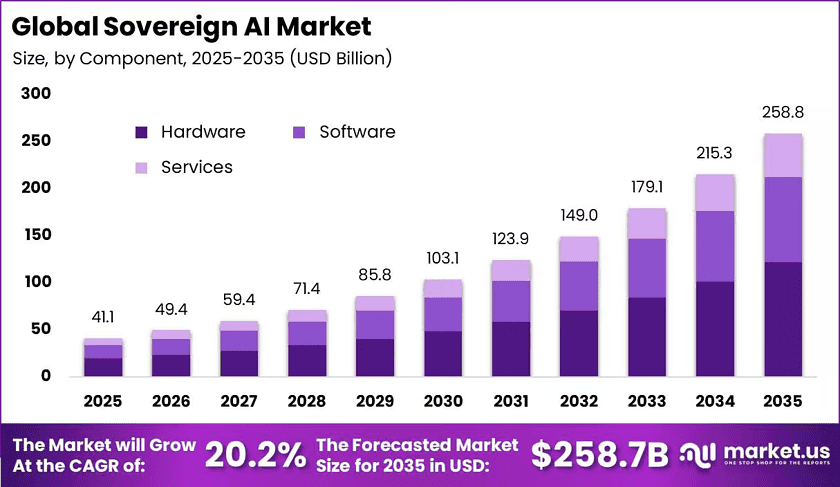
Governments develop sovereign AI systems to strengthen control over infrastructure, training data, models, and critical applications. National programmes connect computing investment with public service priorities and domestic technology development. Additionally, these programmes create demand for secure servers, specialised chips, software platforms, and integration services that support sensitive workloads while preserving national oversight and operational flexibility throughout development and deployment cycles.
Hardware purchases anchor early market spending because national AI projects require reliable computing, networking, cooling, and power systems. Software demand then expands as organisations deploy models and manage infrastructure. Moreover, service providers support installation, security, maintenance, and workforce development, helping buyers convert equipment investments into practical applications that serve government departments, financial institutions, healthcare organisations, and other regulated customers effectively.
North America leads the supplied report’s regional estimates through its computing infrastructure, technology suppliers, and specialist workforce. Asia Pacific shows the strongest projected growth, while Europe expands through coordinated infrastructure programmes. Additionally, Latin America and the Middle East and Africa create demand for locally hosted services, giving providers opportunities to adapt offerings to national requirements and domestic operating conditions effectively.
Market participants must balance national control with access to global technology and specialist expertise. Domestic hosting alone does not resolve every operational dependency highlighted in the report. Consequently, buyers need secure infrastructure, effective governance, skilled teams, and sustainable operating models. Vendors that address these connected requirements can support national programmes while building lasting commercial relationships across the wider AI ecosystem.
Key Takeaways
- The Sovereign AI Market value rises from USD 41.1 billion in 2025 to USD 258.7 billion by 2035, indicating substantial expansion. Forecast CAGR reaches 20.2% during 2026–2035.
- Hardware leads components with 47%; software holds 34.9% and grows fastest as operating needs expand.
- On-premises leads deployment with 41.0%; cloud holds 37.1% and grows fastest through accessible computing.
- Machine learning leads technologies with 31.0%; generative AI and LLMs hold 21.9% and grow fastest.
- Government and public sector leads end use with 34.1%; BFSI holds 13% and grows fastest.
- North America holds 41.0% and generates USD 16.8 billion, supporting its leadership position.
- Asia Pacific holds 21.5% and grows fastest; Europe holds 23% and ranks second for growth.
- Latin America holds 8%; the Middle East and Africa hold 7.0%, extending the market’s geographic reach.
➤ Grab the Exclusive Preview of This Premium Research Report Now – https://market.us/report/sovereign-ai-market/request-sample/
Market Segmentation
By Component
Hardware holds 47%, software 34.9%, and services 18%. These estimates show infrastructure purchases leading spending. Additionally, software enables model development and secure operations, while services support integration, maintenance, and technical assistance across national AI programmes.
By Deployment Model
On-premises holds 41.0%, cloud 37.1%, and hybrid 21.9%. These shares reflect different control and scalability needs. Moreover, government buyers retain sensitive workloads internally, access provider capacity through cloud services, or combine both approaches through hybrid deployments.
By Technology
machine learning holds 31.0%, generative AI and LLMs 21.9%, computer vision 14.1%, NLP 12%, multimodal AI 11.1%, and others 10%. These estimates describe diverse application needs. Additionally, buyers combine language processing, image analysis, and predictive tools across workflows.
By End Use
Government holds 34.1%, defence 15.0%, BFSI 13%, healthcare 12%, telecommunications 10.0%, energy 6.0%, manufacturing 5%, and others 5.0%. Public spending leads demand. Moreover, regulated industries broaden adoption through secure analytics, operational support, and locally governed customer services.
Regional Analysis
North America benefits from established cloud infrastructure, accelerator access, and technical expertise. These strengths support regional leadership across public and commercial projects. Moreover, European programmes expand shared computing access while prioritising domestic governance, secure operations, and coordinated infrastructure investment.
Asia Pacific expands through national programmes across India, South Korea, Japan, China, and Australia. Local-language applications strengthen regional demand. Additionally, Latin American markets pursue domestic hosting, while Middle Eastern and African programmes develop computing capacity and locally governed services.
Drivers
National compute procurement programmes create demand for chips, servers, networking, and supporting software. Public investment gives suppliers clearer project pipelines and longer commercial relationships. Consequently, infrastructure providers can align delivery, maintenance, and capacity management with government development priorities.
Public-sector data residency requirements encourage buyers to select locally controlled infrastructure. Sensitive citizen records and national security workloads increase the importance of governance. Moreover, procurement teams assess hosting arrangements, access controls, and operational responsibility before adopting AI services.
Use Cases
Government agencies use sovereign AI for document processing, translation, citizen support, and administrative workflows. Local-language models help departments adapt services to domestic needs. Additionally, controlled environments allow agencies to manage sensitive records while improving access to public information.
Financial institutions apply locally governed AI to fraud detection, credit assessment, payment monitoring, and compliance support. These applications connect analytical capabilities with regulated data handling. Moreover, multilingual customer tools help institutions serve domestic users within controlled operating environments.
Business Opportunities
Infrastructure operators can commercialise spare computing capacity through residency-compliant services. Smaller national programmes may seek access without building complete facilities. Additionally, providers can differentiate offerings through clear jurisdictional controls, dependable support, workload management, and transparent operating agreements for customers.
Technology companies can develop sector-specific platforms for banking, healthcare, and public administration. Local-language models and independent assurance services offer further opportunities. Moreover, suppliers can combine applications, security controls, and ongoing support to address buyers’ practical deployment requirements more directly.
Major Challenges
Infrastructure suppliers face constraints involving advanced memory, chip packaging, and power equipment. These dependencies can disrupt installation schedules and procurement plans. Consequently, national programmes need coordinated sourcing, realistic delivery assumptions, and infrastructure planning before committing to ambitious deployment timelines.
Public organisations also face specialist talent shortages and uneven computing utilisation. Equipment purchases alone cannot create effective services. Additionally, operators must manage cybersecurity, cooling, and energy requirements while developing teams capable of maintaining models and supporting sustained operational use.
Top Key Players in the Market
- NVIDIA Corporation
- Microsoft Corporation
- Amazon Web Services (AWS)
- Alphabet Inc. (Google)
- IBM Corporation
- Oracle Corporation
- Hewlett Packard Enterprise (HPE)
- Dell Technologies
- Cisco Systems, Inc.
- Intel Corporation
- AMD
- Lenovo
- Alibaba Cloud
- Huawei Technologies
- SAP SE
- Atos SE
- G42
- Mistral AI
- SambaNova Systems
- Cerebras Systems
Conclusion
The supplied report presents sovereign AI as a growing market spanning infrastructure, software, and specialised services. Governments lead demand, while regulated industries expand practical applications. However, suppliers and buyers must address equipment dependencies, workforce gaps, and operating constraints to turn national investment into dependable capabilities.
Discuss your needs with our analyst
Please share your requirements with more details so our analyst can check if they can solve your problem(s)