
Market Overview
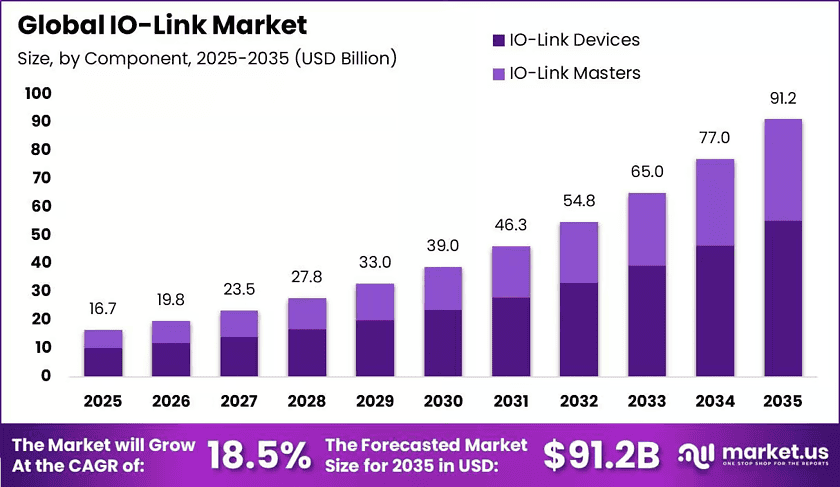
New York, NY – November 03, 2026 – The Global IO-Link Market reached USD 16.7 billion in 2025. Analysts expect it to reach USD 91.2 billion by 2035, growing at an 18.5% CAGR. This strong growth shows that manufacturers now treat digital sensor connections as a core factory investment.
Moreover, IO-Link gives field devices and control systems one common digital link. Manufacturers use this link to set up devices faster, track machine health, and run remote checks. Consequently, plants replace faulty equipment quickly and cut downtime. Connected machines, smart sensors, and industrial robots continue to push this industrial communication standard forward.
Additionally, robot growth fuels demand for smart device connectivity. According to the International Federation of Robotics, factories installed 542,000 industrial robots worldwide in 2024. Installations stayed above 500,000 units for the fourth straight year. Each robotic cell needs many sensors and valves, so steady robot use creates lasting demand for IO-Link communication.
Furthermore, the Americas installed 50,100 industrial robots in 2024, according to the International Federation of Robotics. The United States accounted for 34,200 units, or 68% of the regional total. This figure shows that U.S. plants lead regional automation spending. Therefore, American factories form a key buyer base for connected sensor networks.
However, robot density tells an even clearer story. North America reached 204 robots per 10,000 manufacturing employees in 2024. U.S. manufacturing construction spending also hit USD 215.4 billion in 2025. New and upgraded plants will need modern sensor links, so these figures point to steady future demand for IO-Link solutions.
Key Takeaways
- The IO-Link Market will grow from USD 16.7 billion in 2025 to USD 91.2 billion by 2035, at an 18.5% CAGR.
- IO-Link Devices led the component segment with a 60.5% share, driven by demand from semiconductor and EV manufacturing.
- IO-Link Wired led by type with a 72.1% share, favored for its reliability on fixed production lines.
- Machine Tool led by application with a 30.4% share, supported by rising CNC and precision manufacturing demand.
- Automotive led the industry vertical with a 27.9% share, driven by high automation in vehicle plants.
- North America led the regional landscape in 2025, holding 36.5% of revenue at about USD 6.1 billion.
➤ Download the Detailed Sample Report with TOC, Tables, and Visual Figures – https://market.us/report/global-io-link-market/request-sample/
IO-Link Market Segmentation Analysis
By Component
IO-Link Devices held a leading 60.5% share of the component segment in 2025. This segment covers sensors, actuators, valve terminals, and RFID readers that collect live machine data. Moreover, semiconductor fabs and battery plants use many such devices for inspection and safety. Meanwhile, IO-Link Masters connect these devices to control systems.
By Type
IO-Link Wired held a dominant 72.1% share by type in 2025. Wired links carry power and data through a standard unshielded three-wire cable. Consequently, fixed production lines gain stable, low-delay communication. Moreover, wired setups store device settings and report faults directly, which cuts setup time and boosts uptime.
However, IO-Link Wireless offers a flexible option for moving equipment. The technology runs in the 2.4 GHz band and supports up to 40 device connections per master. This design suits rotating tables, robot tools, and mobile machines. Therefore, wireless adoption should rise as factories add more flexible automation.
By Application
The machine tool segment led applications with a 30.4% share in 2025. Moreover, CNC machines, grinders, and machining centres rely on sensors to track spindle condition, tool position, and clamping force. According to AMT, U.S. manufacturing-technology orders reached USD 5.7 billion in 2025, up 22.5%. This jump signals strong machine tool spending and wider sensor use.
Additionally, packaging, handling and assembly automation, and intralogistics form other key application areas. Packaging lines need fast format changes, while assembly cells need precise part detection. Intralogistics systems use connected sensors on conveyors and sorters. Consequently, IO-Link helps each application switch settings quickly and spot faults early.
By Industry Vertical
Automotive led the industry vertical segment with a 27.9% share in 2025. According to the International Energy Agency, buyers purchased more than 17 million electric cars in 2024, over 20% of total car sales. Consequently, carmakers add more sensors, valves, and RFID systems across battery production, body assembly, and final inspection.
Moreover, food and beverage, pharmaceuticals, semiconductor and electronics, oil and gas, and aerospace and defense also adopt IO-Link. Food and drug makers value accurate process control and traceability. Semiconductor plants need precise flow and pressure sensing. Therefore, these verticals widen the market beyond automotive plants.
Regional Analysis
North America led the global IO-Link market in 2025 with a 36.5% share, worth about USD 6.1 billion. According to AMT, U.S. manufacturing-technology orders reached USD 2.9 billion in the first seven months of 2025, up 14.4%. Moreover, this rise shows strong spending on CNC machines and automated cells, which lifts regional sensor demand.
Meanwhile, Asia Pacific should grow fastest, backed by chip, battery, and auto production. According to SEMI, global chip-making capacity was set to rise 6.6% in 2025 to about 33.6 million wafers per month. Consequently, new fabs in China, Taiwan, and South Korea will need large volumes of connected process sensors.
Key Market Growth Drivers
Automotive electrification stands out as a leading growth driver. EV plants need more digital pressure, position, temperature, and safety devices than traditional lines. According to IEA data, global electric-car sales passed 20 million units in 2025, up 20%. Therefore, this shift could add about 3.2% to the market’s baseline CAGR.
Additionally, semiconductor fab digitalization adds strong momentum. According to SEMI, chip-equipment sales reached USD 135.1 billion in 2025, up 15%. Expanding fabs need flow, pressure, and temperature sensors in every process step. Consequently, this driver could lift the baseline CAGR by about 2.8% over the medium term.
IO-Link Use Cases
Battery plants offer a strong use case for IO-Link technology. Moreover, engineers connect welding, thermal control, and inspection sensors through one digital link. When a sensor fails, technicians swap it, and the master reloads its saved settings automatically. Consequently, production lines restart faster and avoid long manual setup work.
Additionally, packaging and food plants use IO-Link to manage frequent product changes. Operators update sensor settings from a central control screen instead of adjusting each device by hand. Therefore, plants switch between product formats quickly. Condition data from motors and valves also helps maintenance teams fix problems before they stop production.
Business Opportunities
Device data subscription models create a promising revenue path for suppliers. Most IO-Link sales still depend on one-time hardware purchases. However, suppliers can now sell remote diagnostics, energy tracking, and configuration services regularly. Consequently, vendors can build steady income while customers detect leaks, motor overloads, and waste earlier.
Moreover, brownfield conversion offers a large opening among small and mid-sized manufacturers. Many older plants still run legacy machines without smart sensors. Suppliers can offer simple retrofit kits, ready-made masters, and local installation support. Therefore, vendors that lower upgrade effort can win new customers across Europe, Asia Pacific, and Latin America.
Major Challenges
Cybersecurity compliance poses a growing challenge for IO-Link suppliers. IO-Link data now moves from sensors into Ethernet, edge, and cloud systems. Moreover, the EU Cyber Resilience Act requires fast reporting of serious vulnerabilities. Consequently, manufacturers must spend more on secure design, software updates, and incident response, which can slow product launches.
Additionally, a shortage of skilled integration staff limits faster adoption. Many plants lack engineers who understand both field devices and higher-level control systems. Multi-vendor setups also create compatibility issues during installation. Therefore, suppliers must invest in training, simple tools, and clear documentation to help customers deploy IO-Link with confidence.
Top Key Players in the Market
- Siemens AG
- Balluff GmbH
- ifm electronic GmbH
- SICK AG
- Rockwell Automation, Inc.
- OMRON Corporation
- Schneider Electric SE
- Hans Turck GmbH & Co. KG
- Pepperl+Fuchs SE
- Banner Engineering Corp.
Conclusion
The IO-Link market shows strong long-term promise as factories adopt connected sensors, robots, and smart production systems. Automotive electrification, semiconductor expansion, and machine tool upgrades drive steady demand, while North America leads and Asia Pacific grows fastest. However, tariffs, cybersecurity rules, and skill gaps remain real hurdles. Consequently, suppliers that offer secure devices, easy retrofits, and data services will capture the greatest value.
Discuss your needs with our analyst
Please share your requirements with more details so our analyst can check if they can solve your problem(s)