
Market Overview
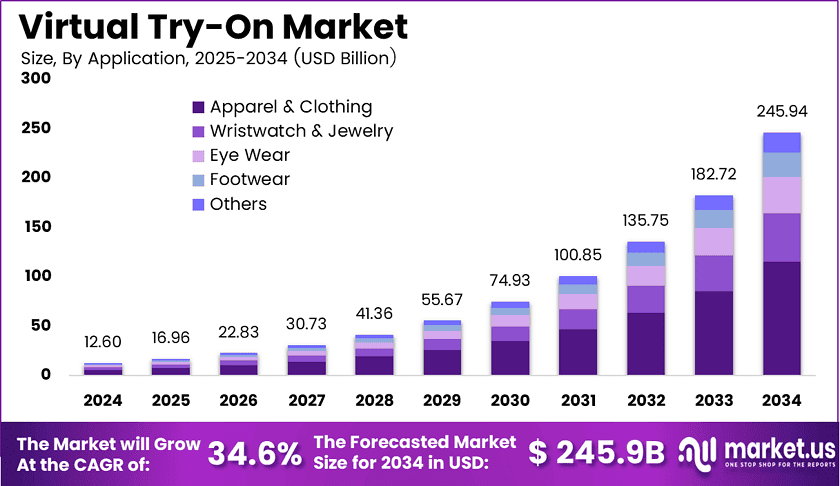
New York, NY – October 15, 2026 – The Global Virtual Try-On Market reached USD 12.6 billion in 2024. Analysts expect it to reach USD 245.9 billion by 2034, growing at a 34.6% CAGR. This fast growth shows that retailers now treat digital fitting tools as a core part of online selling.
Online retail growth fuels demand for virtual fitting solutions. According to China’s National Bureau of Statistics, online retail sales hit 15.97 trillion yuan in 2025, up 8.6%. Consequently, more shoppers buy without touching products first, and brands need tools that show fit and look on screen.
Europe shows a similar shift in shopping habits. According to Eurostat, 78% of EU internet users bought online in 2025, compared with 62% in 2015. Moreover, the ITU estimates that 6 billion people used the internet in 2025. This wide digital reach gives online fitting technology a very large audience.
Shoppers feel unsure about fit when they buy online, so retailers face more returns. Therefore, apparel, footwear, eyewear, and jewelry brands are adding camera-based fitting tools. According to the ITU, the world has about 3 billion 5G subscriptions. Faster networks make try-on features on phones run more smoothly.
Key Takeaways
- The Virtual Try-On Market stood at USD 12.6 billion in 2024 and will reach USD 245.9 billion by 2034.
- The market records a 34.6% CAGR from 2025 to 2034.
- Augmented reality leads the technology segment with a 40.6% share.
- Smartphones and tablets lead the device segment with a 65.6% share.
- Apparel and clothing lead the application segment with a 46.8% share.
- North America dominates with a 38.5% share and USD 4.8 billion in revenue.
➤ Evaluate the Report Quality with an Exclusive Sample Download – https://market.us/report/virtual-try-on-market/request-sample/
Virtual Try-On Market Segmentation
By Technology
Augmented reality leads with a 40.6% share because it runs on smartphones people already own. Shoppers do not need a headset to use it. Moreover, brands can add AR to apps and social platforms, so buyers can test cosmetics, eyewear, and footwear in seconds.
Snap reports that users opened AR Lenses about 8 billion times per day in late 2025. This huge reach lets retailers connect with millions of buyers without buying new hardware. Additionally, according to Eurostat, 20.0% of EU firms used AI in 2025. AI lowers 3D model costs and works well alongside AR.
By Device
Smartphones and tablets lead with a 65.6% share because they combine camera, screen, and processor in one device. Shoppers can preview products and buy within the same app. Furthermore, according to the ITU, the world had 9.2 billion mobile subscriptions in 2025, which gives mobile fitting a huge user base.
Computers are also gaining users because larger screens show watches, jewelry, and clothing in clearer detail. According to Eurostat, 93.1% of EU households had home internet access in 2023. Consequently, shoppers spend longer browsing on laptops and desktops, and this helps with detailed product viewing.
By Application
Apparel and clothing lead with a 46.8% share because fit, size, and drape drive both buying decisions and returns. Virtual fitting rooms help shoppers check these points before checkout. Moreover, WTO data shows world clothing exports of USD 576 billion in 2022, which points to a large addressable category.
Eyewear is one of the fastest-growing uses because facial mapping places frames accurately on a shopper’s face. According to the IAPB Vision Atlas, childhood myopia rose from 24% in 1990 to nearly 36% in 2023. Therefore, rising vision-care needs will keep pushing demand for online frame fitting.
Regional Analysis of Virtual Try-On Adoption
North America leads with a 38.5% share and USD 4.8 billion in revenue. According to the US Census Bureau, e-commerce sales rose 12.2% in the second quarter of 2026, while total retail grew only 6.7%. Consequently, online channels gain share every quarter, and more fitting decisions move to screens.
Asia Pacific is the fastest-growing region in this market. China provides the scale, with online physical goods taking 26.1% of retail sales in 2025. Additionally, the ITU puts internet use in Asia Pacific at 77%. Live commerce in China and South Korea also uses AR filters to sell cosmetics and eyewear.
Market Drivers
Lowering return costs is the biggest growth driver. According to the National Retail Federation, returns made up 16.9% of US retail sales in 2024. Therefore, retailers see virtual try-on as a profit tool, not just a nice feature. Better product previews cut handling, inspection, and markdown costs, and can add about 4.2% to the CAGR.
Generative AI is another strong driver, adding an estimated 3.6% to the CAGR. AI tools create lifelike images that adapt to different body types, fabrics, and poses. Moreover, retailers can produce content faster than with traditional photo shoots. Consequently, shoppers feel more confident about online purchases and have fewer sizing doubts.
Use Cases of Virtual Try-On Solutions
Fashion retailers use virtual fitting rooms so shoppers can check size, length, and drape before they pay. The shopper uploads a photo or uses the camera, and the tool shows the outfit on their body. Consequently, buyers decide with more confidence, and retailers cut avoidable returns and repeat shipping.
Beauty and eyewear brands use AR filters during live shopping broadcasts and on social apps. Viewers test lipstick shades or glasses frames in real time while watching. Additionally, store staff use the same tools on tablets to help shoppers in physical stores. Therefore, brands get one consistent experience across online and offline channels.
Business Opportunities
Fit-intelligence services give providers a new way to earn revenue. Many vendors still offer try-on as a free sales tool. However, providers can sell premium analytics, performance-based pricing, and stock-aware size advice built on approved first-party fit profiles. Consequently, providers can move from simple feature licenses to contracts linked to transactions.
Healthcare and optical uses offer another promising path. Optical retailers can pair facial mapping with frame fitting and vision-care services. Moreover, creator-led digital merchandise and cross-border fit platforms open fresh markets. Therefore, providers that adjust size data for local body shapes can win shoppers buying from international stores.
Major Challenges
Poor product data limits try-on accuracy. These tools need consistent shape, size grading, fabric behavior, and color details for every item. However, many retailers keep incomplete or uneven catalog records. Consequently, brands must invest in data management, 3D asset creation, and performance tracking before shoppers can trust the results.
Privacy rules make deployment harder. The GDPR requires clear and informed consent, and the EU AI Act adds more duties for body-based tools. Additionally, US state biometric laws create legal risk. Therefore, retailers must redesign consent flows and data controls for each region, and this slows rollout.
Top Key Players in the Market
- DeepAR (I Love Ice Cream Ltd.)
- metadome.ai (Formerly Adloid)
- 3DLOOK Inc.
- AUGLIO
- Wannaby Inc.
- Quy Technology Pvt. Ltd. (QUYTECH)
- WEARFITS
- MySize Inc.
- Zugara, Inc.
- Banuba Limited
- Queppelin
- ZAKEKE
Conclusion
The virtual try-on industry is moving from an optional feature to a key retail tool. Smartphones, augmented reality, and generative AI help shoppers judge fit and style before they buy. Moreover, retailers use these solutions to cut returns and raise sales. However, gaps in product data and strict privacy rules still need attention. Providers that fix these problems will lead the next phase of digital commerce.
Discuss your needs with our analyst
Please share your requirements with more details so our analyst can check if they can solve your problem(s)