
Market Overview
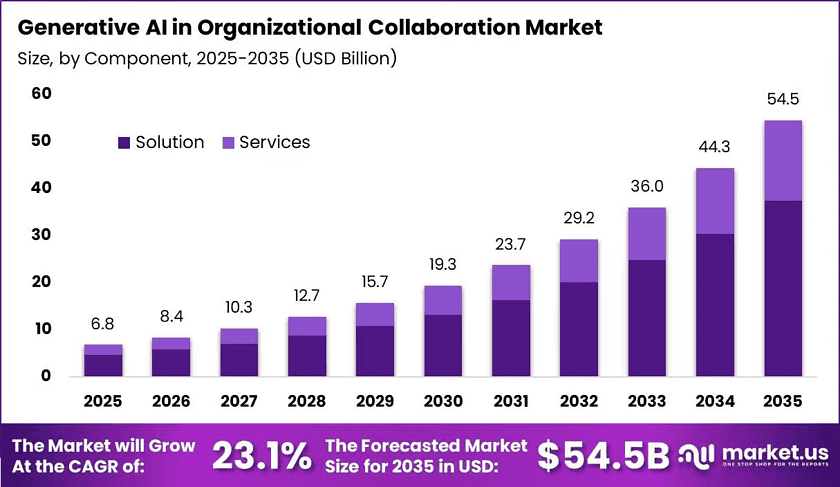
New York, NY – September 29, 2026 – The Generative AI in Organizational Collaboration Market reached USD 6.8 billion in 2025. The market could reach USD 54.5 billion by 2035, growing at a 23.1% CAGR. Generative AI collaboration software helps teams create content, share knowledge, summarize meetings, and automate work across business systems.
Moreover, business adoption supports this expansion. According to the U.S. Census Bureau, AI use among U.S. businesses stayed between 17% and 20% from December 2025 through May 2026. Another 20% to 23% expected adoption within six months, showing a growing pipeline for workplace AI tools.
Additionally, larger firms accelerate demand for organizational AI platforms. The U.S. Census Bureau reported that 37% of companies with at least 250 employees used AI by May 2026. These businesses often connect AI tools with meetings, documents, messaging, customer support, and project workflows, creating broader software spending opportunities.
However, digital access also shapes the addressable user base. According to the International Telecommunication Union, about 6 billion people, or 74% of the global population, used the internet in 2025. This connected workforce gives cloud providers more potential users for secure, distributed collaboration services across regions.
Therefore, companies increasingly treat generative AI as a daily productivity layer rather than a separate experiment. Collaboration vendors can improve content drafting, enterprise search, task management, and knowledge sharing. Enterprises also expect stronger controls for data privacy, accuracy, and integration, which will influence purchasing decisions throughout the forecast period.
Key Takeaways
- The Generative AI in Organizational Collaboration Market reached USD 6.8 billion in 2025 and could reach USD 54.5 billion by 2035, expanding at a 23.1% CAGR.
- The Solution segment held a 68.7% share in 2025, reflecting enterprise demand for licensed AI-enabled collaboration software.
- The Cloud-Based segment led with a 72.5% share in 2025, supported by remote access and centralized platform management.
- Large Enterprises accounted for a 64.1% share in 2025, as they hold stronger budgets, data resources, and technology teams.
- IT and Telecommunications generated the largest industry contribution with a 47.3% share in 2025.
- North America held a 39.7% share in 2025 and generated approximately USD 2.7 billion in revenue.
➤ Access the Exclusive Sample Report Featuring Full TOC, Data Tables & Figures – https://market.us/report/generative-ai-in-organizational-collaboration-market/request-sample/
Market Segmentation
Component
Solution platforms led the component segment with a 68.7% share in 2025. According to Eurostat, 52.7% of EU enterprises used paid cloud services during the year. This adoption creates a strong base for software that adds AI-assisted messaging, document creation, meeting summaries, and workflow automation.
Moreover, services support implementation, customization, training, governance, and system integration. Enterprises often need specialist support when connecting AI assistants with internal knowledge and business applications. Service providers can help companies set access rules, improve employee adoption, and monitor content quality across collaborative work environments.
Deployment Mode
Cloud-Based platforms held a 72.5% share in 2025. According to Eurostat, 71.7% of cloud-using EU enterprises purchased office software. This pattern shows that organizations already rely on online productivity tools, making cloud AI deployment a practical extension of existing workplace technology investments.
However, On-Premise deployment remains important for organizations with strict security, residency, and operational requirements. Financial institutions, government agencies, and critical infrastructure operators may keep sensitive information inside controlled environments. These buyers seek AI collaboration capabilities while retaining direct oversight of storage, access, and system operations.
Organization Size
Large Enterprises held a 64.1% share in 2025. These organizations deploy AI across many employees and departments, which increases platform value. Large companies also maintain stronger cloud infrastructure, larger data stores, and experienced technology teams that can manage complex integrations and governance requirements.
Additionally, small and medium-sized enterprises represent an important future customer group. Easier cloud subscriptions can reduce upfront technology costs and simplify deployment. Vendors can win these customers through practical templates, simple setup, local language support, and clear tools that solve specific communication or administrative tasks.
Industry Vertical
IT and Telecommunications led the industry vertical segment with a 47.3% share in 2025. These companies manage distributed engineering teams, service desks, networks, and customer operations. Generative AI helps workers summarize incident reports, draft technical material, organize knowledge, and coordinate actions during service disruptions.
Moreover, BFSI, healthcare, manufacturing, retail, education, and government organizations create varied demand. Each sector needs different workflows, language, security controls, and approval processes. Vendors that tailor collaboration tools for regulated or operational environments can improve relevance and reduce the burden of generic platform configuration.
Regional Analysis
North America led the market with a 39.7% share and approximately USD 2.7 billion in revenue during 2025. Strong cloud use and early enterprise AI investment support this position. U.S. and Canadian companies increasingly embed AI into communications, shared files, video meetings, project planning, and internal knowledge systems.
Meanwhile, Asia Pacific should record the fastest growth as businesses expand digital operations across China, India, Japan, South Korea, Australia, and Southeast Asia. Growing connectivity and cloud investment support wider platform access. Regional organizations also need AI tools that improve coordination among distributed teams, suppliers, customers, and multilingual workforces.
Market Drivers
Enterprise AI productivity suites drive market expansion by improving daily work across large organizations. AI-enabled premium plans often cost 20% to 30% more than standard packages. This pricing creates recurring revenue opportunities because companies pay for faster drafting, meeting insights, task support, and enterprise knowledge access.
Additionally, hybrid work normalization increases demand for collaboration platforms that work across locations and devices. Distributed employees need shared information and timely decisions without relying on office networks. Cloud-based AI tools can summarize discussions, route tasks, and organize documents, helping managers maintain coordinated work across teams.
Use Cases
Customer support teams use generative AI to summarize tickets, identify recurring issues, and prepare response drafts. Moreover, these tools help agents find approved answers inside internal knowledge systems. Faster access to relevant information can improve service consistency while allowing supervisors to focus on complex cases and quality review.
Product and engineering teams use AI assistants to organize technical notes, create code suggestions, and summarize project meetings. Additionally, collaboration platforms can convert discussions into assigned tasks and searchable records. This workflow reduces manual follow-up work and helps distributed specialists maintain a clearer view of product decisions.
Business Opportunities
Verticalized collaboration suites create an important opportunity for providers serving healthcare, manufacturing, legal services, and public organizations. Moreover, industry-focused products can include specialized language, structured templates, compliance workflows, and role-based controls. These features can help customers achieve faster adoption than they would with general workplace software.
Small business offerings also create room for market expansion. Vendors can deliver simple subscription plans, guided setup, and practical automation for daily communication. Consequently, accessible products can help smaller teams use AI without large technology departments, opening new channels for partners, resellers, and managed service providers.
Major Challenges
Specialized AI talent shortages can slow deployment and reduce system quality. Companies need skilled teams to connect data, manage models, set permissions, and monitor outputs. However, limited expertise increases hiring costs and delays project delivery, especially when organizations attempt large integrations across several legacy business systems.
Data protection rules and inaccurate AI outputs also challenge adoption. Organizations must protect confidential information while ensuring employees verify generated content. Therefore, vendors need strong governance features, audit trails, access controls, and clear review processes. Buyers will favor platforms that support trustworthy use without creating excessive compliance work.
Top Key Players in the Market
- Microsoft Corporation
- Google LLC
- Salesforce, Inc.
- Adobe Inc.
- Cisco Systems, Inc.
- Atlassian Corporation
- Zoom Video Communications, Inc.
- Asana, Inc.
- Notion Labs, Inc.
Conclusion
The Generative AI in Organizational Collaboration Market shows strong growth potential as companies integrate AI into everyday communication, planning, knowledge sharing, and workflow management. Moreover, cloud delivery, hybrid work, and industry-specific products will expand demand. Vendors that combine useful automation with reliable security, simple deployment, and responsible governance can build durable enterprise relationships across global markets.
Discuss your needs with our analyst
Please share your requirements with more details so our analyst can check if they can solve your problem(s)