
Market Overview
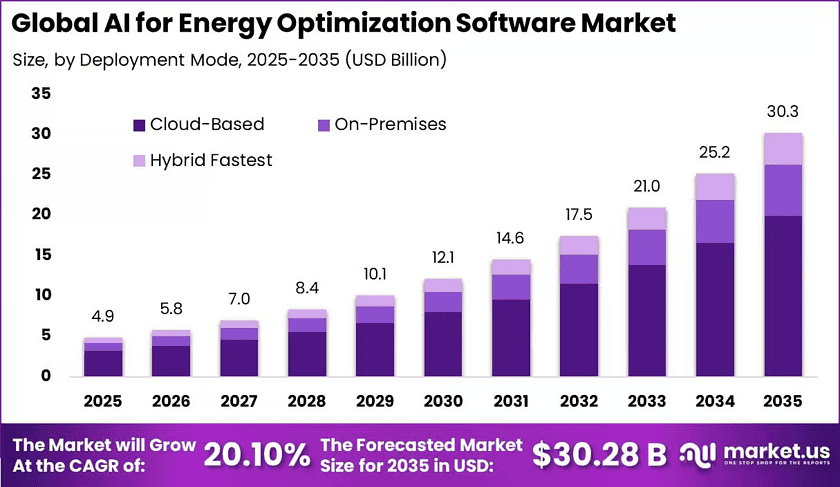
New York, NY – September 29, 2026 – The Global AI for Energy Optimization Software Market reached USD 4.8 billion in 2025. The market could reach about USD 30.2 billion by 2035, supported by a 20.1% CAGR as organizations seek better energy decisions and lower operating costs.
Global electricity demand keeps expanding as buildings, transport, data centers, and industry electrify. According to the IEA, electricity demand grew about 3% in 2025, adding roughly 800 TWh. Consequently, energy users need intelligent software for load forecasting, equipment control, and peak-demand management.
Data centers create another important demand source for intelligent energy management. The IEA expects global data-center electricity use to approach 945 TWh by 2030. Moreover, expanding AI computing increases cooling and power needs, strengthening demand for automated workload, storage, and facility optimization.
Europe provides a strong policy base for energy optimization. European Commission data show buildings consume around 40% of EU energy and about 50% of its gas. Therefore, digital controls support efficiency programs by identifying waste and improving heating, cooling, lighting, and power management.
Digital infrastructure also supports wider software adoption. Eurostat reported that 52.7% of EU enterprises used paid cloud services in 2025, rising 7.4 percentage points from 2023. Additionally, broader cloud use makes AI energy platforms easier to deploy across multiple facilities and utility operations.
Key Takeaways
- AI for Energy Optimization Software Market value reached USD 4.8 billion in 2025 and could reach USD 30.2 billion by 2035 at a 20.1% CAGR.
- Software led the component category with a 65.0% share.
- Cloud-based deployment captured a leading 66.0% share.
- Electricity dominated energy sources with a 58.5% share.
- Machine learning led AI technologies with a 25.9% share.
- Energy Consumption Optimization captured a 28.8% share.
- Utilities led end users with a 32.1% share.
- Energy Consumption and Demand Optimization held a 29.1% share.
- Energy Analytics and Monitoring captured a 31.0% share.
- Manufacturing Plants led facility types with a 32.1% share.
- Small and Medium Enterprises captured a dominant 43.7% share.
- Europe led globally with more than a 35.0% share and about USD 1.69 billion in value.
➤ Download a Complimentary Sample of This Premium Report (Full TOC Included) – https://market.us/report/ai-for-energy-optimization-software-market/request-sample/
Market Segmentation
By Component
Software held a dominant 65.0% share in 2025. Software converts energy, weather, tariff, and asset information into operating decisions. Meanwhile, services are expanding faster as customers need integration, cybersecurity, model training, energy audits, and ongoing performance support for optimization platforms.
By Deployment Mode
Cloud-based solutions captured a dominant 66.0% share in 2025. Cloud platforms process large energy datasets without extensive local servers. Meanwhile, hybrid deployment is growing quickly because users can retain time-sensitive controls locally while using cloud systems for broader forecasting and portfolio analysis.
By Energy Source
Electricity led with a 58.5% share in 2025. Electricity suits digital optimization because meters, sensors, batteries, inverters, and charging systems generate useful operating data. Consequently, AI tools can identify losses, manage peaks, coordinate flexible loads, and improve renewable-energy integration.
By AI Technology
Machine learning held a dominant 25.9% share in 2025. Utilities and facilities use it to turn meter, weather, grid, and equipment information into forecasts. Meanwhile, generative AI is expanding faster by helping operators interpret technical records and prepare scenario guidance.
By Optimization Function
Energy Consumption Optimization captured a dominant 28.8% share in 2025. The function supports savings by monitoring equipment and adjusting schedules, loads, and controls. Meanwhile, Energy Storage Optimization is growing rapidly as battery assets require automated charging, discharging, and market decisions.
By End User
Utilities held a dominant 32.1% share in 2025. Utilities manage variable generation, changing demand, network constraints, and pricing, creating demand for AI forecasting and dispatch tools. Meanwhile, data centers are growing faster because continuous computing loads require tighter power and cooling management.
By Application
Energy Consumption and Demand Optimization led with a 29.1% share in 2025. Advanced metering provides continuous information for demand control and load planning. Meanwhile, Data Center Energy Optimization grows faster as operators improve cooling, workload scheduling, backup coordination, and peak control.
By Solution Type
Energy Analytics and Monitoring held a dominant 31.0% share in 2025. Continuous measurement helps users locate energy waste before applying automated control. Meanwhile, Carbon Management grows faster as companies strengthen emissions tracking, reduction planning, reporting, and energy-related operating decisions.
By Facility Type
Manufacturing Plants captured a dominant 32.1% share in 2025. Factories operate motors, pumps, heating, refrigeration, and production equipment that create optimization data. Meanwhile, data centers are expanding faster because operators must coordinate computing, cooling, power distribution, and resilience systems.
By Organization Size
Small and Medium Enterprises held a dominant 43.7% share in 2025. SMEs increasingly use affordable digital tools to monitor energy and control costs. Moreover, cloud delivery reduces technology barriers and allows smaller organizations to adopt optimization software without maintaining large internal IT teams.
Regional Analysis
Europe led the market in 2025 with more than a 35.0% share and about USD 1.69 billion in value. Strong efficiency policies, building digitalization, renewable integration, and smart-meter adoption support demand. Consequently, organizations increasingly use AI for forecasting, load balancing, and automated energy control.
Asia Pacific represents the fastest-growing regional market, with a projected 22.5% CAGR. Industrial expansion, data-center development, urban growth, renewable installations, and rising electricity demand support adoption. Moreover, utilities and large facilities need software that coordinates complex energy assets while controlling operating costs.
Drivers
Accelerating load complexity remains a key market driver. The report estimates this factor can add about 1.4 percentage points to market CAGR as electricity demand expands across buildings and data centers. Consequently, users need AI tools for forecasting, peak management, HVAC control, and real-time dispatch.
Renewable variability creates another important driver, with an estimated 1.0 percentage-point CAGR contribution. Solar, wind, batteries, and distributed assets create changing operating conditions. Therefore, utilities and energy users increasingly need AI platforms that forecast supply, balance demand, optimize storage, and improve grid coordination.
Use Cases
Commercial buildings use AI energy software to coordinate HVAC, lighting, occupancy patterns, and equipment schedules. The software identifies waste, predicts changing loads, and adjusts controls before costs rise. Moreover, facility teams can combine energy and maintenance information to improve comfort, reduce manual work, and strengthen equipment performance.
Industrial sites use AI optimization to monitor motors, pumps, compressed air, process heating, refrigeration, and production loads. Operators can detect inefficient operating patterns and adjust schedules around production needs. Additionally, predictive insights help maintenance teams address equipment issues earlier while supporting consistent energy performance across complex facilities.
Business Opportunities
Virtual power plant orchestration offers a major business opportunity as distributed batteries, solar systems, flexible loads, and electric vehicles expand. Software providers can connect these assets and coordinate their response to grid conditions. Moreover, utilities can use aggregated flexibility to support peak management, reliability, and electricity-market participation.
Industrial process-heat optimization creates another opportunity for software vendors and automation providers. Many factories operate energy-intensive thermal systems with limited real-time optimization. Therefore, AI platforms can combine production schedules, equipment conditions, energy prices, and heat demand to improve controls while supporting efficiency and decarbonization goals.
Major Challenges
Energy-AI talent scarcity remains a major challenge because deployments require knowledge of software, power systems, controls, and facility operations. Organizations may struggle to connect technical teams with energy experts. Consequently, vendors need simpler interfaces, stronger training, and service support that converts analytical outputs into practical operating actions.
Legacy operational technology also creates integration problems across utilities and industrial facilities. Older control systems often use different protocols, data formats, and communication methods. Moreover, inconsistent information quality can weaken AI models, slow automation, and increase implementation costs, making interoperability and reliable data pipelines essential.
Top Key Players in the Market
- GE Vernova
- Honeywell
- Hitachi Energy
- C3.ai
- Envision Digital
- Schneider Electric
- Siemens
- Uplight
- Stem, Inc.
- Enel X
- IBM
- Johnson Controls
- Trane Technologies
- Innowatts
- Amperon
- Emerald AI
- ABB
- Verdigris
- Grid4C
Conclusion
AI for energy optimization software is moving from a specialized efficiency tool toward a broader operating platform for utilities, buildings, factories, and data centers. Growing electricity demand, cloud adoption, renewable integration, and digital infrastructure support expansion. However, vendors must address integration, cybersecurity, data quality, and skills gaps to sustain reliable adoption.
Discuss your needs with our analyst
Please share your requirements with more details so our analyst can check if they can solve your problem(s)