
Market Overview
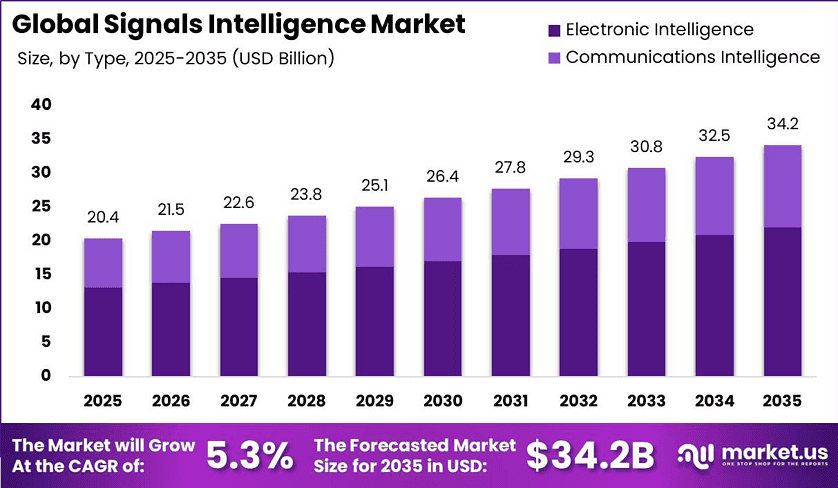
New York, NY – October 01, 2026 – The Global Signals Intelligence Market reached USD 20.4 billion in 2025. The market is expected to reach USD 34.2 billion by 2035. Consequently, the market should expand at a 5.3% compound annual growth rate during 2026–2035. North America led the global market with a 38.6% share in 2025. The region generated about USD 7.87 billion in revenue.
Defense agencies use signals intelligence systems to detect, collect, and assess electronic and communication signals. These capabilities support military planning, border protection, cyber defense, and counterterrorism missions. Moreover, governments need faster intelligence from increasingly crowded radio, radar, satellite, and digital networks. This requirement supports demand for advanced monitoring platforms and analytics software.
According to SIPRI, global military expenditure reached USD 2,887 billion in 2025. This spending marked the eleventh straight year of growth and rose 41% from 2016. Consequently, defense agencies can fund more intelligence, surveillance, reconnaissance, electronic warfare, and signal-processing programs across key security markets.
According to the International Telecommunication Union, about 6 billion people used the internet in 2025. This figure represented 74% of the global population, compared with 60% in 2020. Therefore, larger digital traffic volumes create more communication signals that security organizations must identify, analyze, and protect.
Key Takeaways
- The Signals Intelligence Market should grow from USD 20.4 billion in 2025 to USD 34.2 billion by 2035, reflecting a 5.3% CAGR.
- Electronic Intelligence, or ELINT, led the type segment with a 64.5% market share.
- Airborne solutions led the solution segment with a 41.3% share of total deployments.
- North America held a 38.6% market share and generated approximately USD 7.87 billion in 2025.
➤ See the Full TOC, Market Tables & Figures in Your Sample Copy – https://market.us/report/global-signals-intelligence-market/request-sample/
Market Segmentation
Electronic Intelligence held more than 64.5% of the market in 2025. Armed forces use ELINT systems to identify radar emissions, missile threats, and electronic warfare activity. Moreover, air-defense modernization programs increase demand for threat-warning receivers, wideband monitoring equipment, and radar detection tools across aircraft, ships, and land forces.
Communications Intelligence supports the collection and assessment of voice, data, and transmission signals. Security agencies use COMINT capabilities to improve situational awareness and track potential threats. Consequently, encrypted communications, digital networks, and cross-border security needs encourage suppliers to develop stronger interception tools, secure processing systems, and advanced signal analysis software.
Airborne solutions accounted for around 41.3% of total signals intelligence deployments in 2025. Aircraft and unmanned platforms gather radio, radar, and satellite signals across large operational areas. Additionally, defense forces are adding multi-sensor payloads, upgraded antennas, and reconnaissance pods to improve surveillance reach and faster mission decisions.
Ground, naval, space, and cyber solutions address different intelligence missions. Ground systems support border and infrastructure monitoring, while naval systems protect maritime routes and fleets. Furthermore, space payloads extend coverage across wider regions, and cyber intelligence platforms help agencies identify digital threats affecting government networks and critical services.
Regional Analysis
North America dominated the Signals Intelligence Market with a 38.6% share and about USD 7.87 billion in revenue during 2025. United States defense and intelligence agencies drive regional procurement through national security, cyber defense, and surveillance programs. Moreover, established contractors and research networks support continued deployment of advanced intelligence platforms.
Europe and Asia-Pacific create major growth opportunities as governments strengthen defense readiness and regional monitoring. According to NATO, European Allies and Canada invested more than USD 571 billion in defense during 2025. Consequently, interoperability programs and increased security concerns encourage demand for compatible surveillance, electronic intelligence, and secure communications systems.
Drivers
Global military spending drives the demand for signals intelligence equipment and services. Military expenditure grew by more than 35% between 2015 and 2024. Consequently, defense ministries can establish longer procurement programs for surveillance systems, signal sensors, electronic warfare tools, and intelligence-processing capabilities.
Artificial intelligence strengthens automated signal analysis across complex operating environments. Defense teams use AI tools to sort large signal volumes, identify patterns, and prioritize urgent threats. Moreover, multi-domain intelligence modernization connects air, land, sea, space, and cyber operations. This integration increases demand for software-led processing and real-time decision support.
Use Cases
Military organizations use SIGINT platforms to detect hostile radar activity, communication signals, and electronic emissions. Air forces deploy airborne sensors to observe broad areas, while naval forces monitor maritime traffic and coastal activity. Consequently, commanders gain faster information that supports mission planning, force protection, and timely responses during security operations.
Government agencies use intelligence technologies to protect borders, critical infrastructure, and public networks. Cybersecurity teams assess digital signals to identify intrusions and suspicious activity. Additionally, homeland security programs monitor transport corridors, energy facilities, and communication systems. These applications help agencies respond to threats before disruptions affect essential public services.
Business Opportunities
Software-defined intelligence platforms create a major opportunity for suppliers. Vendors can replace fixed hardware functions with flexible software tools that support faster upgrades and easier maintenance. Moreover, subscription-based analytics services can build recurring revenue, improve customer retention, and help defense users add features without replacing entire signal-processing systems.
Commercial space partnerships offer another path for market expansion. Satellite operators and defense agencies can place monitoring payloads in low Earth orbit to extend signal coverage. Consequently, suppliers can develop new services for remote surveillance, maritime monitoring, and border awareness. Emerging markets also seek local intelligence capabilities that reduce external dependency.
Major Challenges
Complex integration creates a major challenge for signals intelligence programs. Defense agencies must connect space, air, naval, ground, and cyber platforms while protecting sensitive data. However, different sensors, software systems, and communication standards can delay deployment. Suppliers must support older equipment while building modern, connected intelligence architectures for future missions.
Export controls and skilled workforce shortages can slow market growth. Governments restrict sensitive decryption, radio-frequency, and electronic warfare technologies because these tools affect national security. Additionally, suppliers need specialists who understand signal analysis, cybersecurity, and secure software development. These limits can extend procurement timelines and raise program costs for customers.
Top Key Players in the Market
- BAE Systems
- Lockheed Martin Corporation
- Thales
- L3Harris Technologies
- Northrop Grumman
- General Dynamics
- Raytheon Technologies
- HENSOLDT AG
- Elbit Systems
- Saab
- Mercury Systems
Conclusion
The global Signals Intelligence Market benefits from rising defense investment, growing digital traffic, and stronger demand for real-time security information. ELINT and airborne platforms currently lead market adoption, while software-defined systems and space-based monitoring create future opportunities. However, export restrictions, integration demands, and specialist shortages may slow some programs. North America remains central to market development through its defense budgets, technology base, and intelligence infrastructure.
Discuss your needs with our analyst
Please share your requirements with more details so our analyst can check if they can solve your problem(s)