
Market Overview
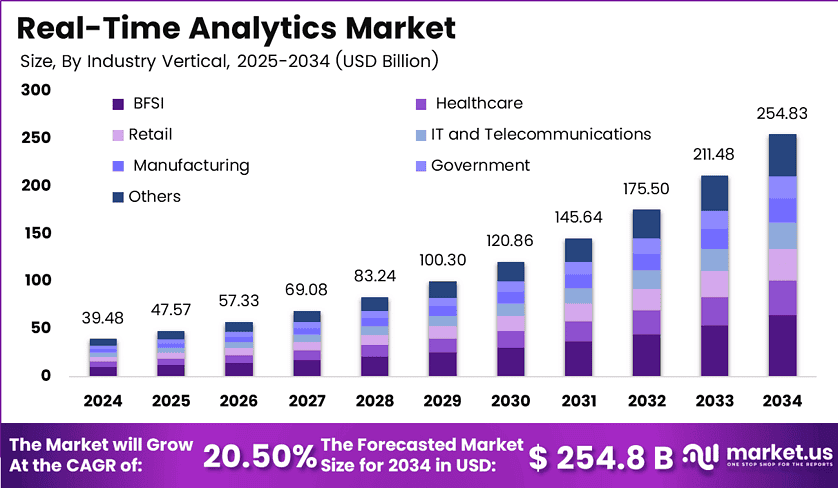
New York, NY – October 01, 2026 – The Global Real-Time Analytics Market reached USD 39.4 billion in 2024 and is projected to reach USD 254.8 billion by 2034. The market will expand at a 20.5% CAGR from 2025 to 2034. North America leads the market with a 43.6% share and USD 17.2 billion in revenue during 2024. Real-time analytics helps businesses turn live data into immediate actions across payments, customer service, operations, and security.
Moreover, digital activity continues to create large streams of business data. According to the ITU, about 6 billion people used the internet in 2025, while 2.2 billion people remained offline. This expanding connected population creates more clicks, transactions, device signals, and service interactions for companies to analyze quickly.
Additionally, organizations need stronger computing capacity to process continuous information flows. According to the IEA, data centre electricity demand may rise from 485 TWh in 2025 to 950 TWh by 2030. This near doubling shows why businesses increasingly invest in efficient streaming platforms and intelligent automation.
Cloud adoption also supports broader demand for live data tools. According to Eurostat, 52.7% of EU enterprises used paid cloud computing services in 2025, up 7.4 percentage points from 2023. This installed cloud base gives companies a practical foundation for real-time dashboards, event processing, and AI-enabled decisions.
Key Takeaways
- The Real-Time Analytics Market held a value of USD 39.4 billion in 2024 and will reach USD 254.8 billion by 2034. The market will grow at a 20.5% CAGR between 2025 and 2034.
- Solutions and platforms lead the component segment with a 70.4% share.
- Cloud leads deployment mode with a 75.2% share.
- Large enterprises lead organization size with a 65.8% share.
- Fraud detection and security analytics lead applications with a 22.5% share.
- BFSI leads industry verticals with a 25.3% share.
- North America dominates with a 43.6% share and USD 17.2 billion in revenue.
➤ Preview Key Insights with an Exclusive Sample Report Download – https://market.us/report/real-time-analytics-market/request-sample/
Market Segmentation
Solutions and platforms lead the component segment with a 70.4% share. Businesses use these systems to collect event streams, apply business rules, run models, and trigger alerts quickly. Moreover, integrated platforms give teams shared controls for data quality, access permissions, dashboards, and business application connections.
Services include consulting and integration, plus managed services for ongoing operations. Consulting partners help firms connect legacy databases, cloud applications, sensors, and AI tools. Additionally, managed service providers support monitoring, security, model updates, and continuous platform performance after deployment.
Cloud deployment leads with a 75.2% share because companies need flexible computing capacity and rapid access across locations. Cloud platforms connect mobile apps, partner systems, branches, and online channels through shared infrastructure. Consequently, organizations can scale processing resources without long hardware purchase cycles.
On-premises deployment remains relevant for sensitive records, regulated operations, and fixed industrial sites. Organizations use local infrastructure when they require direct control over data, systems, and security processes. However, longer installation periods and restricted computing capacity limit on-premises growth compared with hosted analytics services.
Large enterprises account for a 65.8% market share because they manage complex, high-volume data across many business units. These companies invest in data engineers, cyber controls, secure infrastructure, and dedicated support teams. Therefore, they can apply live intelligence across fraud prevention, supply planning, customer operations, and technology monitoring.
Small and medium enterprises create an important growth path for vendors. These businesses can start with ready-made tools, managed support, and focused analytics services. Moreover, low-code features reduce skill barriers and help smaller firms prove value before expanding their data programs.
Fraud detection and security analytics lead applications with a 22.5% share. Banks, merchants, insurers, telecom providers, and government agencies use live monitoring to assess suspicious activity as it occurs. Consequently, rapid risk scoring helps organizations reduce losses and protect customers from harmful transactions.
Other applications include personalized customer experience, supply chain and logistics, supply chain, network monitoring, sales analytics, and marketing analytics. These functions turn fresh operational data into timely actions. Additionally, connected equipment allows factories, utilities, fleets, and buildings to identify warning signs before failures disrupt work.
BFSI leads industry verticals with a 25.3% share because financial institutions process continuous flows of payments, account activity, claims, and investment data. Banks and insurers require instant decisions, strong audit records, and risk controls. Therefore, live data systems support secure services and dependable customer experiences.
Healthcare, retail, IT and telecommunications, manufacturing, government, and other industries also expand adoption. Healthcare providers monitor care operations and claims, while retailers improve offers and inventory decisions. Moreover, telecom operators use event intelligence to identify network issues, manage service quality, and respond to customer needs.
Regional Analysis
North America leads the real-time analytics market with a 43.6% share and USD 17.2 billion in 2024 revenue. Major cloud providers, advanced data centres, and strong enterprise technology spending support this position. Consequently, regional companies gain early access to streaming platforms, AI services, vector search, and event-driven tools.
Asia Pacific represents the fastest-growing regional market as India, China, Japan, South Korea, and Australia expand digital infrastructure. Europe holds the second-largest position through cloud investment, data governance, and AI programs. Additionally, Latin America and the Middle East and Africa offer growth as enterprises modernize payments, logistics, public services, and telecom operations.
Drivers
Operational AI decision automation drives market demand because businesses now need to score transactions and activate workflows during live events. Financial institutions, retailers, manufacturers, and telecom companies use real-time analytics to respond before customer, machine, or network issues grow. Therefore, immediate decision systems replace slower reports that describe past events.
Streaming cloud modernization also accelerates adoption across global enterprise markets. Cloud services allow organizations to combine data storage, machine learning, streaming tools, and business applications within flexible environments. Moreover, this approach helps teams add capacity quickly, lower infrastructure delays, and support users across distributed locations.
Use Cases
Fraud prevention teams use live analytics to detect unusual payments, account behavior, and identity signals. Security teams can then block, review, or escalate risky events before losses spread. Consequently, banks, payment firms, online merchants, and insurers strengthen trust while reducing manual investigation workloads.
Industrial operators use streaming intelligence to monitor equipment health, energy use, location data, and production activity. Maintenance teams receive early warnings when machine behavior changes from normal patterns. Moreover, this use case helps manufacturers, utilities, logistics firms, and fleet operators reduce downtime and maintain reliable service delivery.
Business Opportunities
Connected-product data marketplaces create opportunities for manufacturers that collect information from equipment, vehicles, and devices. Companies can package trusted data services for customers, suppliers, and partners. Consequently, specialized analytics providers can build recurring revenue models around maintenance insights, usage patterns, and operational benchmarks.
Privacy-preserving analytics services offer another attractive business path for regulated industries. Providers can help organizations analyze useful information while protecting identity, location, financial, health, and behavioral data. Moreover, vendors that simplify consent, retention, governance, and secure data sharing can gain stronger customer confidence.
Major Challenges
Real-time data quality remains a major challenge because companies combine feeds from applications, sensors, payment systems, and third-party sources. Teams must check accuracy, completeness, duplicates, timing, and identity matching before automated decisions occur. Therefore, poor governance can increase deployment costs and reduce confidence in live insights.
Specialist talent scarcity and complex distributed systems also slow adoption. Organizations need skilled teams to manage data engineering, cloud operations, cybersecurity, machine learning, and workflow design. However, many companies lack these capabilities internally, which increases dependence on consultants, managed services, and simplified software tools.
Top Key Players in the Market
- Amazon Web Services
- Microsoft Azure
- Google Cloud Platform
- SAP
- Oracle
- IBM
- Informatica
- Amdocs
- Infosys
- Impetus Technologies
- MongoDB
- ADA
- Databricks
- Stream Charts
Conclusion
The real-time analytics market will grow as companies seek faster decisions from customer, operational, security, and machine data. Cloud platforms, AI automation, and connected systems strengthen adoption across major industries. However, providers must address data quality, skills shortages, privacy requirements, and system complexity. Businesses that combine trusted data, practical deployment support, and industry-focused solutions can build durable value in this expanding market.
Discuss your needs with our analyst
Please share your requirements with more details so our analyst can check if they can solve your problem(s)