
Market Overview
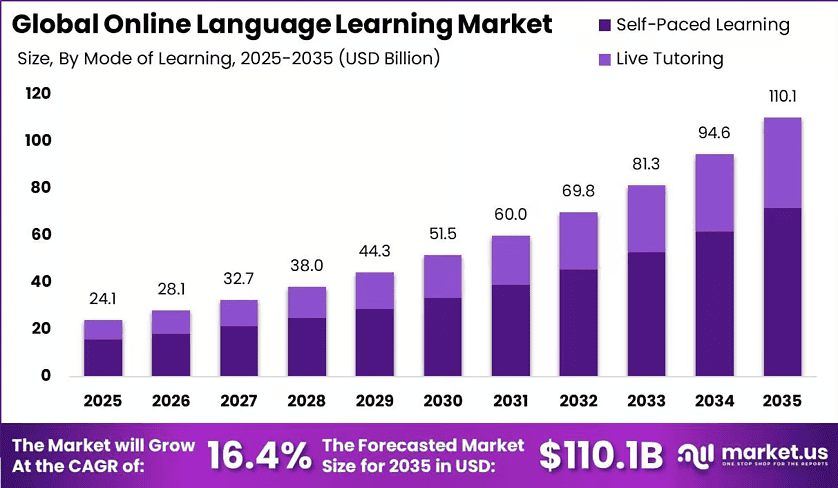
New York, NY – October 22, 2026 – The Online Language Learning Market reached USD 24.1 billion in 2025. Analysts expect it to grow at a 16.4% CAGR and hit about USD 110.1 billion by 2035. This steady rise shows that digital language education is becoming a long-term learning habit for students, workers, and businesses.
Moreover, Asia Pacific led the global market in 2025 with a more than 41.1% share and about USD 9.88 billion in revenue. Large online populations and strong demand for education drive this lead. Consequently, providers see the region as the most important place to grow their language apps and virtual tutoring services.
Additionally, the International Telecommunication Union reports that about 5.5 billion people used the internet in 2024. This equals 68% of the world population. Therefore, language apps, online courses, and virtual tutors can reach a very wide pool of learners. This connected base supports regular subscription demand across many markets.
Furthermore, the World Bank reports that internet use is above 90% in many high-income economies. Emerging markets also keep adding new users each year. As a result, learners can study on smartphones and laptops without going to a classroom. Wider access lowers costs and helps digital language training reach more people.
However, adult learning trends also shape demand. According to the OECD, about 40% of adults in member countries take part in learning each year. Much of this learning is job-related. Consequently, workers choose online language courses to build the communication skills they need for international jobs and global business roles.
Key Takeaways
- The Global Online Language Learning Market should grow from USD 24.1 billion in 2025 to USD 110.1 billion by 2035. at a 16.4% CAGR.
- Self-paced learning leads the mode of learning segment with a 65.1% share, thanks to flexibility, convenience, and personal learning paths.
- Individual learners lead the target audience segment with a 70.3% share, backed by demand for personal and career language skills.
- English leads the language segment with a 55.7% share, reflecting its role in global education and business.
- Asia Pacific holds 41.1% of the global market, worth about USD 9.88 billion in 2025.
➤ Evaluate the Report Quality with an Exclusive Sample Download – https://market.us/report/online-language-learning-market/request-sample/
Online Language Learning Market Segmentation
By Mode of Learning
Self-paced learning held more than a 65.1% share in 2025. Surveys show that about 70% of learners prefer self-paced online courses because they can fit study around work and family. Moreover, studies report that online formats can improve knowledge retention by 25% to 60%. This helps learners stay with courses instead of quitting early.
Additionally, many platforms saw completion rates rise from about 35% to 85% after adding micro-quizzes and short video lessons. Platforms rolled out these features between March and June 2025, ahead of university exams and corporate reviews. Consequently, bite-sized practice keeps learners active and lifts the value of each subscription.
By Target Audience
Individual learners held a 70.3% share in 2025. Budgets and buying decisions are moving from institutions to end users. Moreover, workplace surveys show that about 70% of employees prefer self-paced online courses for new skills. Many workers now use this habit for language learning to improve job mobility and win remote work.
Furthermore, data show that short modules reach completion rates near 80%, compared with about 20% for longer courses. This gap means short lessons keep people learning. Therefore, individuals subscribe to language apps instead of waiting for classroom programs. Institutional buyers also add steady demand through structured training programs.
By Language
English held more than a 55.7% share in 2025. It is the main working and study language across global digital industries. Moreover, one study notes that 94% of Generation Z students use phones for study. Many of them choose English courses to communicate internationally and to access global content.
Additionally, corporate training data show that e-learning can cut course completion time by 40% to 60%. Firms use this speed for English training across distributed teams. Spanish, French, German, Chinese, and Japanese also attract steady interest. Consequently, demand peaks between May and July as learners prepare for admissions, visas, and tests.
Regional Analysis of Language Learning
Asia Pacific leads the online language learning market with about a 41.1% share and close to USD 9.8 billion in value. Large digital populations, fast 4G and 5G growth, and high smartphone use power this lead. Moreover, China, India, Japan, South Korea, and ASEAN countries supply a huge base of learners.
Additionally, companies in Asia Pacific invest in language training for IT services, tourism, manufacturing, and shared service centers. Learners on a budget choose freemium or low-cost apps. Meanwhile, urban professionals pick premium platforms with certifications. North America, Europe, Latin America, and the Middle East and Africa also offer strong growth potential.
Key Market Drivers
Globalization and cross-border mobility lead the drivers, adding about 3.0% to the forecast CAGR. International students and migrant workers need new languages for admission, visas, and jobs. Consequently, platforms report mid-teens to high-teens enrollment growth in markets where international student numbers grew by about 5% to 7% each year.
Moreover, smartphone and broadband growth adds about 2.4% to the CAGR across Asia Pacific, Latin America, and Africa. Better access lets more learners join paid digital courses. Additionally, subscription models can lift average revenue per user by about 20% to 30%. Therefore, providers earn steadier income than they would from one-time course fees.
Practical Use Cases
Students use online language platforms to prepare for university admissions and proficiency tests. They practice speaking, reading, and writing through short lessons and mock exams. Moreover, learners study on their phones during commutes or breaks. Consequently, test preparation becomes flexible and affordable, which helps students meet tough academic and visa deadlines.
Additionally, companies use digital language training to build multilingual teams. IT firms, tourism operators, and manufacturers train staff to serve global clients. Employees join live virtual tutoring sessions or follow self-paced modules. Therefore, businesses improve customer service and teamwork across borders without sending workers to costly physical classrooms.
Business Opportunities
AI-first personalized coaching offers a major growth path for language providers. Platforms can combine real-time speech scoring, conversation bots, and adaptive lessons built around each learner’s gaps. Moreover, these tools can raise completion and proficiency results. Consequently, providers can sell premium subscriptions and keep healthy margins as AI costs grow slowly.
Additionally, providers can link language courses with workforce upskilling and HR platforms. Employers want easy ways to track employee progress and skill gains. Therefore, joint offerings with HR software create steady corporate demand. Industry-specific tracks for export sectors, healthcare, and hospitality can also open new, high-value customer groups.
Major Market Challenges
Low engagement and weak retention remain the biggest challenge for online language platforms. Many users stop before finishing even half of a course. Consequently, high churn pushes up the real cost of keeping each loyal learner. Providers must therefore invest in adaptive paths, reminders, and live support to keep users active.
Moreover, providers face a shortage of qualified online tutors for popular language pairs. This gap limits the growth of live tutoring services. Additionally, local content and cultural nuances make course design harder in multilingual emerging markets. Therefore, companies must invest in skilled teachers and careful localization to stay competitive.
Top Key Players in the Market
- Babbel
- Busuu
- OpenLanguage
- Pimsleur
- Memrise
- Duolingo Inc.
- Rosetta Stone
- italki
- Verbling
- Coursera, Inc.
- Berlitz
- EF Education First
Conclusion
The online language learning market shows strong long-term promise, driven by wider internet access, global mobility, and lifelong learning. Self-paced formats, individual learners, and English courses lead demand, while Asia Pacific remains the top region. Moreover, AI coaching and workforce partnerships open fresh growth paths. However, providers must solve retention gaps and tutor shortages to keep growing at a steady pace.
Discuss your needs with our analyst
Please share your requirements with more details so our analyst can check if they can solve your problem(s)