Market Overview
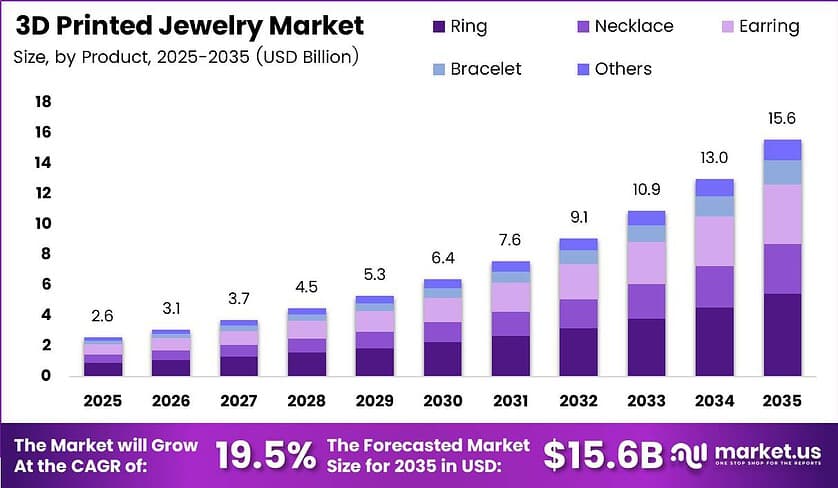
The global 3D printed jewelry market reaches USD 15.6 Billion by 2035 from USD 2.6 Billion in 2025. Industry revenue expands at a 19.5% CAGR from 2026 to 2035. Rising precious metal costs push producers toward lightweight additive manufacturing. Consequently, workshops invest heavily in digital fabrication equipment.
Additive jewelry manufacturing uses digital files and layer-by-layer machines to build castable wax masters or finished metal ornaments.Moreover, printer makers, resin suppliers, casting bureaus, and retail chains deploy these systems daily. Factories adopt digital production to trim bullion weight and accelerate custom order fulfillment.
Bridal, luxury, and fashion retailers lead global commercial adoption across consumer accessory supply chains.Additionally, bridal boutiques print custom engagement rings while mass merchants source standardized batch castings. E-commerce brands also connect browser configurators directly to casting bureaus for rapid personalized production without holding excess stock.
Data-Driven Insights for Smarter Business Decisions: Explore the Full Report
Key Takeaways
- Global 3D Printed Jewelry Market stood at USD 2.6 Billion in 2025.
- Market revenue reaches USD 15.6 Billion by 2035.
- Industry sales expand at a 19.5% CAGR from 2026 to 2035.
- Ring led the Product segment with a 34.89% share in 2025 and grows fastest.
- Women captured a 67.45% End User share in 2025, while Men expands fastest.
- Supermarket/Hypermarket held 38.90% of Distribution Channel revenue in 2025, whereas Online grows fastest.
- Asia-Pacific dominated with a 38.67% share worth USD 1.0 Billion in 2025, while Europe grows fastest through 2035.
Market Segmentation Overview
Ring captured a leading 34.89% product share in 2025 and ranks as the fastest-growing category. Bridal engagement and anniversary rings demand micron-accurate prong seats and bespoke band sizing. Consequently, jewelry boutiques deploy benchtop resin printers to convert custom Valentine and wedding buyers quickly across Necklace, Earring, and Bracelet lines.
Moreover, Women dominated the End User segment with a 67.45% revenue share in 2025. Frequent seasonal gifting and self-purchasing require thousands of personalized pendant and bangle styles before holiday deadlines, including USD 7.5 Billion in 2026 US Mother’s Day spending. Meanwhile, Men represents the fastest-growing buyer group using hollow structural cores for thick signet rings and heavy chains.
Additionally, Supermarket/Hypermarket led the Distribution Channel segment at 38.90% share in 2025. High-volume warehouse clubs and supercenters demand defect-free batch castings under strict retail price caps from multi-jet wax printer farms. However, Online ranks as the fastest-growing channel as shoppers customize browser-based files sent straight to casting bureaus alongside Specialty Store boutiques.
Drivers
Surging bullion prices force commercial workshops away from heavy solid metal castings. LBMA gold climbed from USD 2,060 per ounce in early 2024 past USD 4,000 in October 2025. Consequently, factories in Surat, Mumbai, Shenzhen, and Dubai print hollow lattice designs that cut metal consumption by 30% to 50% and lower wedding bangle prices up to 40%.
Moreover, lightweight additive fabrication shifts retail jewelry pricing from basic gram-weight markups toward higher design fees. Listed Indian jewelers expanded making-charge margins by 150 to 250 basis points in fiscal 2025 through intricate printed geometries. Therefore, casting bureaus and factory cells increased printing capacity by 20% to 25% across 2024 and 2025.
Use Cases
Specialty bridal boutiques use desktop stereolithography printers to produce physical try-on prototypes during high-ticket consultations. Independent jewelers print exact wax ring models within hours so brides can inspect prong heights before precious metal casting. Consequently, retail stores lock in custom deposits during second visits while generating steady resin orders for hardware vendors.
Additionally, precious metal chain manufacturers print hollow internal lattices to produce wide collar frames and interlocking necklaces. USGS data shows platinum prices jumped 25% and ruthenium rose 53% in 2025, inflating solid alloy expenses. Therefore, casting houses run topology-optimized digital necklace templates to preserve visual volume and protect gross margins.
Data-Driven Insights for Smarter Business Decisions: Explore the Full Report
Major Challenges
High capital expenses for precious-metal laser powder-bed fusion systems restrict direct metal adoption among mid-sized and family workshops. Industrial gold and platinum machines cost USD 150,000 to USD 500,000 and require powder stock worth up to 2 times machine value. Consequently, small casters achieve under 40% utilization and outsource metal builds to external service bureaus.
However, acute digital modeling talent shortages also slow daily factory throughput across major manufacturing hubs. Gem and jewelry skill councils report an annual deficit of 15,000 to 20,000 trained CAD designers, pushing salaries up 18% to 25%. Therefore, faulty geometry forces rework on 20% to 30% of prints and stretches design queues up to 7 days.
Business Opportunities
Jewelry producers can monetize digital design libraries through per-print licensing and encrypted subscriptions beyond physical bullion sales. Licensing digital templates yields 70% to 85% margins compared with 8% to 15% net margins on made-to-order gold ornaments. Consequently, charging USD 5 to USD 40 per build recoups modeling costs within 60 prints and cuts retailer stock by 35%.
Moreover, manufacturers can deploy localized on-demand printing hubs and recycled metal powders near major Western consumer markets. World Bank figures show gold surged 42% in 2025 while rising import tariffs threaten cross-border finished jewelry shipments. Therefore, brands operating regional automated plants like the USD 150 Million recycled-metal Vietnam facility capture ethical retail demand and bypass customs duties.
Regional Analysis
Asia-Pacific dominated the global market in 2025 with a 38.67% share valued at USD 1.0 Billion. Dense casting clusters in Surat, Mumbai, Shenzhen, and Bangkok pair with rising household incomes and surging WIPO design filings across China and India. Consequently, export bureaus run high-speed resin printer farms to deliver lightweight wedding gold and fast catalog updates.
Meanwhile, Europe emerges as the fastest-growing regional market through 2035 across luxury hubs in Italy, France, Switzerland, and Austria. Eurostat recorded a 1.2% expansion in European Union non-food discretionary retail during September 2026, supporting steady high-end jewelry turnover. Therefore, heritage luxury houses invest in industrial multi-laser sintering systems to craft intricate geometric platinum and gold collections.
Recent Developments
- October 2026 — 3D Systems, Inc. opened a 50,000 square foot Industrial Technology Center in Littleton, Colorado, expanding its US and European manufacturing footprint to 270,000 square feet.
- October 2026 — Materialise NV updated its EUR 30 Million share buyback program to 2.9% of outstanding stock while holding EUR 153.5 Million in cash reserves.
- May 2026 — Flashforge launched the WJ51C compact desktop wax printer featuring 2900 by 2900 by 1700 DPI resolution, 15 micron layers, and 3 kg monthly wax output.
- March 2026 — B9Creations and Würth Additive Group partnered to link sub-50 micron DLP printers with a 192 by 108 by 320 mm build volume to encrypted Digital Inventory Services.
- November 2025 — EOS GmbH launched the EOS M4 ONYX metal laser printer with 6 lasers at 400 W to boost throughput 50% and cut part cost 30%.
- June 2025 — Formlabs introduced True Cast Resin for Form 4 printers to cast patterns up to 5 mm thick with 0.03% burnout ash content at 25 micron layers.
- June 2025 — Stratasys Ltd. acquired high-speed resin printing intellectual property, inventory, and equipment from Nexa3D Inc. for USD 4.2 Million alongside registering 362,500 ordinary shares.
- May 2025 — Flashforge released the triple-printhead WaxJet 530 industrial wax printer delivering 25% to 50% faster builds and 12 kg monthly wax output.
- April 2025 — Stratasys Ltd. closed a USD 120 Million PIPE investment from Fortissimo Capital by issuing 11,650,485 ordinary shares at USD 10.30 per share for a 10.6% premium.
- April 2025 — Solidscape shipped its Muse benchtop 100% wax jewelry printer featuring 254,000 DPI jet positioning, 25 micron layers, and a 14.6 kg chassis.
- April 2025 — Nano Dimension Ltd. acquired binder-jetting manufacturer Desktop Metal, Inc. for USD 179.3 Million in cash at USD 5.295 per share.
- March 2025 — Platinum Guild International launched the 30-piece Tùsaire direct-metal printed platinum and titanium collection priced from USD 1,040 to USD 34,910.
Conclusion
Global additive jewelry manufacturing accelerates steadily as record gold and silver prices push workshops away from heavy solid castings. Castable resin farms and multi-laser metal printers trim precious metal usage while unlocking higher design-led retail margins. Consequently, digital fabrication shifts from prototyping benches into full-scale commercial production.
Moreover, bespoke rings, female gifting collections, and hypermarket batch orders anchor current global sales volumes. Online customizers and men’s hollow-core accessories generate rapid new demand across retail channels. Meanwhile, Asia-Pacific leads global factory output at USD 1.0 Billion while European luxury houses drive rapid direct-metal adoption.
Therefore, jewelry manufacturers and casting bureaus must automate parametric design workflows, train digital modelers, and license encrypted print libraries. Companies investing in localized on-demand printing will lower bullion risk and bypass cross-border trade friction. These strategic upgrades position industry leaders to capture a global market worth USD 15.6 Billion by 2035.
Looking for data tailored to your specific market, region, or business need?
Request a custom report or consultation — write to us at
sales@market.us
Discuss your needs with our analyst
Please share your requirements with more details so our analyst can check if they can solve your problem(s)