Market Overview
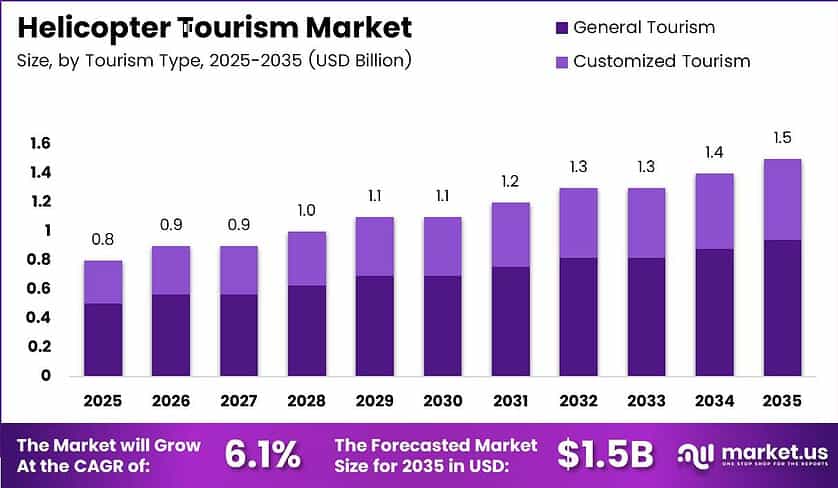
The global helicopter tourism market reaches USD 1.5 Billion by 2035 from USD 0.8 Billion in 2025. Industry revenue expands at a 6.1% CAGR during the 2026 to 2035 forecast period. Rising experiential travel spending and regional helipad investments boost sightseeing passenger traffic. Consequently, commercial rotorcraft operators expand quiet turbine cabin capacity.
Rotary-wing air tours deliver commercial sightseeing flights, glacier landings, luxury resort transfers, and high-altitude pilgrimage shuttles over landmarks. Moreover, leisure vacationers, VIP charter guests, and religious travelers book these aerial excursions daily. Fleet operators monetize short block hours through tiered seating, generating higher revenue per seat mile than regional airlines.
Hospitality resorts, ocean cruise lines, national parks, and religious shrine boards drive global passenger bookings. Additionally, cruise operators bundle coastal shore flights while mountain shrines contract seasonal pilgrim shuttles. Online experience marketplaces also connect local heliports with mobile travelers to fill off-peak seats without heavy direct marketing costs.
Get further insight into the global trends shaping the future of the helicopter tourism industry. Request Sample
Key Takeaways
- The global Helicopter Tourism Market stood at USD 0.8 Billion in 2025.
- Global market revenue reaches USD 1.5 Billion by 2035.
- Industry sales expand at a 6.1% CAGR from 2026 to 2035.
- General Tourism led the Tourism Type segment with a 62.78% market share in 2025.
- Joint Ownership Agreements captured the top Ownership Type share at 43.21% in 2025.
- North America dominated regional revenue in 2025 with a 43.11% share worth USD 0.344 Billion.
- The 10-year forecast runs from 2026 to 2035, with Asia-Pacific recording the fastest regional growth.
Market Segmentation Overview
General Tourism dominated the Tourism Type segment with a 62.78% market share in 2025. Standardized fixed-loop scenic routes maximize daily aircraft turns across domestic vacationers, supported by Blue Hawaiian’s June 2026 network of 20 plus helicopters across 30 hotel desks. Meanwhile, Customized Tourism grows fastest through private glacier landings and doors-off photography charters.
Moreover, Joint Ownership Agreements led the Ownership Type segment with a 43.21% share in 2025. Co-ownership structures split turbine hull purchases, hangar leases, and insurance expenses across multiple commercial partners alongside Fractional Ownership programs like Flexjet’s USD 7 billion aircraft order. However, Charter Service expands fastest as asset-light platforms match leisure groups with third-party operators.
Drivers
Affluent households shift vacation budgets toward premium aerial experiences, lifting scenic fares to USD 600 per seat and private charters to USD 4,000 hourly. Peak load factors reaching 85% let operators raise ticket yields up to 7% yearly while boosting ancillary window and sunset upgrades to 25%. Consequently, per-flight EBITDA margins widen by 5 percentage points.
Moreover, surging religious pilgrimage shuttles and seamless online travel agency bookings expand seat utilization across mountain and island corridors. Viator’s Experiences marketplace generated USD 924 million in 2025 revenue across 425,000 bookable products by connecting mobile tourists with local heliports. Therefore, regional fleet owners fill shoulder-season departures and fund quieter turbine airframe upgrades.
Use Cases
Coastal and canyon sightseeing operators run high-frequency scenic loops from gateway terminals near Las Vegas, the Grand Canyon, Hawaii, and Santa Monica. Maverick Helicopters flies over 250,000 guests yearly across 49 turbine aircraft by pairing 30-minute Hollywood flights with island transfers. Consequently, standardized airframes cut spare-parts inventory costs and secure noise-sensitive park permits.
Additionally, high-altitude shuttle operators transport religious pilgrims and adventure travelers across rugged Himalayan valleys and alpine ski peaks. FAA records show dedicated US tour rotorcraft logged 202,280 sightseeing and Part 135 hours in 2024, proving high airframe durability on steep shuttle circuits. Therefore, multi-base operators spread fixed turbine overhaul reserves across thousands of seasonal passenger tickets.
Major Challenges
High-profile fatal accidents trigger sudden regulatory groundings and peak-season corridor closures, including the April 2025 Hudson River and June 2025 Kedarnath crashes. A 30-day suspension erases up to 20% of annual sales while hull insurance renewals jump 35%. Consequently, stricter weather rules cut daily sorties by 25% and force small single-base operators into fleet consolidation.
However, severe commercial helicopter pilot shortages cap peak-season flight capacity as military aviators retire and airlines recruit rotorcraft crews. Qualifying a tour pilot costs up to USD 120,000 over 30 months, pushing annual staff turnover to 30% and raising starting wages 25% since 2023. Therefore, tour companies leave up to 10% of peak aircraft uncrewed despite full tourist demand.
Business Opportunities
Tour operators can deploy certified electric vertical takeoff aircraft following FAA powered-lift rules to reopen noise-restricted city and park skylines. Electric cabins generate 45 to 65 dB versus 90 dB for conventional turbines while slashing per-seat operating costs up to 50%. Consequently, early vertiport adopters can cut ticket fares 35% and expand contribution margins by 12 percentage points.
Moreover, regional fleet owners can expand pilgrimage shuttles and island resort transfers across Himalayan circuits and Gulf luxury developments. Joby Aviation and Dubai RTA confirmed 3 tourist vertiports in November 2025, while Pawan Hans ordered 10 civil Dhruv NG helicopters exceeding INR 1,800 crore in January 2026. Therefore, early operators lock in multi-year hospitality and shrine contracts.
Get further insight into the global trends shaping the future of the helicopter tourism industry. Request Sample
Regional Analysis
North America dominated the global market in 2025 with a 43.11% share valued at USD 0.344 Billion. High-volume scenic corridors across Nevada, Arizona, Hawaii, and Alaska pair with USD 328.79 million in US light helicopter imports across 248 units during 2024. Consequently, continuous quiet-cabin fleet renewals protect national park operating permits and year-round seat utilization.
Meanwhile, Asia-Pacific emerges as the fastest-growing regional market from 2026 to 2035 across India, Nepal, and Southeast Asia. IATA reports Asia-Pacific airlines held a leading 34.5% global traffic share in 2025 with an 84.2% load factor, feeding crowded mountain and island gateways. Therefore, rising middle-class incomes and government helipad grants propel short-haul rotary shuttle expansion.
Recent Developments
- November 2026 — Eve Air Mobility and FlyBIS Aviation signed a deal for up to 12 four-passenger eVTOL aircraft including 2 firm orders for Brazilian tourist routes.
- July 2026 — The Helicopter Company and Leonardo ordered 11 additional AW139 helicopters under a 130-aircraft framework to expand Saudi tourism and VIP transport.
- July 2026 — Bell Textron Inc. delivered its 700th Bell 505 helicopter at Farnborough as the global fleet surpassed 390,000 flight hours across 55 countries.
- July 2026 — Eve Air Mobility, Moov, and Shearwater Global Capital signed agreements for up to 46 eVTOL aircraft including 30 Cabo Verde tourism units.
- March 2026 — Ministry of Civil Aviation India approved INR 28,840 crore under Modified UDAN including INR 3,661 crore for 200 helipads and INR 400 crore for 4 aircraft.
- February 2026 — Tata Advanced Systems and Airbus Helicopters inaugurated an INR 1,000 crore H125 assembly line on 7.4 lakh square feet building 10 units yearly.
- January 2026 — Hindustan Aeronautics Limited and Pawan Hans signed an agreement exceeding INR 1,800 crore for 10 civil Dhruv NG helicopters by 2027.
- November 2025 — Ostnes Helicopters and Airbus signed a contract for 10 additional H125 helicopters, lifting 2025 Nordic distributor bookings to 14 aircraft.
- November 2025 — Falcon Aviation Services and AutoFlight ordered 50 eVTOL aircraft comprising 35 passenger and 15 cargo units alongside its 19 helicopters.
Conclusion
Global aerial sightseeing and charter tourism expand steadily as affluent vacationers prioritize bucket-list scenic flights, glacier landings, and fast resort transfers. Tiered cabin upgrades, online experience aggregators, and government helipad subsidies lift seat yields across coastal, canyon, and mountain corridors. Consequently, commercial fleet owners invest heavily in quieter next-generation rotorcraft.
Moreover, standardized fixed-loop sightseeing tours and capital-sharing joint ownership agreements anchor current global revenue streams. Private customized charters and asset-light digital booking platforms generate rapid new passenger volume across luxury hubs. Meanwhile, North America leads global performance at USD 0.344 Billion while Himalayan and island shuttles propel rapid Asia-Pacific growth.
Therefore, tour operators must fund simulator-backed pilot academies, hedge Jet A-1 fuel exposure, and secure early urban vertiport slots for electric airframes. Multi-base companies standardizing quiet turbine fleets will absorb safety compliance costs and protect park overflight permits. These strategic moves position aviation leaders to capture a market worth USD 1.5 Billion by 2035.
Looking for data tailored to your specific market, region, or business need? Request a custom report or consultation — write to us at sales@market.us
Discuss your needs with our analyst
Please share your requirements with more details so our analyst can check if they can solve your problem(s)