Market Overview
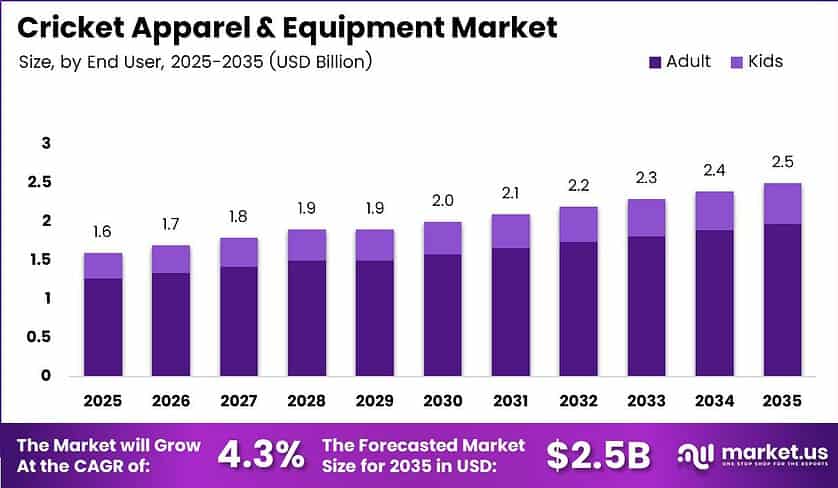
The global cricket apparel & equipment market reaches USD 2.5 Billion by 2035 from USD 1.6 Billion in 2025. Industry revenue expands at a 4.3% CAGR from 2026 to 2035. Expanding T20 franchise tournaments and youth training programs drive global demand. Consequently, sporting goods manufacturers scale seasonal hardware and jersey production.
Cricket gear includes engineered willow bats, stitched leather balls, impact-rated protective pads, breathable sportswear, spiked shoes, and kit bags. Moreover, commercial franchises, school teams, and amateur clubs use these items for match play and net training. Governing bodies and academies rely on certified equipment to protect athletes and sell supporter merchandise.
Professional T20 leagues, corporate wellness tournaments, pay-and-play indoor lanes, and grassroots youth camps drive steady equipment orders. Additionally, private franchise owners refresh replica teamwear annually while commercial turf centers restock bowling-machine balls every quarter. Olympic high-performance committees also procure specialized match kits across associate cricket nations ahead of 2028.
Data-Driven Insights for Smarter Business Decisions: Explore the Full Report
Key Takeaways
- The global Cricket Apparel & Equipment Market stood at USD 1.6 Billion in 2025.
- Global market revenue reaches USD 2.5 Billion by 2035.
- Industry sales expand at a 4.3% CAGR from 2026 to 2035.
- Cricket Bats led Product Type with a 36.43% share in 2025, while Protective Gear grows fastest.
- Adult captured a 78.21% End User share in 2025, whereas Kids registers the fastest expansion.
- Personal Use held an 83.11% User Category share in 2025, while Commercial Use grows fastest.
- Offline Channels accounted for 78.56% of Distribution Channel revenue in 2025, whereas Online Channels expand fastest.
- Asia-Pacific dominated with a 63.23% share worth USD 1.01 Billion in 2025, while North America grows fastest through 2035.
Market Segmentation Overview
Cricket Bats led the Product Type segment with a 36.43% market share in 2025. Aggressive T20 power hitting compresses willow fibers and cracks bat edges within 2 to 3 seasons, driving frequent replacements alongside Cricket Balls, Cricket Apparel, and Footwear. Meanwhile, Protective Gear grows fastest as boards mandate titanium-grille helmets against 140 km/h deliveries.
Moreover, Adult buyers dominated the End User segment at 78.21% revenue share in 2025. Corporate wellness leagues and municipal weekend T20 tournaments encourage salaried players to buy pro-grade English willow blades and spiked footwear. However, Kids represents the fastest-growing group because growth spurts require junior bat and pad replacements every 12 to 18 months.
Additionally, Personal Use captured an 83.11% User Category share in 2025. Individual cricketers purchase personal bats, gloves, guards, and helmets because grip balance, head sizing, and sweat hygiene prevent safe gear sharing. Consequently, Commercial Use expands fastest as urban indoor cricket lanes and turf academies sign quarterly restocking contracts for heavy-wear balls and mats.
Furthermore, Offline Channels held a dominant 78.56% Distribution Channel share in 2025. Players test physical bat pick-up balance and helmet grille visibility inside specialty stores, prompting Decathlon’s EUR 100 million expansion across 190 Indian outlets. Meanwhile, Online Channels grow fastest by delivering seasonal T20 replica jerseys nationwide within 48 hours during tournament windows.
Drivers
Global cricket has shifted rapidly from bilateral tours toward commercial T20 franchise leagues surpassing 80 squads worldwide. Annual team kit refreshes concentrate supporter buying into 8 to 10 week tournament windows and lift inventory turns by 15% to 20%. Consequently, apparel manufacturers adopt fast-turn digital fulfillment, capturing contribution margins up to 12 percentage points above wholesale retail.
Moreover, cricket’s inclusion in the Los Angeles 2028 Olympic Games unlocks new government funding across non-traditional sports markets. The tournament features 6 teams and 90 athlete quotas per gender across 28 T20 matches. Therefore, national Olympic committees award multi-year institutional kit and training equipment contracts across associate nations well ahead of opening ceremonies.
Use Cases
Urban pay-and-play indoor cricket centers and commercial coaching facilities deploy heavy-duty bowling-machine balls, synthetic turf mats, and shared rental pads. High daily player footfall wears down shared training gear every week across growing metropolitan fitness venues. Consequently, facility operators establish predictable quarterly B2B restocking agreements with durable commercial-grade equipment manufacturers.
Additionally, professional T20 franchises and governing bodies procure custom-sublimated teamwear tailored to men’s, women’s, and youth academy rosters. For instance, Castore donated GBP 150,000 in women’s and girls’ performance kits in July 2026 under its GBP 25 million ECB contract. Therefore, apparel suppliers running female-specific fabric lines secure lucrative multi-year institutional tenders.
Data-Driven Insights for Smarter Business Decisions: Explore the Full Report
Major Challenges
Illicit counterfeit apparel severely restricts official replica jersey revenue for licensed sportswear sponsors across South Asia and the Middle East. Unlicensed copies sell for INR 300 to INR 600 against INR 2,500 official kits, capturing up to 60% of peak Indian volume. Consequently, licensees clear 25% unsold stock at steep markdowns, cutting gross margins by 6 percentage points.
However, acute scarcity of English willow timber from Essex and Suffolk bottlenecks pro-grade cricket bat manufacturing. Willow trees require up to 20 years to mature, and under 40% of harvested clefts meet top grades, lifting prices 40% since 2023. Therefore, Indian and Pakistani assemblers face 20-week import delays that cap seasonal premium blade output.
Business Opportunities
Equipment makers can embed MEMS swing sensors into amateur and academy bat handles, where buyers purchase over 90% of cricket gear. Pairing a 15% to 25% hardware premium with an INR 199 to INR 499 monthly coaching app creates recurring digital income. Consequently, 20% software attach rates lift blended gross margins from 40% up to 55%.
Moreover, sporting goods brands can expand specialized turf footwear and leather ball distribution across new North American stadium complexes. American Cricket Enterprises surpassed USD 150 million in US investments by September 2025 and committed another USD 150 million for 10 venues by 2030. Therefore, permanent turf pitches create sustained demand for pro-grade spikes and sight-screen hardware.
Regional Analysis
Asia-Pacific dominated global revenue in 2025 with a 63.23% market share valued at USD 1.01 Billion. Massive playing populations in India, Australia, Pakistan, and Bangladesh combine with projected 6.9% South Asian GDP growth in 2026. Consequently, rising household incomes help amateur cricketers upgrade to branded protective gear across expanding tier-2 retail networks.
Meanwhile, North America ranks as the fastest-growing regional market from 2026 to 2035 across the United States and Canada. Expanding South Asian diaspora leagues, Major League Cricket franchises, and projected USD 5.6 trillion US core retail sales fuel athletic spending. Therefore, affluent suburban households purchase imported English willow bats and turf shoes through specialty distributors.
Recent Developments
- October 2026 — Sanspareils Greenlands launched Hardik Pandya’s BORN TO BE line featuring 333 Vibram-outsole shoes at INR 20,000 to INR 25,000 and apparel up to INR 12,000.
- October 2026 — Washington Freedom broke ground on Maryland’s privately funded USD 45 million, 10,000-seat Frederick Cricket Park across 24 acres.
- October 2026 — Agilitas Sports and One8 received NCLT merger approval, lifting Virat Kohli’s stake to 6.4% after an INR 40 crore investment targeting INR 3,000 crore revenue.
- September 2026 — Puma SE debuted 3 PUMA x RCB x Dhruv Kapoor jackets in Milan after INR 5,499 RCB authentic jerseys posted a 300% sales jump.
- July 2026 — Knight Riders Group opened a 5,000-seat stadium in Pomona, California for 7 MLC games ahead of a 20,000-seat expansion for LA28.
- June 2026 — Agilitas Sports raised INR 225 crore from Nexus Venture Partners and Rainmatter as subsidiary Mochiko Shoes hit INR 1,350 crore in fiscal 2026 revenue.
- April 2026 — Skechers renewed its Official Kit Partner deal with Mumbai Indians for a 3rd straight season, pricing fan jerseys at INR 699 to INR 999.
- January 2026 — Shrey Sports signed a 5-year agreement through 2030 with Cricket South Africa as Official Helmet and Luggage Partner for Proteas squads.
- November 2025 — Gray-Nicolls Sports Pty Ltd. released its 2026 Havoc and Imperia ranges with NEOCORE technology priced from GBP 36.99 to GBP 999.99.
- November 2025 — Gunn & Moore introduced BS7928-compliant Maestro helmets from GBP 51.95 and Nottingham-made L540 DXM English willow bats up to GBP 999.95.
- July 2025 — New Balance Athletics Inc. signed a 5-year deal with Cricket Australia to supply kits for 8 BBL and 8 WBBL clubs from 2025 to 2026.
Conclusion
Global cricket equipment and teamwear sales expand steadily as commercial T20 leagues, women’s tournaments, and Los Angeles 2028 Olympic preparations broaden participation. Annual franchise jersey drops and stricter impact-safety rules accelerate replacement cycles across amateur and professional tiers. Consequently, athletic brands gain predictable seasonal demand across hardware and fan merchandise.
Moreover, replacement willow bats, salaried adult players, personal kit bags, and physical specialty shops anchor current global revenue. Junior coaching academies, commercial indoor lanes, protective helmets, and direct online portals generate rapid new unit growth. Meanwhile, Asia-Pacific leads global sales at USD 1.01 Billion while North American stadium investments unlock premium export channels.
Therefore, manufacturers must secure multi-year willow timber contracts, launch sub-INR 1,000 fan jerseys against counterfeits, and embed smart swing sensors. Brands pairing authenticated direct-to-consumer fulfillment with female and junior fit ranges will protect operating margins. These strategic investments position market leaders to capture an industry worth USD 2.5 Billion by 2035.
Looking for data tailored to your specific market, region, or business need? Request a custom report or consultation — write to us at sales@market.us
Discuss your needs with our analyst
Please share your requirements with more details so our analyst can check if they can solve your problem(s)