Market Overview
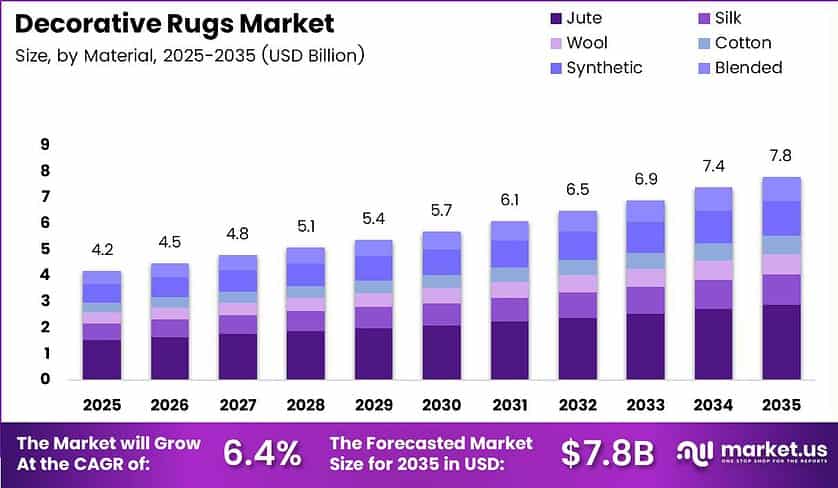
The global decorative rugs market reaches USD 7.8 Billion by 2035 from USD 4.2 Billion in 2025. Industry revenue expands at a 6.4% CAGR during the 2026 to 2035 forecast period. Home remodeling cycles and direct online sales drive steady floor textile demand. Consequently, weavers expand automated loom capacity and digital fulfillment.
Decorative floor textiles include woven, knotted, tufted, and printed coverings built for indoor and outdoor spaces. Moreover, homeowners, interior designers, corporate specifiers, and hotel operators install these pieces daily. Buyers use patterned floor mats to anchor furniture layouts, absorb room noise, insulate hard subfloors, and separate visual zones.
Residential homes, open-plan corporate offices, luxury retail stores, resorts, and cruise liners drive global purchasing. Additionally, homeowners place standard woven mats over hardwood planks while workplaces add acoustic lounge coverings. Hospitality properties also commission custom Axminster lobby carpets on strict 5 to 7 year refurbishment schedules.
Data-Driven Insights for Smarter Business Decisions: Explore the Full Report
Key Takeaways
- The global Decorative Rugs Market stood at USD 4.2 Billion in 2025.
- Market revenue reaches USD 7.8 Billion by 2035 across the 2026 to 2035 forecast window.
- Global sales expand at a 6.4% CAGR from 2026 to 2035.
- Area Rugs led Product Type in 2025 with a 33.67% share, while Outdoor Rugs grow fastest.
- Oriental and Persian led Style Type at 37.56% share in 2025, whereas Traditional styles expand fastest.
- Jute held the top Material share at 36.78% in 2025, while Silk grows fastest.
- Hand-Knotted led Manufacturing Process at 33.21% in 2025, while Power-Loomed / Machine-Made grows fastest.
- Residential captured 62.34% of End Use revenue in 2025, whereas Commercial buyers expand fastest.
- Offline stores held 65.78% of Distribution Channel sales in 2025, while Online platforms grow fastest.
- Asia-Pacific dominated in 2025 with a 38.34% share worth USD 1.60 Billion, while Middle East and Africa grows fastest.
Market Segmentation Overview
Area Rugs led the Product Type segment with a 33.67% market share in 2025. Homeowners installing hardwood and vinyl planks need room-sized coverings to quiet footsteps alongside Runner Rugs. Meanwhile, Outdoor Rugs grow fastest after a 56.07% Indian export surge in weather-resistant polypropylene patio mats.
Moreover, Oriental & Persian designs dominated Style Type at 37.56% share in 2025. Dense medallion motifs hide daily soil and retain collector resale value across luxury showrooms alongside Contemporary / Modern and Transitional patterns. However, Traditional styles expand fastest as young remodelers buy pre-washed classic European borders at mid-tier prices.
Additionally, Jute captured the largest Material share at 36.78% in 2025. Low-cost biodegradable bast fibers let big-box chains sell thick braided layers alongside Wool, Cotton, Synthetic, and Blended options. Consequently, Silk records the fastest material expansion as luxury galleries weave light-refracting filaments above 300 knots per square inch.
Furthermore, Hand-Knotted construction led Manufacturing Process with a 33.21% value share in 2025. Latex-free artisan tying commands multi-thousand-dollar retail tickets alongside Hand-Tufted, Hand-Woven / Flatweave, Machine-Tufted, and Printed lines. Meanwhile, Power-Loomed / Machine-Made production grows fastest as high-speed Wilton looms protect factory margins against rising weaver wages.
Similarly, Residential buyers held 62.34% of End Use revenue in 2025 while Offline stores captured 65.78% of Distribution Channel sales. Housing completions and showroom tactile checks sustain core demand alongside Hospitality projects. However, Commercial offices and Online parcel-shipped platforms register the fastest growth across their respective segments.
Data-Driven Insights for Smarter Business Decisions: Explore the Full Report
Drivers
Digital-first direct retail transforms floor covering distribution because rollable, flat-packed mats ship economically through standard parcel couriers. Online platforms captured up to 45% of US area-rug unit volume between 2024 and 2025 while cutting wholesale markups by 30%. Consequently, digital brands earn 55% to 65% gross margins and cut minimum order sizes by 40%.
Moreover, steady household remodeling cycles and washable performance yarns accelerate repeat purchases across hard-floored residences. US privately-owned housing completions hit an annualized 1,608,000 units in August 2025, triggering multi-room textile purchases across living and dining spaces. Therefore, brands launching stain-resistant indoor-outdoor collections capture higher unit turnover from families and young renters.
Use Cases
Corporate workplaces, retail boutiques, and healthcare clinics install heavy-duty decorative textiles to create warm resimercial interiors. US office construction spending reached an annualized USD 162.30 Billion in September 2026, fueling demand for open-concept acoustic zoning without drywall partitions. Consequently, mills supplying flame-retardant, stain-resistant commercial piles win recurring corporate refurbishment tenders.
Additionally, luxury resorts, wellness spas, and cruise ships commission bespoke wool and hand-tufted carpets for high-traffic lobbies and suites. UNWTO recorded 1.52 Billion international tourist arrivals in 2025, creating heavy luggage abrasion that forces 5 to 7 year hotel replacements. Therefore, specialized hospitality weavers secure predictable multi-property order pipelines.
Major Challenges
Steep United States import tariffs severely squeeze cross-border floor textile trade, especially across Indian weaving hubs shipping 60% of exports to America. Tariff hikes up to 50% in 2025 lifted retail prices by 35% and cut Bhadohi loom utilization by 40%. Consequently, Western importers freeze new catalog launches and shift orders toward Egypt and Turkiye.
However, aging rural artisan workforces across India, Nepal, and Anatolia shrink hand-knotted production capacity each year. Younger workers prefer urban jobs paying up to 40% higher daily wages, leaving over 50% of active weavers past age 40. Therefore, skilled weaver attrition raises annual labor costs up to 12% and stretches loom lead times by 10 weeks.
Data-Driven Insights for Smarter Business Decisions: Explore the Full Report
Business Opportunities
Manufacturers can scale recycled-PET and mono-material circular floor coverings, which currently form under 8% of decorative assortments. Replacing latex-and-jute backings with pure PET constructions cuts end-of-life recycling expenses by 25% to 35% ahead of European eco-design penalties. Consequently, certified circular lines command 30% retail premiums and lift gross margins by 500 basis points.
Moreover, specialty brands can pair compact urban swatch studios with custom made-to-order digital configurators. Interior designers inspect physical fiber sheen inside small metro galleries before placing direct mill drop-ship orders online. Therefore, omnichannel operators cut expensive full-inventory store leases while slashing e-commerce color-mismatch return rates below 8%.
Regional Analysis
Asia-Pacific dominated the global market in 2025 with a 38.34% revenue share valued at USD 1.60 Billion. Unmatched Indian artisan clusters and Chinese mechanized looms combine with 4.8% Chinese GDP growth and rapid urban apartment handovers. Consequently, regional mills capture dual revenue streams across middle-class domestic housing and Western wholesale exports.
Meanwhile, Middle East & Africa emerges as the fastest-growing region through 2035 as regional GDP growth accelerates to 3.3% in 2026. Gulf Cooperation Council tourism megaprojects, airport expansions, and luxury villas commission bespoke Persian and Anatolian hospitality carpets. Therefore, global luxury houses expand Dubai and Riyadh showrooms to secure high-margin commercial contracts.
Recent Developments
- October 2026 — Capel Rugs launched 5 hand-knotted 100% wool collections and 2 domestic flat-braided lines priced under USD 1,699 for 5×8 sizes.
- October 2026 — Lavin Rugs opened a remodeled 5,500 square foot High Point IHFC showroom and introduced 54 new area rug designs.
- October 2026 — Interface, Inc. unveiled its Twist and Texture modular collection featuring 7 woven-inspired styles across 18 colorways on a 3 week QuickShip schedule.
- April 2026 — Nourison Home rolled out 14 new area rug collections across Nourison Home, Reserve, and licensed DKNY Pure labels at High Point Market.
- April 2026 — Harounian Rugs International debuted 6 programmed area rug collections with 3 to 4 colorways per line at Showroom D431.
- March 2026 — STARK Carpet announced a new luxury rug and custom broadloom trade showroom in Charleston building on over 85 years of bespoke operations.
- January 2026 — Ernesta opened 3 retail showrooms including a 1,250 square foot Michigan store and a 1,256 square foot Dallas space targeting 10 plus locations.
- December 2025 — Ruggable partnered with Anthropologie Home to launch 7 washable tufted area rugs starting at USD 139 alongside 3 doormats.
- November 2025 — STARK Carpet acquired New York bespoke hand-knotted silk atelier Fort Street Studio to distribute artisanal silk pieces across over 25 domestic showrooms.
Conclusion
Global decorative floor covering demand expands steadily as hard-surface flooring installations, urban apartment handovers, and direct e-commerce channels reshape interior decorating. Washable outdoor synthetics, corporate acoustic zoning, and hotel refurbishment schedules sustain year-round mill orders. Consequently, automated looms and digital configurators capture growing industry investment.
Moreover, room-sized area mats, Oriental patterns, natural jute fibers, hand-knotted heirlooms, residential homes, and physical showrooms anchor current revenue. Outdoor polypropylene piles, silk blends, machine-woven lines, commercial offices, and parcel-shipped web portals drive rapid new growth. Meanwhile, Asia-Pacific leads at USD 1.60 Billion while Gulf megaprojects propel Middle East expansion.
Therefore, textile manufacturers must automate power-loomed production, diversify tariff-exposed sourcing hubs, and retool backings for mono-material PET recycling. Brands pairing compact swatch studios with augmented-reality room visualizers will protect retail margins against shipping delays and weaver shortages. These strategic moves position suppliers to capture a global market worth USD 7.8 Billion by 2035.
Looking for data tailored to your specific market, region, or business need? Request a custom report or consultation — write to us at sales@market.us
Discuss your needs with our analyst
Please share your requirements with more details so our analyst can check if they can solve your problem(s)