Market Overview
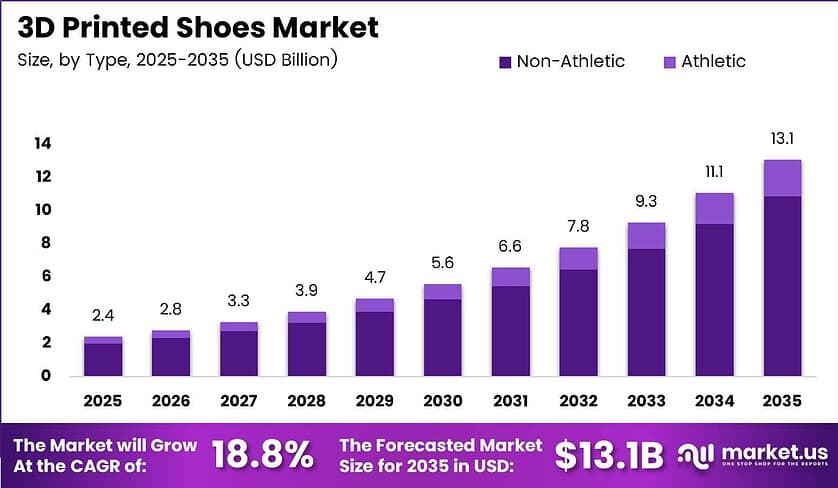
The global 3D printed shoes market reached USD 2.4 billion in 2025. Analysts expect it to hit USD 13.1 billion by 2035, growing at an 18.8% CAGR from 2026 to 2035. Digital manufacturing helps brands cut waste and respond faster to demand.
These shoes use light-based printing, laser sintering, or polymer extrusion to build lattice midsoles and single-piece footwear from digital files. Fashion brands, sports labels, and podiatry clinics use them. Consequently, companies avoid costly molds and reduce unsold inventory.
Design protection supports this shift. WIPO reports industrial design filings rose 2.6% to 1.22 million applications in 2024. Footwear brands can now protect digital shoe files. Therefore, investors can monetize shoe geometries safely while blocking unauthorized copying.
Venture capital also backs domestic print farms. Zellerfeld raised USD 30 million in June 2026 and runs 1,700 printers in Austin. Its capacity nears 1 million pairs yearly. This scale shows printed shoes can now serve mainstream brand launches.
Data-Driven Insights for Smarter Business Decisions: Explore the Full Report
Key Takeaways
- USD 2.4 billion in 2025, rising to USD 13.1 billion by 2035.
- Growth runs at an 18.8% CAGR from 2026 to 2035.
- Non-Athletic footwear leads with 82.34%; Athletic grows fastest.
- Women hold 62.13%; Men grow fastest.
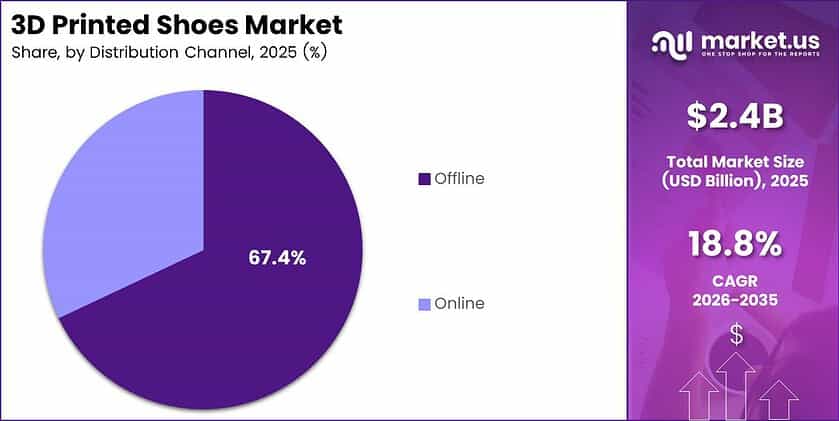
- Offline stores hold 67.45%; Online grows fastest.
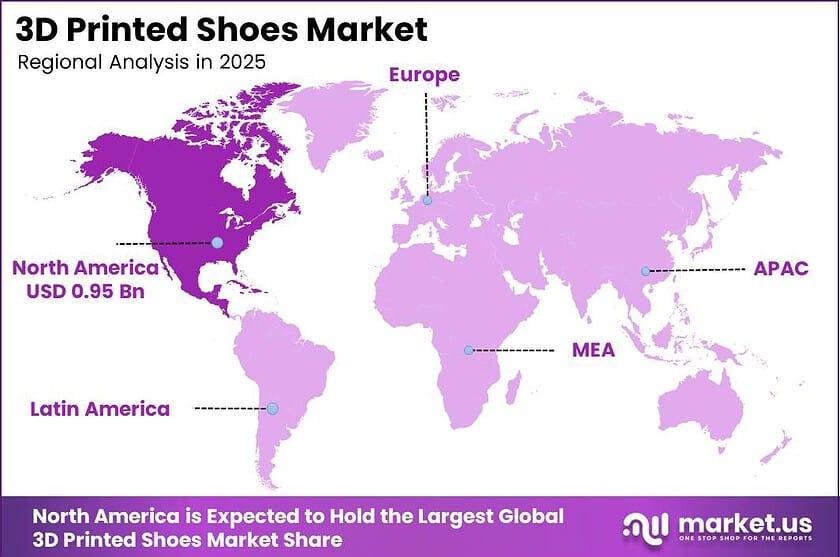
- North America leads with 39.78%, worth USD 0.95 billion; Asia-Pacific grows fastest.
Market Segmentation Overview
Non-Athletic footwear leads types with an 82.34% share. Single-piece printing replaces 60-part stitching and steel molds for casual styles. Consequently, fashion labels earn higher margins without holding seasonal stock. Meanwhile, Athletic shoes grow fastest through tuned energy-return midsoles for runners.
Moreover, women hold 62.13% of end users because they buy seasonal styles often. Small-batch printing lets labels test heel designs without risking unsold stock. However, men grow fastest as sneaker collectors embrace lattice midsoles that resist compression.
Additionally, offline stores generate 67.45% of revenue because shoppers want to try unfamiliar lattice midsoles. In-store foot scans reduce sizing returns. Meanwhile, online sales expand fastest as smartphone scans turn phones into convenient home fitting rooms.
Drivers
Single-material on-demand printing drives growth strongly. Brands replace cut-and-sew assembly and skip steel molds worth USD 60,000 to USD 120,000 per style. Adidas, Nike, and Zellerfeld launched printed lines in 2025. Consequently, concept-to-shelf time falls from 15 months to 3 weeks.
Moreover, EU rules ban large companies from destroying unsold footwear from 19 July 2026. On-demand printing avoids unsold stock altogether. Pre-consumer scrap falls by 65% to 80%. Therefore, brands lift gross margins by 800 to 1,200 basis points.
Data-Driven Insights for Smarter Business Decisions: Explore the Full Report
Use Cases
Fashion brands print casual loafers, sandals, and mules on demand. HUGO and Zellerfeld launched scan-to-order loafers at USD 229 to USD 249 in July 2025. Customers pay premium prices for custom fits. Therefore, labels capture higher margins without markdown stock.
Additionally, podiatry clinics print custom orthotics from gait scans. Materialise reported medical revenue rose 15.4% to EUR 134.2 million in 2025. Printers create arch zones that plaster casting cannot match. Consequently, clinics and contract printers earn recurring consumable revenue.
Major Challenges
High material costs hold back mass adoption. Printing elastomers cost USD 45 to USD 110 per kilogram, versus USD 1.50 to USD 4.00 for standard plastics. Ex-factory costs reach USD 38 to USD 65 per pair. Therefore, brands cannot serve the sub-USD 100 tier.
However, manual finishing slows output. Post-processing takes 35% to 50% of production time and adds USD 4.50 to USD 8.20 per pair. Scrap reaches 4% to 7%. Consequently, plants must redirect 20% to 30% of automation capital to robotic wash cells.
Business Opportunities
Circular subscriptions offer major potential. Brands can reclaim worn pairs and reprint new styles for USD 18 to USD 28 monthly. Closed-loop programs cut virgin polymer spending by 55% to 70%. This model could add 3.6 percentage points to growth.
Additionally, in-clinic micro-factories bring printing to podiatry offices. This opportunity could add 2.3 percentage points to growth across North America and Asia-Pacific. Meanwhile, EU Digital Product Passport rules begin in 2027. Therefore, brands with traceable, recyclable shoes gain a compliance edge.
Regional Analysis
North America leads with a 39.78% share, worth USD 0.95 billion in 2025. U.S. footwear imports reached USD 27.19 billion, so brands seek onshore speed. Strong e-commerce lets labels sell scan-to-order drops directly to shoppers. Consequently, domestic print farms replace ocean-freighted stock.
However, Asia-Pacific grows fastest through 2035. The ILO says the region’s garment and footwear sector employs 65 million workers. Legacy factories now automate. Therefore, Asian contract manufacturers install industrial laser sintering lines to defend export accounts against Western reshoring.
Key Players Analysis
Leading companies compete through printer partnerships, scale, and direct digital sales. Adidas earned EUR 24,811 million in 2025 net sales. Nike generated USD 46,309 million revenue in fiscal 2025. Both turn printed concepts into global retail franchises.
- Adidas AG
- Nike, Inc.
- New Balance Athletics, Inc.
- Under Armour, Inc.
- ECCO Sko A/S
- ASICS Corporation
- Puma SE
- Reebok International Limited
- Hoka One One
- Carbon, Inc.
- Materialise NV
- Stratasys Ltd.
- 3D Systems Corporation
- Other Key Players
Recent Developments
- November 2026 — Stratasys launched the SAF H550 powder-bed printer.
- November 2026 — 3D Systems released its MJP 300 printer at Formnext.
- November 2026 — Adidas launched printed soccer boots at USD 300.
- November 2026 — Materialise expanded Phits Dynaprint orthotic capacity.
- November 2026 — Carbon and Arkema expanded their elastomer resin partnership.
- November 2026 — Drifbolt launched 3 bio-TPU printed shoe collections in India.
- October 2026 — Havaianas and Zellerfeld launched the USD 119 Top Toe Mule.
- July 2025 — TPM3D introduced a laser sintering footwear system cutting cycles to 25 minutes.
- April 2025 — PUMA and A$AP Rocky commercialized the USD 250 Mostro 3.D.
Conclusion
The 3D printed shoes market grows rapidly through 2035. On-demand production, waste regulation, and digital design protection drive adoption. Brands gain speed, lower inventory risk, and higher margins. Consequently, additive footwear shifts from novelty drops to mainstream retail.
Therefore, companies must automate finishing, secure resin supply, and build circular programs. Non-Athletic styles and North America lead today, while Asia-Pacific accelerates. Firms that act early and invest wisely can capture a market worth USD 13.1 billion by 2035.
Looking for data tailored to your specific market, region, or business need? Request a custom report or consultation — write to us at sales@market.us
Discuss your needs with our analyst
Please share your requirements with more details so our analyst can check if they can solve your problem(s)