Market Overview
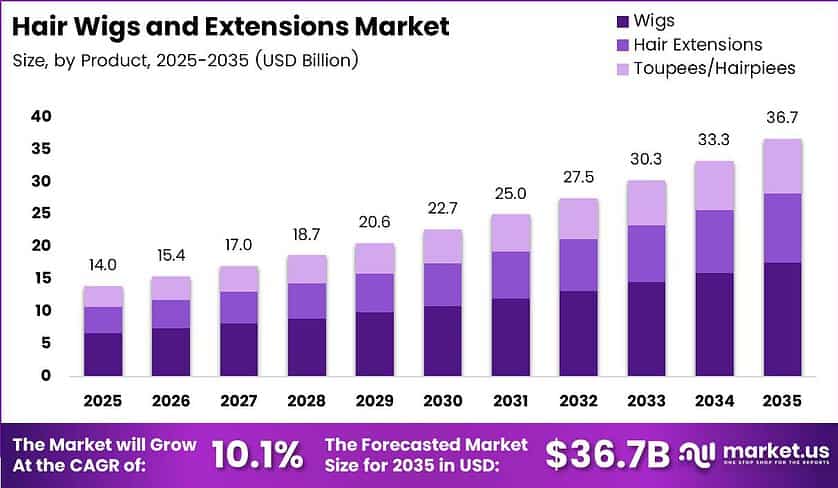
The global hair wigs and extensions market reached USD 14.0 billion in 2025. Analysts expect it to hit USD 36.7 billion by 2035, growing at a 10.1% CAGR from 2026 to 2035. Hair loss solutions and fashion styling both fuel this rapid growth.
Wigs and extensions use human hair or synthetic fibers to hide hair loss, add volume, and change styles without chemical damage. Salons, oncology clinics, and social commerce stores sell them. Consequently, brands earn recurring margins across retail and clinical channels.
Supply chains lean heavily on East Asia. UN Comtrade shows China exported USD 5.41 billion in wigs and hairpieces in 2023, or 52% of its Chapter 67 exports. This concentration creates sourcing risk. Therefore, distributors diversify assembly across South Asian hubs.
Safety rules add transparency. The FDA recorded 16,398 cosmetic facilities and 1,298,361 product listings by June 30, 2026. Higher traceability forces adhesive and fiber makers to verify safety early. Consequently, compliant manufacturers win shelf space from gray-market importers.
Data-Driven Insights for Smarter Business Decisions: Explore the Full Report
Key Takeaways
- USD 14.0 billion in 2025, rising to USD 36.7 billion by 2035.
- Growth runs at a 10.1% CAGR from 2026 to 2035.
- Wigs lead with 47.67%; hair extensions grow fastest.
- Mid-range products hold 43.45%; Premium grows fastest.
- Female consumers hold 83.23%; the male segment grows fastest.
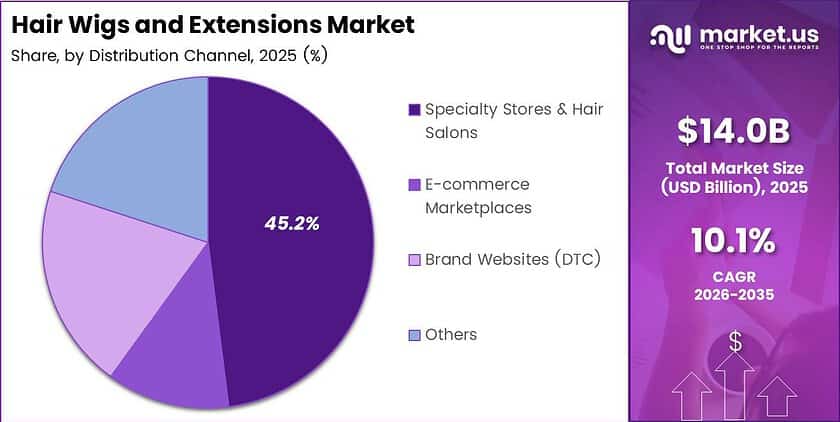
- Specialty stores and salons hold 45.2%; e-commerce grows fastest.
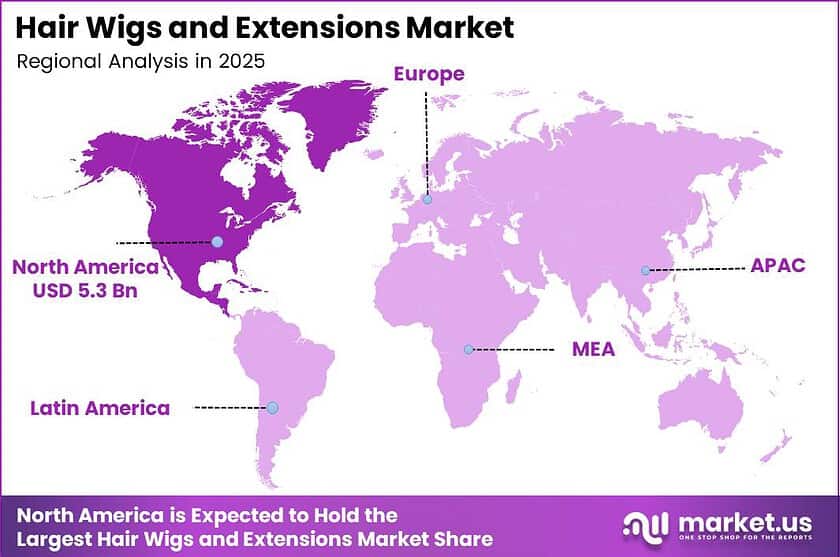
- North America leads with 38.56%, worth USD 5.3 billion; Middle East and Africa grows fastest.
Market Segmentation Overview
Wigs lead products with a 47.67% share. Chemotherapy causes full scalp hair loss, so patients need full-cap cranial prostheses. WHO data shows 20.6 million new cancer cases in 2024. Consequently, medical wig makers partnering with insurers secure stable revenue, while extensions grow fastest.
Moreover, mid-range items hold 43.45% of price tiers because human-hair blends offer accessible value. Female consumers hold 83.23% because they style and protect hair often. However, Premium and male buyers grow fastest as stigma around hair loss fades.
Additionally, specialty stores and salons hold 45.2% of distribution because extensions need professional fitting and color matching. L’Oreal’s salon channel grew 7.5% in 2025. Meanwhile, e-commerce marketplaces expand fastest through verified reviews and next-day fulfillment.
Drivers
Live-video social commerce drives growth most strongly. Active beauty storefronts nearly doubled from 29,000 to 56,000 across 2024 and 2025. Factories skipped 2 to 3 distributor layers. Consequently, customer acquisition costs fell 22% to 35%, and this driver adds 2.9 percentage points.
Moreover, rising alopecia and cancer cases lift clinical demand. Androgenetic alopecia affects about 30 million U.S. women and 50 million U.S. men. Sufferers seek toppers, lace wigs, and hair systems. Therefore, clinical demand adds 2.3 percentage points to growth.
Use Cases
Oncology and alopecia patients use medical wigs for full scalp coverage. Breathable cranial prostheses replace hair lost to treatment. Therefore, suppliers of silicone vacuum caps and hypoallergenic wigs earn recurring, non-cyclical revenue from clinics.
Additionally, fashion consumers use extensions for instant length and density. Clip-in and tape-in styles avoid chemical damage and long salon waits. India exported USD 763.4 million in human hair in 2024. Consequently, brands with direct hair sourcing protect margins.
Major Challenges
Safety scrutiny pressures synthetic fiber brands. Lab tests found lead above limits in 90% to 96.7% of 40 extension samples. Testing adds USD 0.45 to USD 1.15 per pack. Consequently, launches slip by 6 to 10 weeks.
However, trade barriers also hurt. India banned raw hair exports below USD 65 per kilogram from February 10, 2025. Tariffs of 10% to 50% raised bundle costs by 28% to 42%. Therefore, converter margins fell by 450 to 700 basis points.
Data-Driven Insights for Smarter Business Decisions: Explore the Full Report
Business Opportunities
Plant-based biopolymer fibers offer open white space. Bio-based filaments make up under 1.5% of extension volume today. They biodegrade in 3 to 6 months and command 35% to 60% price premiums. This opportunity adds 2.4 percentage points to growth.
Additionally, direct-billed cranial prosthesis networks serve patients through insurers. This opportunity adds 2.0 percentage points in the United States and Western Europe. Consequently, brands combining clinical access with automation can build durable advantages.
Regional Analysis
North America leads with a 38.56% share, worth USD 5.3 billion in 2025. Protective styling traditions, oncology coverage, and social commerce support demand. Consequently, manufacturers prioritize U.S. fulfillment hubs for faster delivery.
However, Middle East and Africa grows fastest. The IMF expects Sub-Saharan GDP growth of 4.5% in 2026 and 2027. Young urban buyers in Nigeria, South Africa, Kenya, and the Gulf shift from basic braids to branded human-hair blends. Therefore, Asian exporters build regional assembly plants.
Key Players Analysis
Leading companies compete through vertical integration and new Asian capacity. Aderans earned JPY 79,359 million in fiscal 2026 sales. Evergreen Products produces 98.3% of its turnover in Bangladesh. This shield protects North American shipments from Chinese tariffs.
- Aderans Co., Ltd.
- Evergreen Products Group Ltd.
- Great Lengths S.p.A.
- Rebecca Hair Products Co., Ltd.
- Artnature Co., Ltd.
- HairUWear Inc.
- Luxy Hair Co.
- Indique Hair
- Mayvenn Inc.
- Hairdreams Haarhandels GmbH
- So.Cap USA
- Donna Bella Hair
- Other Key Players
Recent Developments
- November 2026 — Taekwang approved KRW 150 billion for modacrylic wig fiber capacity.
- August 2026 — HairClub debuted DNA-driven hair restoration.
- June 2026 — HairUWear introduced the Wavy Invisible Extension.
- April 2026 — BELLAMI unveiled its Halo PRO extension kit.
- December 2025 — Artnature began wig production in Bangladesh.
- November 2025 — UNice donated 100 wigs.
- June 2025 — Rebundle won a patent for biodegradable braiding hair.
- June 2025 — Ecotrade leased a UK distribution hub.
- June 2025 — Aderans introduced cooling hairpieces.
- December 2024 — DBAG acquired a majority stake in Great Lengths.
- December 2024 — UNice opened a Manhattan luxury salon.
Conclusion
The hair wigs and extensions market grows rapidly through 2035. Social commerce, rising alopecia cases, and fashion demand drive expansion. Trade barriers and safety rules raise costs but reward compliant suppliers. Consequently, the industry offers strong opportunities across retail and clinical channels.
Therefore, companies must diversify sourcing, test materials, and invest in bio-based fibers. Wigs, mid-range products, female buyers, and North America lead today. Firms that act early can capture a market worth USD 36.7 billion by 2035.
Looking for data tailored to your specific market, region, or business need? Request a custom report or consultation — write to us at sales@market.us
Discuss your needs with our analyst
Please share your requirements with more details so our analyst can check if they can solve your problem(s)