Market Overview
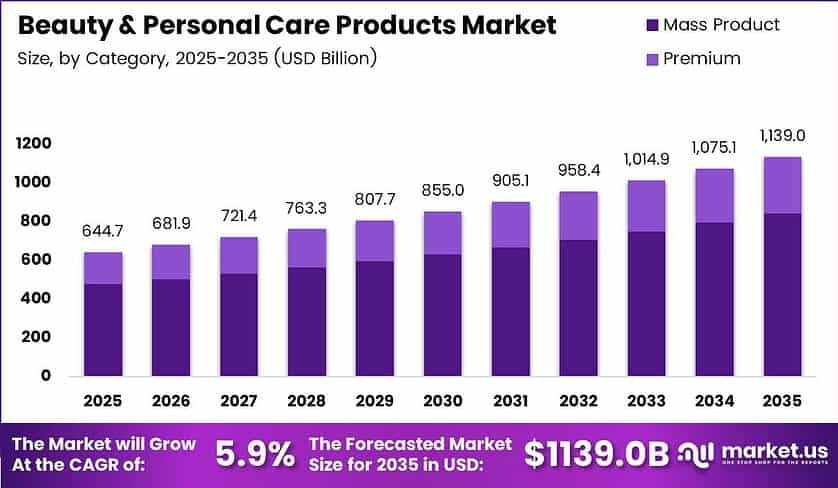
The global beauty and personal care products market reached USD 644.7 billion in 2025. Analysts expect it to climb to USD 1,139.0 billion by 2035, growing at a 5.9% CAGR from 2026 to 2035. Daily replenishment habits keep manufacturer cash flows steady.
These products cover skin, hair, oral, hygiene, fragrance, and color items that cleanse, protect, and enhance appearance. Grocers, pharmacies, dermatology clinics, salons, and online marketplaces sell them. Consequently, brands reach shoppers through many channels.
The industry carries real economic weight. The Personal Care Products Council reports the U.S. industry generated USD 495.6 billion in output and supported 2.6 million jobs. Deep links to chemicals, packaging, and retail make this sector resilient. Therefore, investors value its defensive cash flows.
Safety rules also shape the market. The FDA lists 16,398 active cosmetic facilities and 1,298,361 product listings by June 2026. Renewals and adverse event tracking raise compliance costs for small labels. Consequently, scale manufacturers with toxicology teams win shelf space.
Data-Driven Insights for Smarter Business Decisions: Explore the Full Report
Key Takeaways
- USD 644.7 billion in 2025, rising to USD 1,139.0 billion by 2035.
- Growth runs at a 5.9% CAGR from 2026 to 2035.
- Personal Care Products lead with 41.23%; Cosmetics and Makeup grow fastest.
- Mass products hold 73.45%; Premium grows fastest.
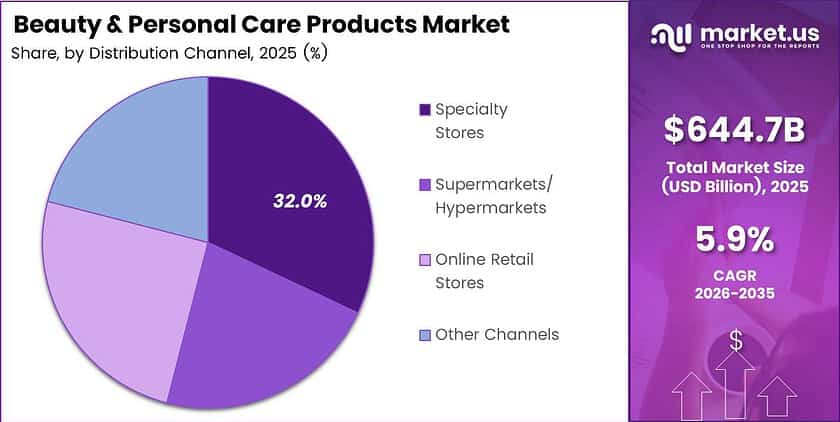
- Specialty Stores hold 32.00%; Online Retail grows fastest.
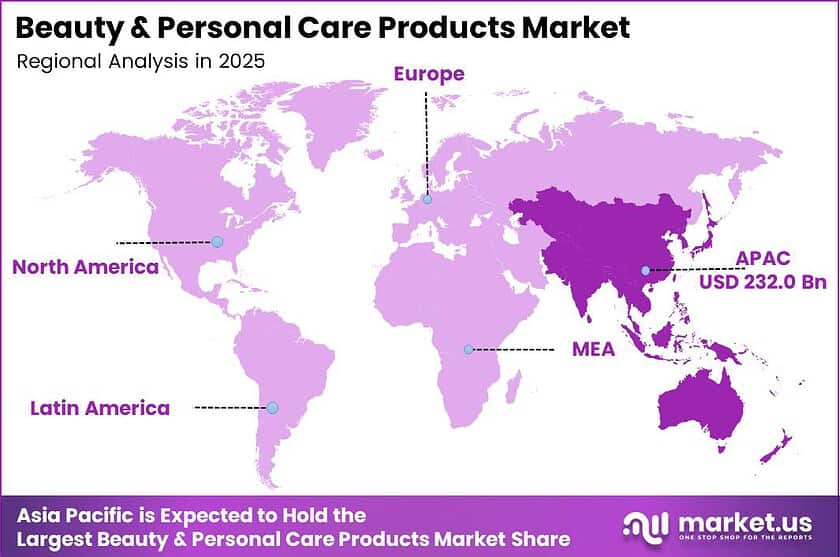
- Asia-Pacific leads with 36.06%, worth USD 232.0 billion, and grows fastest.
Market Segmentation Overview
Personal Care Products lead with a 41.23% share. Households replace shampoo, toothpaste, and soap constantly, which secures steady factory use. Colgate-Palmolive reported USD 20,382 million in 2025 sales, and oral care made up 44%. Meanwhile, Cosmetics and Makeup grow fastest.
Moreover, mass products hold 73.45% of category sales because affordable prices reach broad households. However, Premium grows fastest as informed shoppers trade up to dermatologist-backed serums and scents.
Additionally, Specialty Stores hold 32.00% of distribution because shoppers want shade matching and skin diagnostics. Meanwhile, Online Retail grows fastest, as U.S. e-commerce hit USD 340.2 billion in Q2 2026.
Drivers
Clinical dermocosmetics drive demand strongly. Shoppers moved toward dermatologist-backed skincare between 2024 and 2026. Proven barrier-repair products command 25% to 40% price premiums. Consequently, repeat purchases rise by 18% to 22%, and this driver adds 1.6 percentage points to growth.
Moreover, social commerce lifts sales in Asia-Pacific and North America. Shoppable videos shorten the path from discovery to purchase. Dense Asian contract manufacturers also speed product launches. Therefore, brands localize research hubs across Asia, and this driver adds 1.2 percentage points.
Use Cases
Households rely on personal care products for daily hygiene. Toothpaste, shampoo, and soap need constant replacement. P&G Beauty net sales rose 7.1% to USD 16,023 million in fiscal 2026. Consequently, suppliers enjoy predictable baseline demand throughout economic cycles.
Additionally, hybrid makeup blends color with skincare benefits. Foundations now include peptides and ceramides for coverage plus hydration. European decorative cosmetics reached EUR 13.6 billion in 2025 retail sales. Therefore, brands that add skincare actives command higher prices and stronger loyalty.
Data-Driven Insights for Smarter Business Decisions: Explore the Full Report
Major Challenges
Chemical bans force costly reformulation. Europe prohibits 22 toxic substances and restricts cyclic siloxanes after June 2026. Retesting takes 14 to 22 months per product. Consequently, producers delay capacity expansions by 4 to 6 quarters.
However, packaging rules add pressure. Recycled cosmetic resins cost 28% to 45% more than virgin plastic. Retooling costs USD 1.2 million to USD 3.5 million per line. Therefore, smaller brands struggle to comply, and this challenge drags growth by 0.9 percentage points.
Business Opportunities
Precision fermentation offers strong potential. Fewer than 8% of mass and masstige formulas use bioengineered actives today. Large bioreactors cut active production costs by 40% to 65%. This opportunity adds 1.3 percentage points to growth and shields brands from harvest swings.
Additionally, companion skincare for GLP-1 users serves a new customer group in North America and Europe. This opportunity adds 1.1 percentage points to growth. Consequently, brands launching targeted care early can capture fresh demand.
Regional Analysis
Asia-Pacific leads with a 36.06% share, worth USD 232.0 billion in 2025. China hosts 4,260 registered cosmetic factories, South Korea 617, and India 309. Dense manufacturing shortens formulation cycles. Consequently, multinational brands localize research and launches across Asian cities.
Meanwhile, North America keeps high per-capita beauty spending through clinical skincare and specialty retail. U.S. cosmetic exports reached USD 15.8 billion in 2025. Therefore, manufacturers investing in automated U.S. production lines protect margins against freight volatility.
Key Players Analysis
Leading companies compete through acquisitions, technology hubs, and portfolio focus. L’Oreal reported EUR 44.05 billion in 2025 sales. Unilever posted EUR 50.5 billion turnover. Both invest in AI-powered innovation centers to speed personalized product launches.
- L’Oréal SA
- Unilever PLC
- Procter & Gamble Company
- Beiersdorf AG
- Colgate-Palmolive Company
- The Estée Lauder Companies Inc.
- Shiseido Company, Ltd.
- ITC Limited
- Kenvue Inc.
- Kao Corporation
- Henkel AG & Co. KGaA
- LVMH Moët Hennessy Louis Vuitton SE
- Other Key Players
Recent Developments
- November 2026 — Unilever committed EUR 35 million to Indian AI R&D hubs.
- October 2026 — Estée Lauder bought the remaining 51% of Forest Essentials.
- October 2026 — Estée Lauder invested EUR 5.7 million in Belgian water systems.
- September 2026 — L’Oréal announced a EUR 4 million Cairo plant upgrade.
- August 2026 — P&G agreed to buy Thorne for USD 3.8 billion.
- July 2026 — Coty returned the Gucci Beauty license to Kering for USD 400 million.
- May 2026 — ITC raised its Mother Sparsh stake to 49.32%.
- April 2026 — Henkel acquired Not Your Mother’s, adding EUR 190 million sales.
- March 2026 — Henkel agreed to acquire Olaplex for USD 1.4 billion.
- February 2026 — L’Oréal raised its Galderma stake to 20%.
- June 2025 — Beiersdorf began a EUR 139 million Hamburg innovation center.
Conclusion
The beauty and personal care market grows steadily through 2035. Daily replenishment, clinical skincare, and digital commerce drive demand. Strict safety and packaging rules raise costs but favor scaled players. Consequently, the industry remains resilient and attractive to investors.
Therefore, companies must invest in clinical actives, compliant formulations, and biotech ingredients. Personal care, mass products, specialty stores, and Asia-Pacific lead today. Firms that act early can capture a market worth USD 1,139.0 billion by 2035.
Looking for data tailored to your specific market, region, or business need? Request a custom report or consultation — write to us at sales@market.us
Discuss your needs with our analyst
Please share your requirements with more details so our analyst can check if they can solve your problem(s)