Market Overview
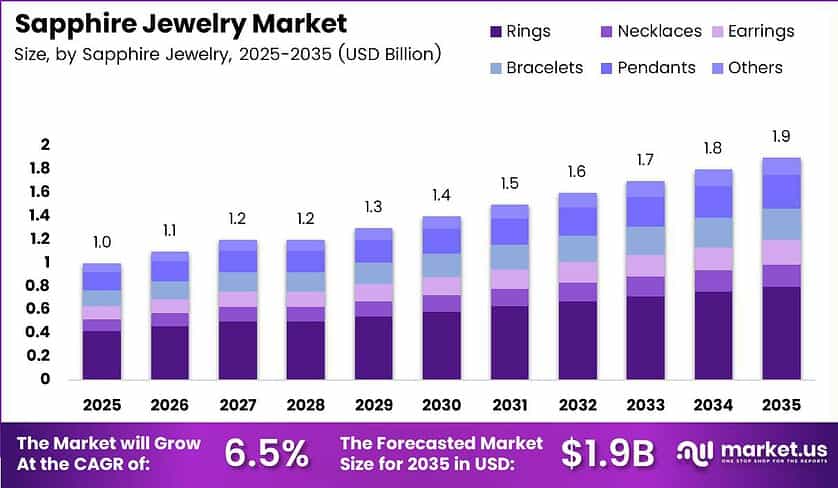
The global sapphire jewelry market reached USD 1.0 billion in 2025. Analysts expect it to climb to USD 1.9 billion by 2035, growing at a 6.5% CAGR from 2026 to 2035. Bridal demand and luxury collecting support this steady rise.
Sapphire jewelry pairs cut natural or synthetic corundum stones with precious metal settings. Bridal buyers, luxury fashion shoppers, and heritage wealth collectors purchase it. Consequently, retailers and custom jewelers earn higher unit margins than they earn on clear, commodity stones.
Diamond weakness shifts attention to colored stones. USGS reports U.S. gemstone imports fell 44% to USD 11.0 billion in 2025. Retailers respond by stocking more colored corundum to protect store revenue. Therefore, sapphires gain shelf space in bridal and fashion collections.
Metal costs also shape pricing. The World Bank says precious metal prices jumped 41% in 2025. Manufacturers now design lighter 14-karat settings to keep jewelry affordable. Moreover, Gemfields sold 348,409 carats at its June 2026 auction, which steadies rough supply.
Data-Driven Insights for Smarter Business Decisions: Explore the Full Report
Key Takeaways
- USD 1.0 billion in 2025, rising to USD 1.9 billion by 2035.
- Growth runs at a 6.5% CAGR from 2026 to 2035.
- Rings lead with 41.23%; Necklaces grow fastest.
- Blue Sapphire holds 78.67%; Green Sapphire grows fastest.
- Specialty Jewelry Stores hold 67.34%; Brick-and-Mortar Retailers grow fastest.
- North America leads with 43.78%, worth USD 0.43 billion; Middle East and Africa grows fastest.
Market Segmentation Overview
Rings lead jewelry types with a 41.23% share. Sapphire’s hardness of 9 on the Mohs scale suits daily wear in bridal settings. Consequently, jewelers expand custom margins on engagement rings. Meanwhile, necklaces grow fastest as collectors buy statement pieces.
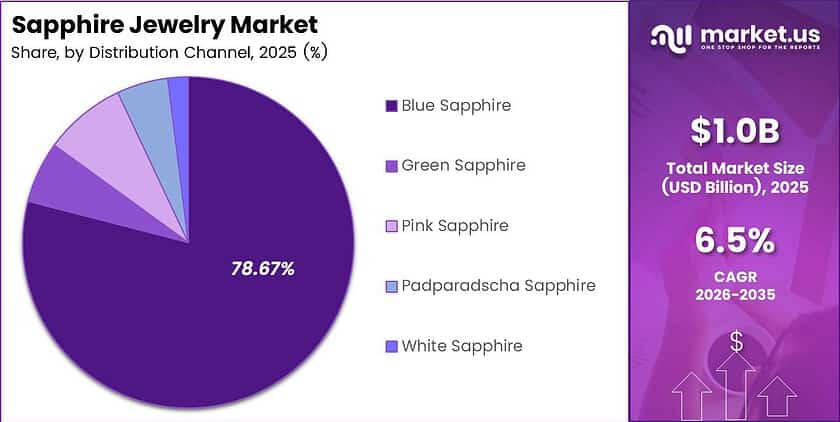
Moreover, Blue Sapphire holds 78.67% of color demand because of royal heritage and bridal preference. Stable heat-treated blue gives jewelers reliable resale value. However, Green Sapphire grows fastest as younger buyers seek earthy, traceable alternatives.
Additionally, specialty jewelry stores hold 67.34% of distribution. Buyers want expert inspection of high-value stones under calibrated lighting. U.S. specialty stores generated USD 39.53 billion in 2024 sales. Meanwhile, online retailers capture digital shoppers who compare certificates and videos.
Drivers
Non-diamond bridal choices drive growth most strongly. Diamond wholesale prices fell 26% between 2024 and 2026, and up to 38% of engagement shoppers consider sapphires. Jewelers cut acquisition costs by 12% to 18%. This driver adds 2.1 percentage points to growth.
Moreover, demand for fancy-color stones keeps rising. Parti and teal sapphires attract buyers in the United States, United Kingdom, and Japan. This trend adds 1.5 percentage points. Meanwhile, astrological and cultural traditions in India and the Middle East add 1.0 point, which supports steady purchases.
Use Cases
Engagement rings use sapphire as a center stone. Signet agreed to buy bespoke jeweler The Clear Cut in May 2026, with a USD 30,000 average order value. Buyers pay premiums for custom designs. Therefore, jewelers grow margins by moving shoppers away from clear stones.
Additionally, luxury houses use sapphires in high jewelry necklaces. Tiffany unveiled a 184.15-carat unheated Sri Lankan sapphire necklace in September 2026. Articulated links spread heavy stones across the collarbone. Consequently, maisons command seven-figure prices for bespoke commissions.
Data-Driven Insights for Smarter Business Decisions: Explore the Full Report
Major Challenges
Record gold prices raise finished jewelry costs. Gold climbed 67% in 2025, and metal makes up 50% to 75% of manufacturing cost. Fabrication tonnage fell 17% to 18%. Consequently, wholesalers face 165 to 270 basis points of margin pressure.
However, large clean rough is running short. Alluvial deposits in Madagascar and Sri Lanka no longer yield stones of 50 to 100 carats. Cuttable yields fall below 15% to 22%. Therefore, luxury houses face sourcing delays of 90 to 150 days.
Business Opportunities
Certified pre-owned sapphire programs offer strong upside. Retailers can buy estate stones at 30% to 45% below primary wholesale cost. Recutting and certification cost USD 45 to USD 110 per stone. This model expands gross margins by 800 to 1,200 basis points.
Additionally, blockchain digital product passports build trust in origin claims. This opportunity adds 1.3 percentage points in the European Union, United States, and Switzerland. Meanwhile, lab-grown demi-fine lines add 1.1 points. Consequently, brands with traceable sourcing can win cautious buyers.
Regional Analysis
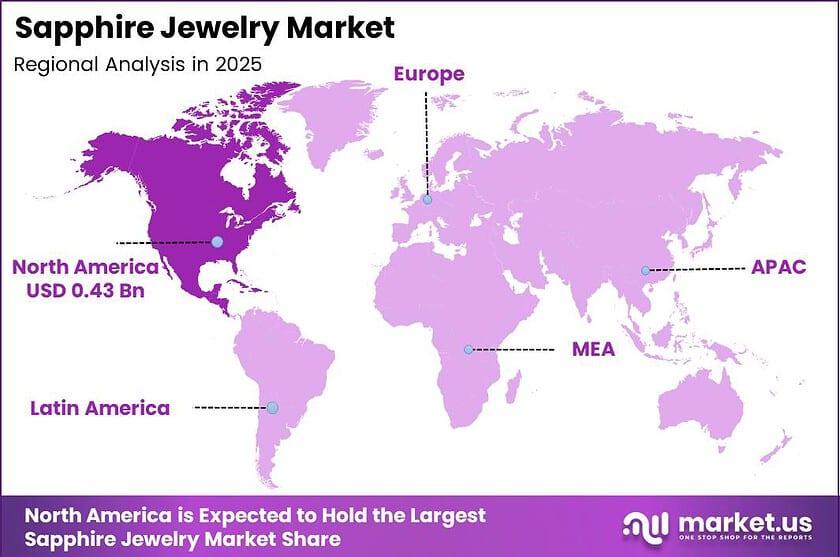
North America leads with a 43.78% share, worth USD 0.43 billion in 2025. Non-diamond bridal adoption and concentrated specialty retail drive sales. U.S. precious-metal jewelry imports reached USD 12.78 billion in 2024. Therefore, exporters prioritize calibrated Montana and Ceylon assortments for bespoke wholesalers.
However, Middle East and Africa grows fastest. UAE precious-metal jewelry imports reached USD 16.43 billion in 2024. Duty-free Gulf hubs and tourist wealth accelerate turnover. Consequently, global jewelry houses expand flagships and distribution hubs across Dubai, Riyadh, and Doha.
Key Players Analysis
Leading houses compete through flagship expansion, rare stone sourcing, and craftsmanship. LVMH Watches and Jewelry, which includes Tiffany, earned EUR 10,486 million in 2025. Richemont’s jewelry maisons, including Cartier, grew 18% in the first half of fiscal 2027. Strong margins fund rough stockpiling.
- Tiffany & Co.
- Cartier
- Harry Winston
- Bulgari
- Chopard
- Graff Diamonds
- Van Cleef & Arpels
- Blue Nile
- Swarovski
- Kay Jewelers
- Other Key Players
Recent Developments
- September 2026 — Pandora invested USD 150 million in a Vietnam jewelry facility.
- September 2026 — Signet signed a credit agreement with Bread Financial through 2035.
- May 2026 — Cartier opened a Sydney boutique.
- May 2026 — Chopard launched its Red Carpet Collection with 79 creations.
- January 2026 — Van Cleef & Arpels advanced a EUR 55 million workshop expansion.
- November 2025 — Tiffany won approval for a Beverly Hills flagship.
- August 2025 — Harry Winston opened a Ginza flagship salon.
- July 2025 — Titan agreed to buy 67% of Damas for USD 283.2 million.
Conclusion
The sapphire jewelry market grows steadily through 2035. Bridal substitution, colored-stone demand, and luxury collecting drive expansion. Metal costs and rough shortages raise pressure but reward disciplined sourcing. Consequently, the market remains attractive for retailers and luxury houses.
Therefore, companies must secure rough supply, trace origins, and build pre-owned programs. Rings, Blue Sapphire, specialty stores, and North America lead today. Firms that act early can capture a market worth USD 1.9 billion by 2035.
Looking for data tailored to your specific market, region, or business need? Request a custom report or consultation — write to us at sales@market.us
Discuss your needs with our analyst
Please share your requirements with more details so our analyst can check if they can solve your problem(s)