Market Overview
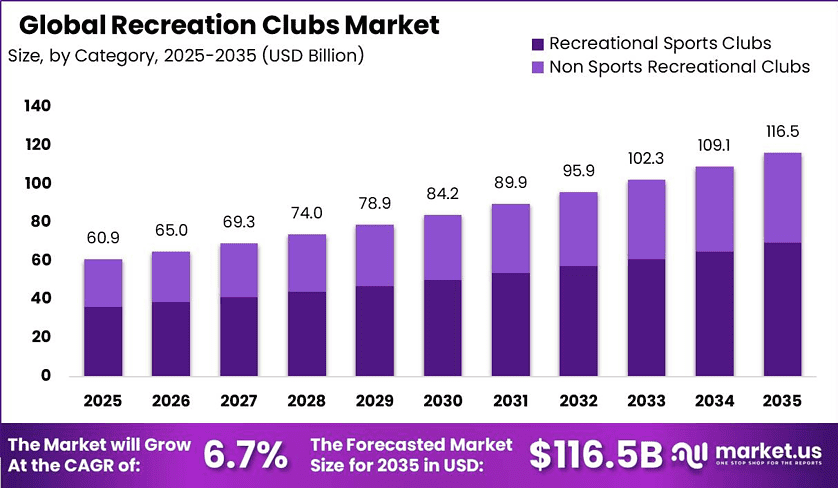
The Global Recreation Clubs Market is projected to reach USD 116.5 Billion by 2035, up from USD 60.9 Billion in 2025. Analysts expect a CAGR of 6.7% from 2026 to 2035. Strong member demand for structured social, fitness, and lifestyle experiences drives this expansion.
Recreation clubs combine sports facilities, social spaces, and wellness programs under single membership models. The market spans private members clubs, sports academies, and lifestyle communities. Operators shape offerings around category type, age group, and travel behavior to match the needs of diverse members.
Recreational sports clubs run tennis, swimming, and team sports programs for athletes and families. Non-sports clubs focus on dining, networking, and leisure spaces for professionals and retirees. Meanwhile, private members clubs such as The Arts Club and Soho House serve creative and high-income communities in major cities.
Technology is changing club competition. AI-based coaching tracks member progress and personalizes training without extra staff. Mobile-first booking systems offer real-time availability and dynamic pricing. Additionally, clubs add padel and pickleball courts, and cold plunge and infrared therapy rooms, to attract members seeking modern recovery and racquet sport options.
Data-Driven Insights for Smarter Business Decisions: Explore the Full Report
Key Takeaways
- Market value is USD 60.9 Billion in 2025 and will reach USD 116.5 Billion by 2035, at a CAGR of 6.7%.
- Recreational Sports Clubs lead the category segment with a 59.7% share.
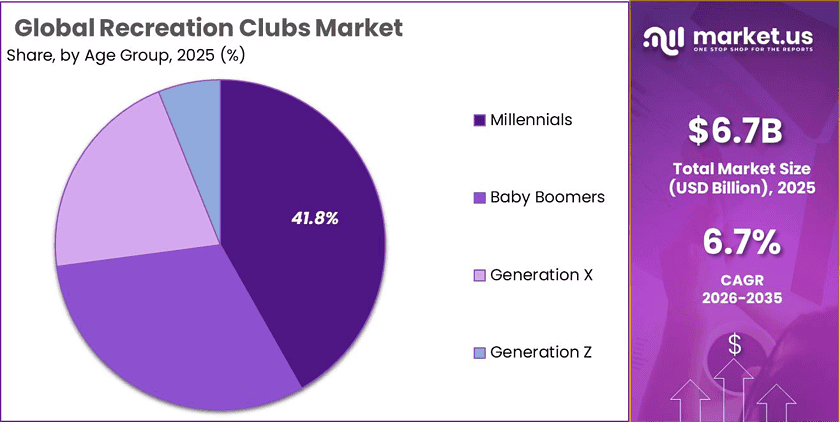
- Millennials lead the age group segment with a 41.8% share.
- Group travelers lead the traveler type segment with a 65.9% share.
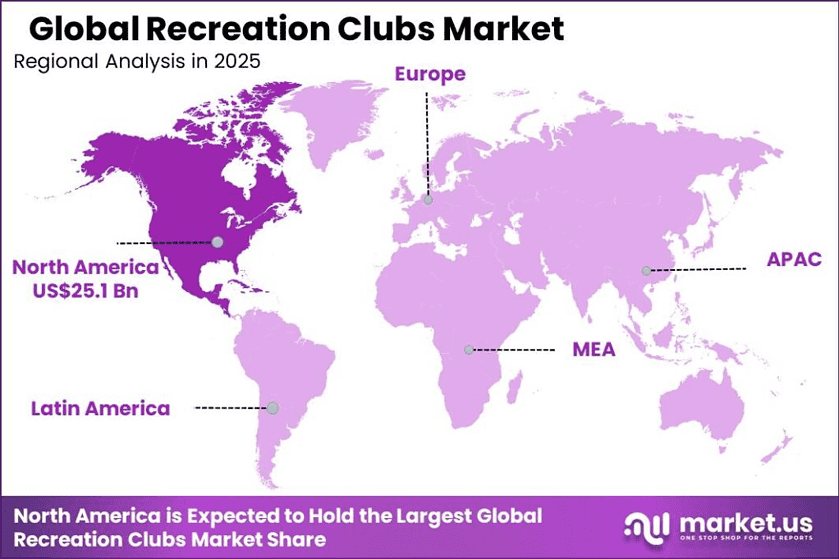
- North America leads regionally with a 41.25% share.
Market Segmentation Overview
Recreational sports clubs lead the category segment with a 59.7% share in 2025. Members prefer organized physical activity over passive social spaces. Consequently, operators that invest in coaching staff and tournament schedules capture the largest share of new memberships across tennis, swimming, and team sports.
Moreover, non-sports recreational clubs serve members who want social and lifestyle amenities over athletic programming. These venues compete on dining, networking, ambiance, and exclusivity. Therefore, they attract professionals and retirees who value community connection more than fitness routines and sport infrastructure.
Millennials lead the age group segment with a 41.8% share, because peak career and family life stages drive membership. They want flexible scheduling and child-friendly amenities. Consequently, operators that align programs with career and parenting demands retain this valuable group longest.
Additionally, baby boomers seek low-impact fitness and social engagement, and members aged 65 and above grew by 8.6% year over year in 2025, per Health Club Management. This signals rising demand for senior wellness. Generation X holds higher discretionary income and favors express fitness with networking. Generation Z completes the age mix.
Group travelers lead the traveler type segment with a 65.9% share because clubs act as community hubs. Members traveling together prioritize shared events and group packages, which builds loyalty. Meanwhile, solo members value flexible schedules, private training, and personalized service, so clubs differentiate through independent membership tiers.
Drivers
The aging population reshapes demand worldwide. By 2030, people aged 65 and above will exceed 1 billion, and about 10,000 Americans enter this group daily. Senior members show lower churn and higher lifetime value. Therefore, operators build longevity-focused programs for this expanding membership pool.
Moreover, health and wellness awareness drives the largest impact, at +2.1% on CAGR. Rising lifestyle disease rates push consumers toward preventive health. Strength training also raises muscular strength by around 40% and cuts fall risk by nearly 30%. Consequently, clubs with wellness programming win more new members.
Use Cases
Urban clubs convert existing space into padel and pickleball courts. Health and Fitness Association data shows pickleball participation in fitness facilities grew 21.3% year over year. This growth reflects strong member appetite for racquet sports. Consequently, operators prioritize court conversions over legacy amenities.
Additionally, premium clubs add cold plunge and infrared therapy rooms as recovery amenities. These spaces answer member demand for wellness beyond traditional fitness equipment. Therefore, operators can justify premium membership tiers and stand apart from budget-focused competitors. Members then pay more for complete wellness experiences.
Data-Driven Insights for Smarter Business Decisions: Explore the Full Report
Major Challenges
Macroeconomic pressure squeezes member budgets. US PCE inflation reached 4.5% in Q1 2026, and euro area inflation hit 3.0% in April. Households therefore prioritize essentials over memberships. As a result, operators face renewal hesitancy, lower per-member spending, and slower new member acquisition. The report assigns this a -1.5% CAGR impact.
However, facility costs strain operators. Leases carry annual rent escalations of 2 to 3%, and US commercial electricity prices rose 6.4% between January 2025 and January 2026. Emergency repairs cost 10 to 15 times more than routine upkeep. Consequently, operators must balance modernization against expansion plans.
Business Opportunities
Member data offers an untapped revenue stream. Clubs can use check-ins, wearables, and spending patterns to personalize pricing, predict churn, and sell personal training, nutrition coaching, and spa services. First-mover operators could earn an extra 8 to 12% of operating revenue through consent-compliant data monetization.
Additionally, APAC and Middle East greenfield expansion offers a +2.2% CAGR upside across India, GCC, Southeast Asia, and China Tier-2 and Tier-3 cities. Regions outside North America hold most global share. Therefore, early entrants in these underserved markets can build member bases before saturation occurs.
Regional Analysis
North America leads with a 41.25% share, valued at USD 25.1 Billion. Dense urban populations and an established private membership culture drive this position. The Club opened a second fitness studio in Charlotte in April 2026 with heated workout concepts. Such local growth reinforces the region’s advantage in mature metropolitan markets.
However, regions beyond North America together hold most global share, and Europe, Asia Pacific, Latin America, and the Middle East and Africa offer unexploited demand. Asia Pacific’s rising middle class, especially in China and India, unlocks first-time memberships. Therefore, operators that enter these regions early can claim members before saturation.
Recent Developments
- May 2025 — TSG Consumer signed a definitive agreement to acquire EōS Fitness, a gym chain with more than 200 locations, to accelerate expansion into new markets.
- February 2026 — Planet Fitness announced 181 new clubs opened during 2025, lifting its footprint to 2,896 clubs and adding about 1.1 million net new members.
Conclusion
The recreation clubs market is nearly doubling, rising from USD 60.9 Billion in 2025 at a 6.7% CAGR. Health awareness, aging populations, and new sport formats drive this growth. Moreover, rising costs and inflation remain real pressure points, so operators must manage budgets carefully while members stay price-sensitive.
Recreational sports clubs, millennials, and group travelers lead their segments with shares of 59.7%, 41.8%, and 65.9%. North America leads regionally with 41.25%. Meanwhile, other regions hold most global share, which signals strong room for new entrants. Each leader reflects demand for structured, social experiences.
Companies must modernize facilities, add padel and pickleball courts, and invest in AI coaching and booking tools to capture this opportunity. Brands should also serve seniors, solo members, and corporate clients. Those that act early will secure loyal members as the market reaches USD 116.5 Billion by 2035.
Looking for data tailored to your specific market, region, or business need? Request a custom report or consultation — write to us at sales@market.us
Discuss your needs with our analyst
Please share your requirements with more details so our analyst can check if they can solve your problem(s)