Market Overview
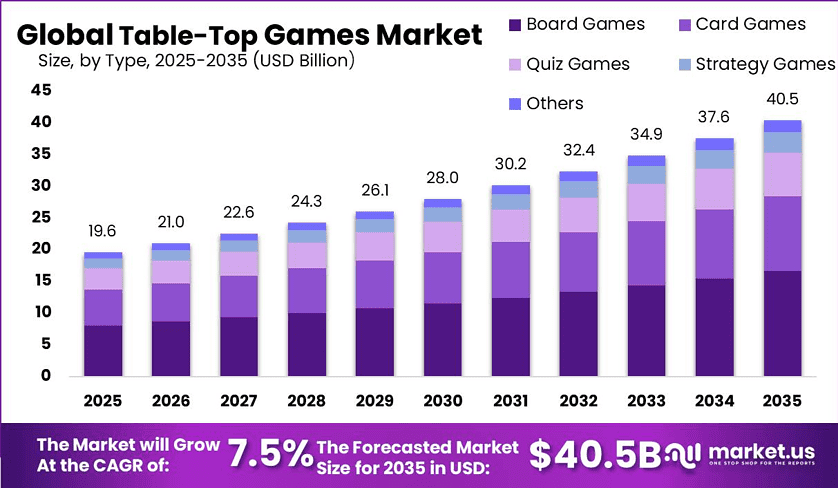
The Global Tabletop Games Market is projected to reach USD 40.5 Billion by 2035, up from USD 19.6 Billion in 2025. Analysts expect a CAGR of 7.50% from 2026 to 2035. The industry now shows structured segments, loyal consumers, and repeat spending cycles.
Tabletop games are non-digital, physical game formats sold to consumers and institutions. Board games, card games, quiz games, and strategy games form the core. Buyers include children and adults who play for fun at home, in organized competitions, and in educational settings.
Specialty hobby retailers, supermarkets, convenience stores, and online platforms sell these products. Public libraries in the United States now run tabletop gaming programs, as the American Library Association highlighted in 2024. Consequently, publishers gain institutional buyers in schools and community spaces beyond traditional retail.
Technology supports the industry through digital-linked ecosystems and crowdfunding. Platforms such as Gamefound let publishers raise funds before manufacturing, and tabletop campaigns there generated more than USD 85 Million in 2024, up 52%. This reduces financial risk and validates demand before retail launch.
Data-Driven Insights for Smarter Business Decisions: Explore the Full Report
Key Takeaways
- Market value stands at USD 19.6 Billion in 2025 and will reach USD 40.5 Billion by 2035.
- The market grows at a CAGR of 7.50% from 2026 to 2035.
- North America leads with a 41.50% share, valued at USD 8.134 Billion.
- Board Games dominate the type segment with a 41.20% share.
- Children dominate the application segment with a 56.80% share.
- Specialty Stores dominate distribution with a 36.40% share.
Market Segmentation Overview
Board games dominate the type segment with a 41.20% share in 2025. Broad age appeal, wide retail placement, and high replayability drive this lead. Consequently, publishers that invest in board game franchises face lower buyer acquisition costs because retail trusts the category.
Moreover, card games hold 29% because their compact format and low manufacturing cost support steady sell-through. Quiz games follow at 17%, supported by screen-free gatherings among adults. Strategy games hold 8% but command higher prices due to component complexity and collector demand, which lifts revenue per unit.
Children dominate the application segment with a 56.80% share because parents prefer screen-free, social learning tools. Schools and libraries add institutional sales beyond household buying. Meanwhile, adults form the core base for premium, hobby, and collector products, and they drive repeat purchases through expansions and limited editions.
Specialty stores dominate distribution with a 36.40% share because hobby communities gather there and staff recommend complex titles. Consequently, publishers with specialty retail ties hold an edge over mass-market-only competitors. Supermarkets and hypermarkets hold 27%, serving accessible, family-oriented titles at mass retail.
Additionally, convenience stores hold 19% and serve impulse and gifting occasions. Online channels account for 10% and represent the direct-to-consumer and crowdfunding-adjacent segment. Therefore, indie publishers find the clearest opening against established players online, where crowdfunding connects them with buyers.
Drivers
Licensing drives growth because famous entertainment franchises lower customer acquisition barriers. Recognizable stories attract existing fan communities, so licensed games enjoy stronger launches, higher trust, and longer relevance. The report assigns licensed IP a +2.0% CAGR impact. Consequently, publishers shift toward franchise portfolios and recurring content.
Moreover, adult collector demand lifts average selling prices, the largest driver at +2.3% on CAGR. Collectors buy expansions, limited editions, and premium components. Retailers also stock more games tied to popular properties. Therefore, publishers prioritize premium tiers in North America, Western Europe, Japan, and Korea.
Use Cases
Public libraries in the United States use tabletop programs to support community engagement and education. The American Library Association highlighted this integration in 2024. Consequently, publishers of educational and strategy titles reach a secondary institutional procurement channel beyond standard retail.
Additionally, independent publishers use crowdfunding to fund new games before printing. Kickstarter reported that tabletop creators raised more than USD 220 Million in pledges during 2024, making tabletop the largest category within Games. As a result, publishers test demand directly with consumers and lower manufacturing risk.
Data-Driven Insights for Smarter Business Decisions: Explore the Full Report
Major Challenges
Tariffs create costly uncertainty. Publishers lock manufacturing contracts 6 to 12 months before release, so sudden policy shifts hurt. A 10% tariff increase can raise wholesale prices by 15 to 25%. Consequently, companies build 200 to 400 basis points of extra margin buffers into production planning.
However, manufacturing concentration limits flexibility. Chinese factories make nearly 70% of global board games, and relocating boards, plastic pieces, and miniatures is hard. A survey of 74 companies found more than USD 206,000 in tariffs already paid. Therefore, smaller publishers postpone launches or freeze print runs.
Business Opportunities
IP-led transmedia monetization offers the largest tabletop upside, at +2.4% CAGR within 2 years. Expansion content, premium editions, licensed digital games, and media collaborations extend product life cycles. Therefore, publishers that add licensing and merchandising to proven hobby titles unlock revenue far beyond initial unit sales.
Additionally, emerging-market localization offers a +2.1% upside across India, Southeast Asia, Latin America, and the Middle East. Hybrid digital companion ecosystems add +1.9% in developed markets. Meanwhile, rolling up indie studios and catalogs adds +2.0%. Consequently, well-funded companies can build scale through localization, digital layers, and acquisitions.
Regional Analysis
North America leads with a 41.50% share, valued at USD 8.134 Billion. A mature specialty retail network, high hobby spending, and dense organized play culture drive this lead. The United States and Canada anchor the world’s largest tabletop consumer base. Consequently, publishers there gain first-mover advantages in premium and collector segments.
Meanwhile, Europe ranks second, and SPIEL Essen drew 220,000 visitors from over 80 countries in October 2025, confirming its role as a publishing hub. Asia Pacific offers growth potential through expanding middle classes in China, India, and Southeast Asia, although localization needs and fragmented retail create barriers.
Recent Developments
- January 2025 — CMON released Zombicide: White Death, adding medieval-fantasy mechanics to its miniatures portfolio.
- February 2025 — Kickstarter reported tabletop creators raised more than USD 220 Million in pledges during 2024.
- June 2025 — Asmodee acquired the Zombicide intellectual property from CMON, strengthening its cooperative board game position.
- July 2025 — Hasbro reported Wizards of the Coast and Digital Gaming revenue up 16% in Q2, with Magic: The Gathering up 23%.
- August 2025 — Gen Con Indy drew nearly 72,000 attendees and more than 575 exhibitors, a new record.
- 2025 — UK Games Expo reported 87,837 visitor entries and 51,196 unique visitors.
- 2025 — Wizards of the Coast continued celebrating the 50th anniversary of Dungeons and Dragons.
Conclusion
The tabletop games market is on a strong path, doubling from USD 19.6 Billion in 2025 at a 7.50% CAGR. Licensing, adult collector demand, and crowdfunding drive this climb. However, tariffs and manufacturing concentration remain the biggest brakes, so publishers must manage costs carefully.
Board games, children’s titles, and specialty stores lead their segments with shares of 41.20%, 56.80%, and 36.40%. North America leads regionally with 41.50%. Meanwhile, Europe and Asia Pacific add hub strength and growth potential. Each leader reflects trusted formats, family spending, and hobby community concentration.
Companies must build franchise ecosystems, diversify manufacturing, and master crowdfunding and discoverability to capture this opportunity. Publishers should also localize products for emerging markets. Those that act early will secure loyal fans as the market reaches USD 40.5 Billion by 2035.
Looking for data tailored to your specific market, region, or business need? Request a custom report or consultation — write to us at sales@market.us
Discuss your needs with our analyst
Please share your requirements with more details so our analyst can check if they can solve your problem(s)