
Market Overview
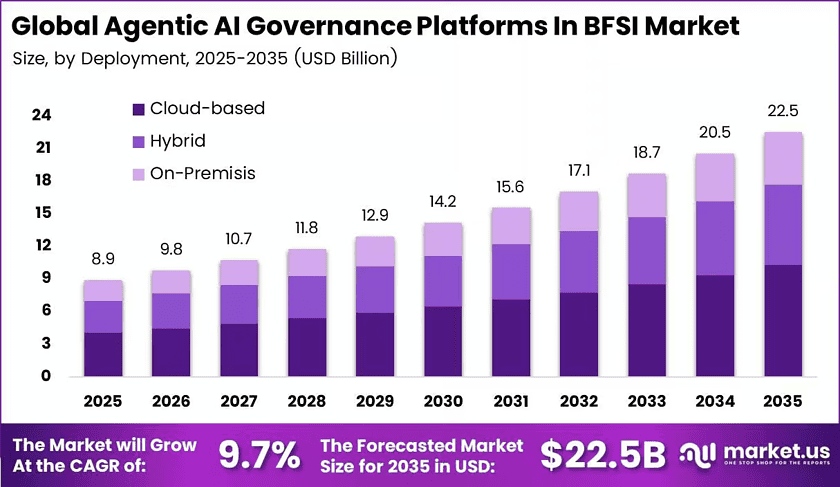
New York, NY – November 23, 2026 – The Global Agentic AI Governance Platforms in BFSI Market reached USD 8.9 billion in 2025. Analysts expect it to hit USD 22.5 billion by 2035 at a 9.7% CAGR. This growth shows that financial firms now treat AI oversight as a core business need. North America led the market in 2025 with a 38.2% share and about USD 3.4 billion in revenue.
Financial inclusion builds a strong base for demand. According to the World Bank, account ownership rose from 51% of adults in 2011 to 79% in 2024. Consequently, banks and payment providers now serve, screen, and protect many more customers. That larger customer base raises the need for well-governed AI agents.
Additionally, AI use keeps spreading across finance. According to the Bank of England and FCA, 75% of surveyed financial firms used AI in 2024. This high adoption rate means most firms already need clear rules, audit trails, and named owners for their automated systems.
Strong profits also support spending. According to the FDIC, US insured banks earned USD 295.6 billion in 2025, up 10.2% from 2024. Therefore, banks have money for software, staff, and risk controls. Large groups now want shared inventories and monitoring tools across all business units.
Key Takeaways
- The Agentic AI Governance Platforms in BFSI Market stood at USD 8.9 billion in 2025 and should reach USD 22.5 billion by 2035, growing at a 9.7% CAGR from 2026 to 2035.
- By offerings, Software/Platform leads with a 68.5% share.
- By deployment, Cloud-based leads with a 53.8% share.
- By end-user industry, Large Banks and Financial Groups lead with a 41.2% share.
- By function, Regulatory Compliance and Control Mapping leads with a 19.4% share.
- North America leads with a 38.2% share and USD 3.4 billion in revenue.
➤ Preview Key Insights with an Exclusive Sample Report Download – https://market.us/report/agentic-ai-governance-platforms-in-bfsi-market/request-sample/
Market Segmentation by Offerings, Deployment, End User, and Function
By Offerings
Software/Platform leads with a 68.5% share because banks need one central system to track every AI agent. According to the Bank of England and FCA, 84% of UK firms name an accountable person for AI. Therefore, firms buy platforms that log decisions, set guardrails, and keep audit trails.
Services, however, grow the fastest. According to the same survey, 46% of respondents only partly understand the AI systems they use. This skills gap matters because firms cannot govern tools they do not understand. Consequently, banks hire outside experts for setup, model reviews, and staff training.
By Deployment
Cloud-based deployment leads with a 53.8% share because banks can add tools quickly without new servers. According to the European Banking Authority, 92% of EU banks now use AI. Most reach outside models through cloud APIs, so cloud governance fits their current setup well.
Moreover, the EBA notes that EU banks often mix 1 to 3 deployment approaches. About 40% of EU banks use general-purpose AI that often touches protected customer data. As a result, Hybrid and On-Premises platforms help firms apply one policy set across cloud and local systems.
By End User Industry
Large Banks and Financial Groups lead with a 41.2% share. These groups run AI across many business lines and face the closest supervision. Additionally, the Financial Stability Board flags reliance on a few cloud and model vendors as a concentration risk. That risk pushes large banks toward active vendor inventories.
Small Banks, Fintechs and Insurtechs form the fastest-growing group. According to the World Bank, digital merchant payments climbed to 42% of adults in 2024, up from 35%. Fintechs capture much of this online traffic. Meanwhile, Mid-Size Banks, Asset Managers, and Insurance Companies adopt low-cost plug-in governance tools to meet similar rules.
By Function
Regulatory Compliance and Control Mapping leads with a 19.4% share. The EU AI Act lists credit scoring as a high-risk use under Annex III. Consequently, banks need tools that link each agent to a rule, a control, and an owner. These tools also provide proof during audits.
Explainability and Transparency show the fastest growth as lenders must explain automated decisions. Furthermore, firms invest in AI Inventory, Risk Tiering, Lifecycle Management, and Policy-as-Code. Model Risk Validation, Monitoring and Testing, Bias Management, and Privacy Protection complete the function mix. Together, these functions cover the full life of each AI agent.
Regional Analysis of AI Governance Demand
North America holds a 38.2% share and USD 3.4 billion in revenue. US supervisors expect full model inventories, separate validation, and board reporting. Therefore, large banks buy inventory, model risk, and compliance tools. The region also leads on supply, with vendors such as Fiddler AI selling directly to banks and insurers.
Asia Pacific shows rising demand as banks in Singapore, Japan, India, and Australia expand AI use. Singapore’s MAS published FEAT principles on fairness and accountability. Additionally, India’s RBI set up a responsible AI framework, while China enforces strict algorithm rules. These rules drive demand for explainability tools across the region.
Key Drivers of Market Growth
Automated financial workflows drive the strongest demand. According to the FCA, 55% of AI use cases include some automated decisions, while only 2% run fully on their own. This gap shows a control-heavy base. Consequently, firms need action logging, approval routing, and live intervention tools as automation expands.
Executive accountability for AI forms the second driver. Regulated firms now assign named leaders who answer for each AI deployment. Moreover, these leaders want clear dashboards and proof of control before approving new agents. As a result, governance platforms become a standard purchase for boards and senior risk teams.
Use Cases in Banking and Insurance
Banks use governance platforms to oversee fraud-response agents. These agents block suspicious payments and flag risky accounts in real time. However, each action affects a real customer. Therefore, banks use governance tools to log every decision, set limits, and let staff review or reverse actions quickly.
Insurers and retail banks also govern customer-facing agents. These agents handle onboarding, lending questions, and claims. Additionally, firms must make sure agents treat customers fairly and follow conduct rules. Governance platforms check agent replies, track bias, and create records that supervisors can review during audits.
Business Opportunities for Vendors
Cross-institution agent authorization offers a major opening. Agents increasingly act across banks, insurers, and business partners. NIST launched its AI Agent Standards Initiative to address identity and authentication. Consequently, vendors can build shared credential and permission layers that let trusted firms connect agents safely and with less setup effort.
Independent agent assurance certification creates another opportunity. Banks want outside proof that an agent meets safety and fairness standards. Moreover, supervisors may build their own oversight workbenches. Therefore, vendors that offer trusted testing, certification, and supervisor-ready reporting can win new revenue from regulators and regulated firms alike.
Major Challenges Facing Adoption
Validating non-deterministic agents remains the hardest challenge. An agent’s output and tool choices can change with context. Therefore, testing becomes an ongoing task rather than a one-time check. The FSB links limited explainability and hallucinations to model risk, so vendors need reusable test harnesses and versioned execution traces.
Procurement gates also slow sales. Platforms that support critical functions must pass strict third-party due diligence, especially in the EU. However, many vendors lack complete evidence packs. Consequently, deals stall and revenue gets delayed. Legacy system connections and a shortage of skilled governance engineers add further friction.
Top Key Players in the Market
- Credo AI, Inc.
- ValidMind, Inc.
- Fiddler AI, Inc.
- Holistic AI Limited
- ModelOp, Inc.
- Monitaur, Inc.
- Asenion Inc.
- Arthur AI, Inc.
- Trustible, Inc.
- Aporia Technologies Ltd.
- Truera, Inc.
- Saidot Oy
Conclusion
The Agentic AI Governance Platforms in the BFSI Market is growing steadily as financial firms move from AI pilots to agents that take real actions. Software platforms and cloud deployment lead, and large banks remain the main buyers. Moreover, compliance rules and executive accountability are driving demand forward. However, agent validation and procurement barriers still slow some deals. Vendors that offer trusted, flexible governance tools stand to gain the most.
Discuss your needs with our analyst
Please share your requirements with more details so our analyst can check if they can solve your problem(s)