Market Overview
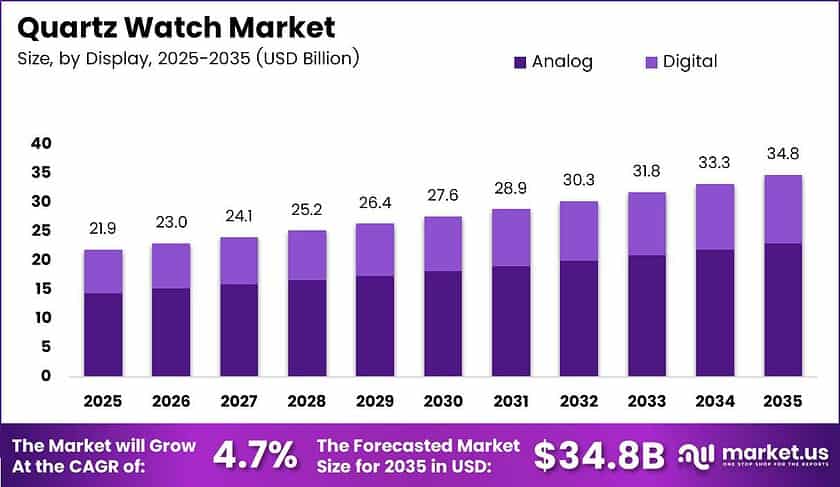
The global Quartz Watch Market reached USD 21.9 Billion in 2025 and will reach USD 34.8 Billion by 2035. Industry revenue expands at a 4.7% CAGR from 2026 to 2035. Premium brand upgrades and analog demand fuel steady growth worldwide.
Moreover, quartz watches use an electronic oscillator regulated by a tiny crystal to keep accurate time with minimal drift. Makers pair battery or solar movements with analog dials or digital screens. Commuters, athletes, executives, and collectors wear these reliable timepieces daily.
Additionally, mass fashion stores, specialty jewelry chains, corporate gifting programs, and sports outlets drive global sales. Jewelry retailers showcase steel dress watches for career milestones, while outdoor stores sell shock-resistant digital models. Corporate buyers also order engraved wristwatches for executive rewards.
Furthermore, watchmakers integrate light-powered solar cells, GPS time-sync modules, thermo-compensated calibers, and virtual try-on tools across modern lines. Solar charging removes routine battery swaps while low-power sensors support hybrid health tracking. Consequently, brands win over buyers tired of daily smartwatch charging.
Data-Driven Insights for Smarter Business Decisions: Explore the Full Report
Key Takeaways
- The global quartz watch market stood at USD 21.9 Billion in 2025.
- Market revenue is forecast to reach USD 34.8 Billion by 2035.
- The market grows at a CAGR of 4.7% from 2026 to 2035.
- Analog displays led the display segment with a 65.78% share in 2025.
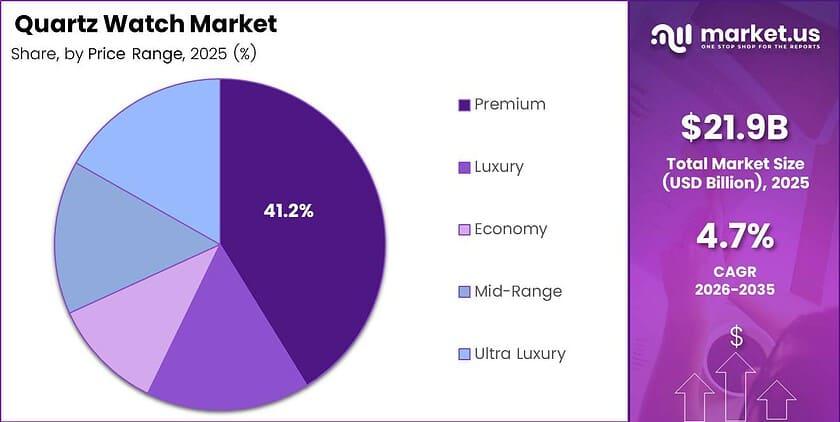
- Premium watches held the largest price range share at 41.23% in 2025.
- Men accounted for the leading end user share at 67.89% in 2025.
- Offline stores dominated sales channels with a 76.56% share in 2025.
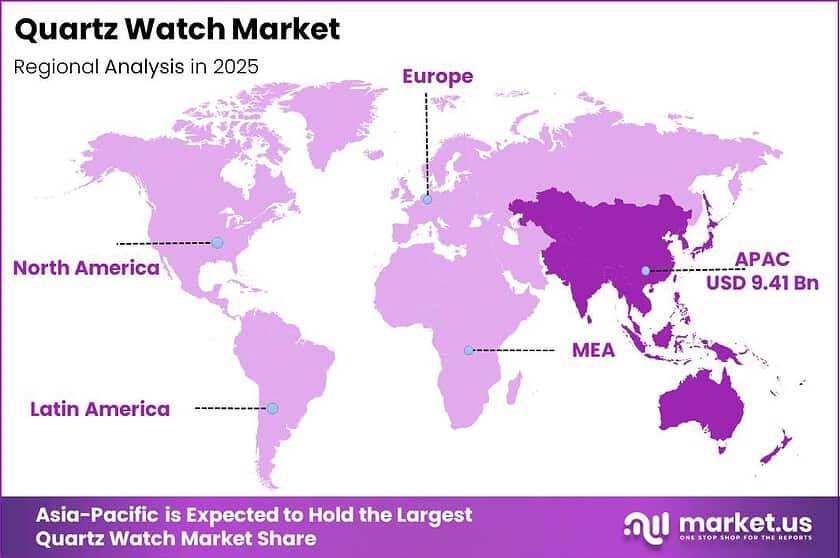
- Asia-Pacific led regional revenue with a 43.12% share valued at USD 9.41 Billion in 2025.
Market Segmentation Overview
Analog displays led at 65.78% share in 2025 via classic styling and smartwatch fatigue. Digital watches still serve rugged sports buyers. Premium models also topped price tiers at 41.23% share in 2025, ahead of luxury, mid-range, economy, and ultra-luxury lines.
Furthermore, men led end users at 67.89% share in 2025 through larger steel chronographs. Women grow fastest via slim jewelry styles. Offline stores also led sales channels at 76.56% share in 2025 for sizing checks, while online portals expand rapidly.
Drivers
Japanese watch groups are shifting from volume output to higher-ticket branded lines, adding +0.9% to the baseline CAGR. Seiko lifted operating margin to 9.2% in March 2026, while Casio watch sales jumped 25.8%. Consequently, premium mix protects group operating margins.
Moreover, smartwatch fatigue and analog rebound add +0.8% to forecast growth across global retail hubs. Titan analog watch sales grew 17% in late 2025 while its smartwatch value dropped 26%. Therefore, buyers seeking screen-free designs lift repeat analog retail purchases.
Use Cases
Corporate professionals and gift buyers choose stainless-steel analog timepieces with sapphire glass for office wear and milestone celebrations. Low-power stepper motors run for years without daily charging cords or distracting screen alerts. Consequently, specialty jewelers maintain strong full-price gift turnover.
Additionally, athletes and outdoor workers rely on digital quartz watches for shock protection, alarms, and stopwatch timing. Makers now release rugged outdoor editions and scarce collector collaborations to counter budget smartwatches. Therefore, sports watch brands defend average selling prices effectively.
Data-Driven Insights for Smarter Business Decisions: Explore the Full Report
Major Challenges
Unsettled US tariff rules impose a -0.7% CAGR drag after Section 301 duties hit 12.5% in July 2026. US watch imports fell 19.4% in August 2026 before jumping 85.7% in September. Consequently, distributors face erratic orders and strained working capital.
However, silver and gold price swings create a -0.5% drag on batteries and plated cases. Silver rose 42% in 2025 before falling 66% below its January 2026 peak by November 2026. Therefore, makers use 6 to 12 month metal hedges.
Business Opportunities
Hybrid analog health-tracking watches offer a +0.8% CAGR upside as lapsed smartwatch users still want sleep and heart-rate data. Adding low-power sensors to solar cores raises material costs by just 9% to 14%. Consequently, early movers capture loyal high-retention buyers.
Additionally, solar eco-premium models and live social commerce unlock a combined +0.9% CAGR upside across Europe and Asia. Shoppers value multi-year light charging alongside interactive online watch launches. Therefore, brands pairing solar movements with direct digital studios boost retail margins.
Regional Analysis
Asia-Pacific led the global market in 2025 with a 43.12% share valued at USD 9.41 Billion. IMF data projects regional GDP growth at 4.7% in 2026, led by India at 7.0%. Integrated Japanese and Chinese supply chains anchor regional dominance.
Moreover, Europe grows fastest as retail tourism and luxury exports rebound across key boutiques. Swiss watch exports reached nearly CHF 22 Billion in the first 10 months of 2026, rising 3.4%. Consequently, strict green rules lift European solar watch demand.
Recent Developments
- November 2026 — Fossil Group extended its Michael Kors watch license for 5 years through 2032 across 130 countries.
- November 2026 — Fossil Group renewed its Diesel license through 2032 alongside USD 271.2 Million Q3 2026 revenue.
- November 2026 — Casio launched the analog G-SHOCK GAC-2500 in India at ₹9,995 following a USD 145 U.S. debut.
- September 2026 — Citizen launched 2 Eco-Drive Tosa Washi models with 5-second accuracy for its 50th anniversary.
- September 2026 — Swatch released 6 artist timepieces globally for the 15th anniversary of Swatch Art Peace Hotel.
- May 2026 — Titan Company acquired a 67% stake in Damas Jewellery, adding 123 international retail stores.
- 2026 — Titan Company launched 43 Ducati watch SKUs from ₹16,000 to ₹25,000 across 1,000 target outlets.
- 2026 — Seiko Watch Corporation launched the Astron GPS Solar SSJ039 capped at 1,500 pieces at USD 2,400.
- 2026 — Casio America unveiled the G-SHOCK MRGD5000 Blue Sapphire digital watch limited to 20 pieces globally.
- 2026 — Seiko Watch Corporation targeted 2x India revenue in 3 years and 30 exclusive boutiques by 2028.
Conclusion
The global quartz watch industry maintains steady growth as brand elevation and smartwatch fatigue lift analog demand. Shoppers across mature and emerging economies continue trading up to solar and stainless steel timepieces. Consequently, disciplined retail pricing strengthens watchmaker operating margins worldwide.
Moreover, analog dials, premium price tiers, men’s chronographs, and physical boutiques anchor current global revenue. Asia-Pacific holds leading market value through dense manufacturing hubs, while Europe posts the fastest regional growth. Meanwhile, women’s slim designs and online try-ons unlock fresh buyers.
Therefore, watchmakers must hedge precious metals, navigate US tariff shifts, and launch hybrid analog health lines. Brands expanding premium retail stores and solar calibers will outperform volume rivals. Steady execution will lift the global market to USD 34.8 Billion by 2035.
Looking for data tailored to your specific market, region, or business need? Request a custom report or consultation — write to us at sales@market.us
Discuss your needs with our analyst
Please share your requirements with more details so our analyst can check if they can solve your problem(s)