Market Overview
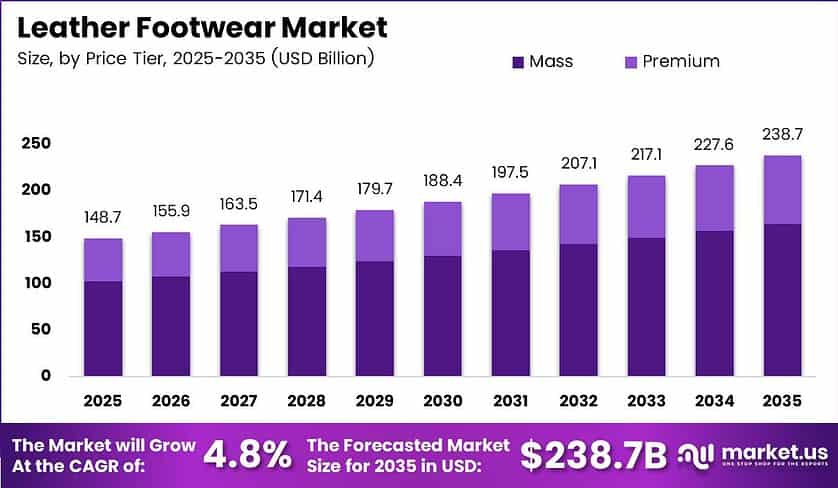
The global Leather Footwear Market reached USD 148.7 Billion in 2025 and will hit USD 238.7 Billion by 2035. Industry revenue expands at a 4.8% CAGR from 2026 to 2035. Workplace demand and premium trade-up fuel steady expansion across global retail hubs.
Moreover, leather footwear spans casual shoes, boots, formal dress styles, and sandals crafted from tanned hides. Commuters, executives, factory crews, and fashion buyers wear these pairs for breathability, arch support, and durability. Natural hides mold to feet far better than synthetics.
Additionally, daily urban wear, corporate offices, industrial workwear, and luxury fashion houses drive worldwide sales. Construction crews rely on Goodyear-welted boots for abrasion protection, while office staff wear calfskin dress silhouettes. Luxury labels also craft hand-stitched loafers for boutique shoppers.
Furthermore, brands adopt digital fit-prediction tools, supply-chain traceability platforms, and yield-optimization software across modern operations. Online sizing technology reduces costly return rates while helping direct storefronts display full width runs. Consequently, footwear makers capture stronger direct margins beyond physical stores.
Data-Driven Insights for Smarter Business Decisions: Explore the Full Report
Key Takeaways
- Global Leather Footwear Market reached USD 148.7 Billion in 2025.
- Market revenue will reach USD 238.7 Billion by 2035.
- Industry expands at a 4.8% CAGR from 2026 to 2035.
- Casual Shoes led Product Type at 37.00% share in 2025, while Boots grow fastest.
- Mass footwear led Price Tier at 68.78% share in 2025, while Premium grows fastest.
- Men led End Users at 78.56% share in 2025, while Women grow fastest.
- Offline led Sales Channels at 68.56% share in 2025, while Online grows fastest.
- Asia-Pacific led in 2025 at 63.45% share worth USD 93.6 Billion, while MEA grows fastest.
Market Segmentation Overview
Casual shoes led product types at 37.00% share in 2025 via relaxed office wear. Boots grow fastest for workwear alongside formal shoes and sandals. Mass footwear also led price tiers at 68.78% share in 2025, while Italian craftsmanship lifts premium lines fastest.
Furthermore, men led end users at 78.56% share in 2025 through office and safety shoes. Women grow fastest alongside children school pairs. Offline stores also led sales channels at 68.56% share in 2025 for fit checks, while online platforms expand fastest.
Drivers
Shoppers are rotating from sneakers back to occasion leather shoes, adding +2.2% to the baseline CAGR. Florsheim dress-shoe sales rose 12% in Q2 2026, while Ferragamo North America rose 15.4% in H1 2026. Consequently, premium makers lift gross margins by 10 points.
Moreover, emerging-market trade-up and tariff cuts add +1.7% and +1.3% to forecast growth across key hubs. The EU ban on destroying unsold shoes from 19 July 2026 also tightens retail buy depth. Therefore, brands achieve stronger full-price sell-through on full-grain lines.
Use Cases
Industrial and construction employers issue Goodyear-welted leather boots to protect crews against water, abrasion, and heavy loads. Durable welted soles allow repeated resole repairs over multi-year work cycles. Consequently, safety boot makers earn higher selling prices and steadier wholesale margins.
Additionally, corporate executives and formal buyers purchase full-grain calfskin oxfords and loafers for office and ceremonial wear. Structured leather uppers retain crisp shapes far longer than synthetic substitutes across repeated use. Therefore, heritage shoemakers focus formal lines on resoleable designs.
Major Challenges
The West Asia conflict starting 28 February 2026 disrupted petrochemicals and shipping, creating a -0.6% CAGR drag. Polyurethane and adhesive costs jumped 40% to 60%, while ocean freight rose 25% to 50%. Consequently, Agra exports fell 15% under locked contracts.
However, cattle hide quality bifurcation imposes a -0.3% drag after the US herd hit 86.2 Million head in January 2026. Hides form 50% to 70% of leather cost, and top European hides rose 4.5% in August 2026. Therefore, tanneries diversify contracts.
Data-Driven Insights for Smarter Business Decisions: Explore the Full Report
Business Opportunities
The India-EU trade deal closed on 27 January 2026 offers a +0.5% CAGR upside by cutting 17% EU tariffs. India supplies just 2.4% of EU leather imports despite Agra making 1.5 Lakh pairs daily. Consequently, compliant Indian exporters can win major share.
Additionally, orthopedic leather shoes and resole repair services unlock a combined +0.7% CAGR upside across mature Western markets. Buyers value medical arch support alongside circular refurbishment programs that extend shoe life. Therefore, brands adding repair studios and digital fitting capture recurring revenue.
Regional Analysis
Asia-Pacific led the market in 2025 with a 63.45% share valued at USD 93.6 Billion. UN Comtrade shows Vietnam exported USD 11.3 Billion and China exported USD 9.78 Billion in 2024. Dense tanning clusters and rising incomes anchor regional dominance.
Moreover, Middle East & Africa grows fastest as urban malls and young workforces lift formal and casual shoe sales. IMF data projects Sub-Saharan Africa GDP growth at 4.3% in 2026 and 4.4% in 2027. Consequently, global footwear franchises expand regional stores.
Recent Developments
- November 2026 — Geox S.p.A. opened 18 shops and closed 71 stores, optimizing to 517 boutiques.
- November 2026 — Wolverine World Wide lifted 2026 guidance to USD 2.010 Billion after USD 505.4 Million Q3 sales.
- November 2026 — Bata India announced export expansion by 2030 after selling 51 Million pairs in FY26.
- November 2026 — Kering SA ended the Gucci Beauty license with Coty Inc. for USD 400 Million.
- August 2026 — Salvatore Ferragamo S.p.A. deployed EUR 18 Million in H1 2026 capex for store renovations.
- June 2026 — Wolverine World Wide launched Texas work boot production alongside Merrell’s USD 648.9 Million revenue.
- April 2026 — Kering SA formed a Milan property venture for EUR 729 Million plus EUR 432 Million deferred.
- March 2026 — Kering SA bought a 20% stake in Raselli Franco S.p.A. for EUR 115 Million cash.
- February 2026 — Deichmann SE opened its Essen headquarters and planned 11 Italian stores in 2026.
Conclusion
The global leather footwear sector maintains steady momentum as occasion dress wear and workwear boots lift demand. Consumers across emerging and mature markets continue trading up from synthetics to durable hides. Consequently, disciplined inventory rules support healthier retail margins worldwide.
Moreover, casual silhouettes, mass price tiers, men’s styles, and physical stores anchor current global unit volume. Asia-Pacific commands leading revenue through integrated manufacturing hubs, while Middle East & Africa posts the fastest growth. Meanwhile, women’s lines and online fitting unlock margin expansion.
Therefore, footwear makers must diversify hide sourcing, manage freight shocks, and tap new duty-free trade corridors. Brands investing in vertical factories, compliant tanning, and omnichannel fitting tools will outperform rivals. Steady execution will lift the global market to USD 238.7 Billion by 2035.
Looking for data tailored to your specific market, region, or business need? Request a custom report or consultation — write to us at sales@market.us
Discuss your needs with our analyst
Please share your requirements with more details so our analyst can check if they can solve your problem(s)