
Market Overview
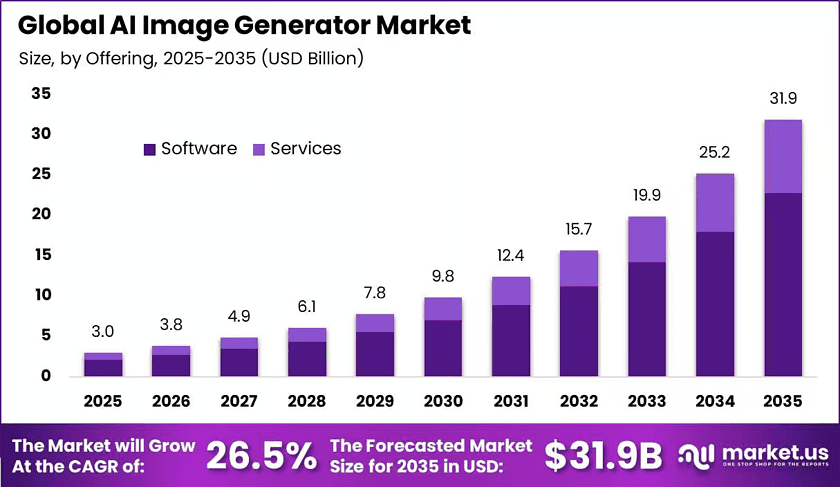
New York, NY – November 12, 2026 – The Global AI Image Generator Market was worth USD 3.0 billion in 2025. Analysts expect it to reach USD 31.9 billion by 2035, growing at a CAGR of 26.5%. This tenfold rise shows that businesses now treat AI visual tools as core content infrastructure rather than test projects.
Moreover, wider internet access is pushing demand higher. According to the International Telecommunication Union, about 6 billion people used the internet in 2025, up from 5.8 billion in 2024. This larger online audience gives cloud-based image creation platforms more users in marketing, retail, media, and design.
Additionally, investors keep putting money into artificial intelligence. According to UNCTAD, corporate AI investment rose from USD 15 billion in 2013 to USD 189 billion in 2023. This steady flow of capital funds new models, better tools, and faster rollout of generative visual software around the world.
However, adoption still differs from region to region. According to Microsoft AI Diffusion data, generative AI use reached 24.7% of working-age people in the Global North by late 2025. The Global South reached only 14.1%. Consequently, richer markets currently produce most paid subscriptions and enterprise licenses for these platforms.
Furthermore, users have taken up integrated image tools very quickly. According to OpenAI, more than 130 million users created over 700 million images in the first week of native ChatGPT image generation. This response shows strong consumer appetite, which encourages vendors to build image features straight into their everyday software.
Key Takeaways
- The AI Image Generator Market was valued at USD 3.0 billion in 2025 and should reach USD 31.9 billion by 2035, growing at a CAGR of 26.5%.
- Software led the Offering category with 71.4% of total market share.
- Image Generation led the Application category with 29.3% of the market.
- Media and Entertainment led the End-User category with 32.7% share, driven by demand from film, streaming, and publishing.
- North America led in 2025 with a share of more than 38.2% and about USD 1.1 billion in revenue.
➤ Get Instant Access to the Premium Report Sample Before Purchase – https://market.us/report/ai-image-generator-market/request-sample/
Market Segmentation by Offering, Application, and End-User
By Offering
Software holds 71.4% of the AI image generator market. Businesses prefer cloud subscriptions that need no dedicated hardware. According to the OECD, 49% of firms with 10 or more employees used cloud computing in 2023. Therefore, widespread cloud readiness makes software-based visual tools the easiest choice for most buyers.
Moreover, the services segment covers professional services, training, consulting, system integration, support, and managed services. According to UNCTAD, global IT services value added grew at a CAGR of 8% between 2000 and 2022. This steady growth shows that companies increasingly pay experts to deploy and run digital tools.
By Application
Image Generation leads applications with a 29.3% share. Advertisers, retailers, and media firms need large volumes of fresh visuals every day. According to UNCTAD, global advertising revenue reached USD 806 billion in 2023. Consequently, brands use AI picture creation to cut photography costs and speed up campaign delivery.
Additionally, other applications include semantic image-to-photo translation, image-to-image conversion, resolution upscaling, and 3D shape generation. According to UNCTAD, e-commerce sales across 45 economies reached USD 28 trillion in 2024. Online sellers therefore need sharper product photos, varied formats, and 3D views that these tools produce at scale.
By End-User
Media and Entertainment leads end users with a 32.7% share. Studios, streamers, publishers, and game makers need posters, promotional art, and social content. According to UNCTAD, the global box office reached USD 33.9 billion in 2023, rising 30.5%. This recovery increases promotional spending, which raises demand for fast visual production.
Furthermore, BFSI, healthcare, manufacturing, retail, logistics, real estate, energy, and government also use these tools. According to UNCTAD, creative services exports hit a record USD 1.7 trillion in 2024, up 12%. Consequently, many industries outside media now buy creative content, widening the customer base for generative imaging vendors.
Regional Analysis of AI Image Generation
North America leads with a 38.2% share and about USD 1.1 billion in 2025 revenue. Strong cloud infrastructure and early generative AI adoption support this lead. According to Barclays, using US Bureau of Economic Analysis data, AI capital spending added nearly 1.0 percentage point to US GDP growth in early 2025. Therefore, heavy investment keeps the region ahead.
However, Asia Pacific is the fastest-growing region. According to the ITU, internet use in the region rose from 50% in 2019 to 77% in 2025. This jump creates a large new base of users. Consequently, China, India, and Southeast Asia should drive strong revenue gains for AI visual platforms through 2035.
Key Growth Drivers
Native multimodal integration into productivity suites adds about 3.2% to market CAGR. Major chat and office platforms now include image creation inside existing subscriptions. Moreover, this bundling cuts customer acquisition costs by an estimated 30% to 40%. Therefore, vendors reach more users at lower expense and grow faster.
Additionally, falling per-image costs add about 2.4% to market CAGR. Model distillation and efficiency gains have cut inference costs by around 80% across model updates. Consequently, providers can offer cheaper API pricing while keeping healthy margins. Lower prices then encourage businesses to use AI imaging for high-volume work.
Use Cases Across Industries
Online retailers use AI image generators to create product photos, ad banners, and virtual merchandising scenes. Moreover, sellers can show items in many settings without costly photo shoots. Consequently, retail teams launch new catalog pages faster. They also test more ad designs and adjust visuals quickly for different shopper groups and seasons.
Additionally, film studios, streaming platforms, and publishers use these tools to produce posters, concept art, and social media visuals. Creative teams generate early design drafts in minutes instead of days. Therefore, artists spend more time refining ideas. Marketing teams also adapt promotional content quickly for different regions and languages.
Business Opportunities Ahead
Vertical enterprise licensing offers a strong opportunity for AI image generator providers. Retail catalogs, real estate staging, and game asset production still rely heavily on manual work. Moreover, dedicated industry APIs with brand control and compliance features can win larger contracts. Consequently, vendors can earn steadier, higher-quality revenue than consumer subscriptions provide.
Additionally, small businesses and creators in Latin America, Africa, and Southeast Asia remain underserved. Self-serve platforms with simple pricing and mobile-friendly design can reach these new users. Therefore, providers that offer local languages and affordable plans can capture early loyalty. On-device and edge inference also opens new paths for product revenue.
Major Challenges Facing Vendors
Limited GPU computing capacity remains a serious barrier. Long chip supply backlogs restrict API capacity and delay platform expansion. Moreover, rising accelerator rental prices squeeze margins, especially for smaller vendors. Consequently, grid connection delays slow new data center construction, which leaves providers short of the computing power that growing enterprise demand needs.
However, the shortage of skilled machine learning researchers creates another major hurdle. Companies compete hard for the same small talent pool, which pushes salaries up. Therefore, smaller firms struggle to keep pace with model upgrades. Copyright lawsuits and unclear training-data rules also add legal risk for platforms in North America and Europe.
Top Key Players in the Market
- Microsoft
- AWS
- Adobe
- NVIDIA
- OpenAI
- META
- Anthropic
- Databricks
- Lightricks
- Midjourney
- Canva
- Jasper
Conclusion
The AI image generator market is moving from early testing to wide commercial use. Cloud software leads adoption, while media and retail firms create steady demand for visual content. Moreover, North America leads today, but Asia Pacific is growing fastest. However, compute shortages, talent gaps, and copyright risks need careful planning. Therefore, vendors that offer industry-specific tools and efficient pricing should capture strong long-term value.
Discuss your needs with our analyst
Please share your requirements with more details so our analyst can check if they can solve your problem(s)