Market Overview
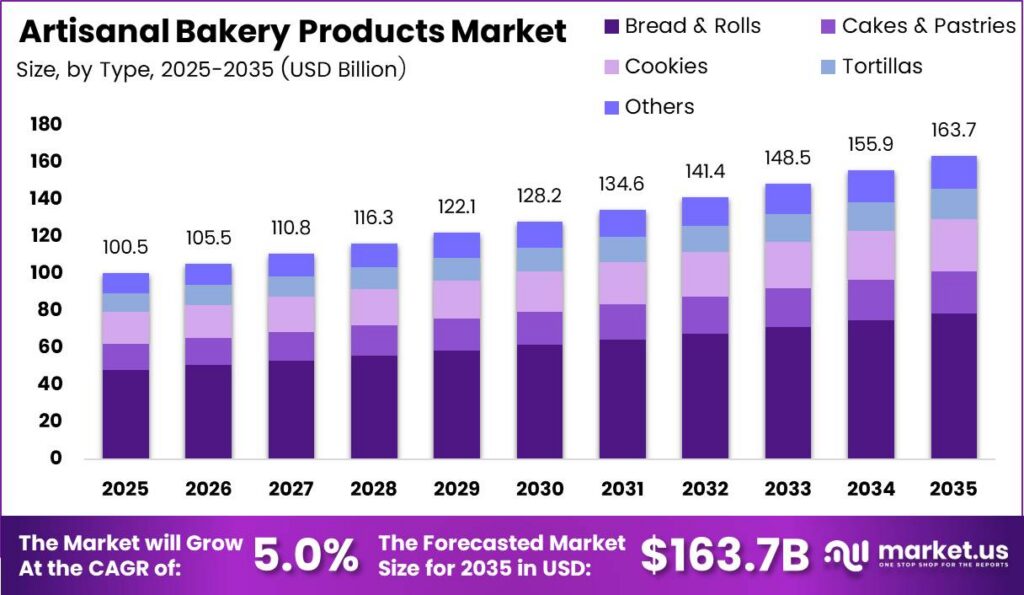
The global artisanal bakery products market reaches USD 163.7 billion by 2035, up from USD 100.5 billion in 2025. Analysts expect a 5.0% CAGR across the 2026 to 2035 forecast period. This growth reflects rising consumer preference for authentic, craft-made baked goods.
Artisanal bakery products include small-batch, slow-fermented breads, laminated pastries, hand-shaped rolls, and specialty cookies. Bakers use unbleached flours, wild yeast starters, and minimal preservatives. Neighborhood bakeries, par-baked dough makers, and hospitality commissaries supply cafés, hotels, and premium grocers across retail and foodservice.
Key Takeaways
- The market was valued at USD 100.5 billion in 2025.
- Revenue is projected to reach USD 163.7 billion by 2035.
- The market expands at a 5.0% CAGR from 2026 to 2035.
- Bread & Rolls hold 47.34% of the type segment and grow fastest.
- Specialty Stores lead with 27.56%, while Hypermarkets & Supermarkets grow fastest.
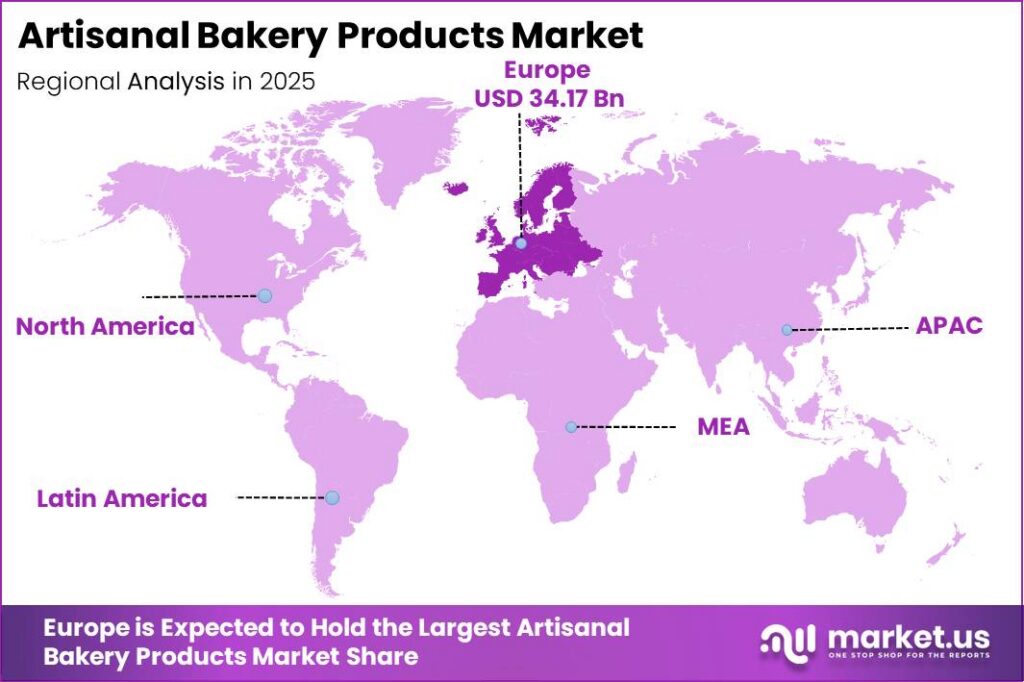
- Europe dominates with 34.11%, worth USD 34.17 billion, while Asia-Pacific grows fastest.
Data-Driven Insights for Smarter Business Decisions: Explore the Full Report
Moreover, retail and foodservice buyers drive adoption. Supermarkets install bake-off ovens to finish par-baked doughs, while specialty stores sell fresh loaves. Convenience stores sell single-serve rolls and pastries for impulse breakfast and commuter snack purchases. Hotels and restaurants also buy pastries for dining occasions.
Additionally, major baking groups invest in automated fermentation lines and zero-emission logistics to scale craft quality. A leading Mexican baker committed over USD 2 billion across 7 states through 2028. Capital-intensive automation now clearly separates market leaders from smaller regional bakeries.
Government trade programs, tariff-rate quotas, and clean-label food standards shape how bakers source heritage grains and export finished goods. USDA data show U.S. baked goods exports reached USD 4.27 billion in 2025, below the USD 4.38 billion three-year average. Consequently, regulatory compliance and trade access determine margin stability for cross-border producers.
UN Comtrade and ITC data show global bakery exports under HS 1905 rose over 8.6%. Exports climbed from USD 38.05 billion in 2020 to USD 54.40 billion in 2024. Cold-chain par-baking lets producers ship authentic loaves globally. Therefore, scalable specialty bakeries earn high-margin export revenue.
Market Segmentation Overview
Bread & Rolls dominates the type segment with 47.34% share in 2025 and also grows fastest. Loaves, baguettes, rolls, buns, and ciabatta form this group. Long fermentation makes sourdough daily staples for health-conscious households. Consequently, bakers investing in automated retarder-proofers win recurring grocery contracts.
However, Cakes & Pastries serve hospitality dining, with exports under HS 190590 reaching USD 36.61 billion in 2024. Small cafés cannot replicate lamination equipment, so frozen pastry makers win foodservice accounts. Cookies scale nationwide through shelf-stable portions, while Tortillas and other products complete the mix.
Specialty Stores lead distribution with 27.56% share in 2025. Crust crispness fades within hours of baking, so on-premise boutique bakeries command premium prices and neighborhood loyalty. Moreover, Convenience Stores, Departmental Stores, Traditional Grocery Stores, Airport Retail Stores, and Online channels extend reach.
Hypermarkets & Supermarkets grow fastest by installing in-store ovens that finish frozen par-baked doughs on demand. High foot traffic lowers customer acquisition costs and speeds inventory turnover at fresh bakery counters. Consequently, par-baked suppliers gain volume through supermarket private-label contracts.
Drivers
Premium sourdough demand leads growth, adding 0.40 percentage points to the CAGR. Puratos surveyed over 20,000 consumers across 50 countries, and 70% linked sourdough with superior taste. Consequently, bakers shifting sales into items priced 15% above average gain pricing power.
Neighborhood bakery-café consumption adds 0.25 percentage points across urban Europe, North America, and Asia-Pacific. Moreover, celebration and customized pastry purchases add 0.20 points. Consumers seek visible craft and fresh products, so bakeries pair café seating with custom pastry programs to lift revenue.
Data-Driven Insights for Smarter Business Decisions: Explore the Full Report
Use Cases
Supermarkets and specialty stores sell sourdough loaves, baguettes, and rolls as daily staples. Wild yeast starters give these loaves their crust and flavor. Health-conscious households buy long-fermented bread for digestibility and taste. Consequently, bakers with automated retarder-proofers secure recurring grocery contracts and steady volumes.
Hotels, cafés, and restaurants buy laminated pastries for dining occasions. Frozen laminated pastry manufacturers supply these accounts because small cafés cannot replicate temperature-controlled sheeting equipment in-house. Additionally, bake-off ovens finish par-baked breads on demand, giving operators fresh items without extra skilled labor.
Major Challenges
Skilled baker turnover creates the biggest challenge, dragging growth by 0.25 percentage points. In an 8-person team, replacing 1 veteran with a trainee at 70% output cuts capacity by 3.75%. Consequently, bakeries must fund apprenticeships and automate dough dividing to scale without losing quality.
Moreover, limited working capital restrains independent bakeries by 0.30 percentage points. The Federal Reserve reported that credit access challenged over 25% of small firms. Therefore, bakeries lacking cash cut store hours or close, so owners should secure deposits and align supplier terms.
Business Opportunities
Surplus-product monetization offers the top opportunity, with 0.30 points of potential CAGR upside. Timed markdown apps turn unsold loaves into revenue. Consequently, a bakery selling 90% of output at full price can add 2.2% to current sales by discounting half its remaining 10%.
Moreover, institutional artisanal meal contracts add 0.15 points at corporate campuses, universities, and care facilities. Underpenetrated secondary-city expansion adds another 0.15 points in Asia-Pacific, Latin America, and Africa. Therefore, bakers that target these buyers can build steady demand beyond big-city storefronts.
Data-Driven Insights for Smarter Business Decisions: Explore the Full Report
Regional Analysis
Europe leads with 34.11% share, valued at USD 34.17 billion in 2025. The EU bakery sector counts over 210,000 enterprises, 98% of them small and medium-sized, and bread intake averages 53 kilograms per person yearly. This cultural preference sustains neighborhood bakeries and stable demand for equipment and specialty flour suppliers.
However, Asia-Pacific grows fastest as urban middle-class households adopt Western bakery-café habits and premium packaged baked goods. India’s wheat harvest hit a record 117.9 million tonnes in 2025, which lowers flour costs. Therefore, regional manufacturers can price artisanal items competitively for mass urban retail.
Recent Developments
- October 2026 — Grupo Bimbo committed MXN 1,760 million (USD 101.2 million) for a Puebla City plant and upgrades at over 30 plants.
- September 2026 — Rich Products completed a USD 3.2 million Customer Innovation Center redesign in Buffalo.
- February 2026 — Finsbury Food Group launched its 2026 Bakery Flavour Trends range and expanded Kara proofing and blast-freezing lines.
- January 2026 — Grupo Bimbo agreed to acquire Joy Food International, adding a line making 1,300 pieces per hour.
- January 2026 — Yamazaki relaunched Royal Bread after investing USD 380 million in 2025 capital projects.
- December 2025 — GAIL’s Bakery planned 40 new stores, reaching 180 locations as sales rose 20% to £278 million.
- September 2025 — Grupo Bimbo won Brazilian antitrust clearance to acquire 6 Wickbold companies and 4 plants, divesting 2 brands.
- September 2025 — Lantmännen Unibake acquired Boboli Benelux, adding EUR 50 million in sales and 200 staff.
- August 2025 — Finsbury Food Group bought 70% of Lola’s Cupcakes, adding £26.2 million revenue across 45 kiosks.
Conclusion
The artisanal bakery products market grows from USD 100.5 billion in 2025 at a 5.0% CAGR. Premium sourdough demand and bakery-café visits power this momentum. Consequently, consumers across urban markets pay more for visible craft, authentic flavor, and fresh products.
Bread & Rolls leads types with 47.34%, and Specialty Stores lead channels with 27.56%. Moreover, Europe commands 34.11% of revenue, while Asia-Pacific grows fastest. Hypermarkets & Supermarkets also grow fastest among channels, as in-store bake-off ovens expand fresh artisanal supply.
Companies must act on two priorities. First, bakers should systematize production, train staff, and automate repetitive tasks. Additionally, they should expand par-baked supply and recover surplus revenue. Therefore, early movers can capture growth as the market reaches USD 163.7 billion by 2035.
Looking for data tailored to your specific market, region, or business need? Request a custom report or consultation — write to us at sales@market.us
Discuss your needs with our analyst
Please share your requirements with more details so our analyst can check if they can solve your problem(s)