Market Overview
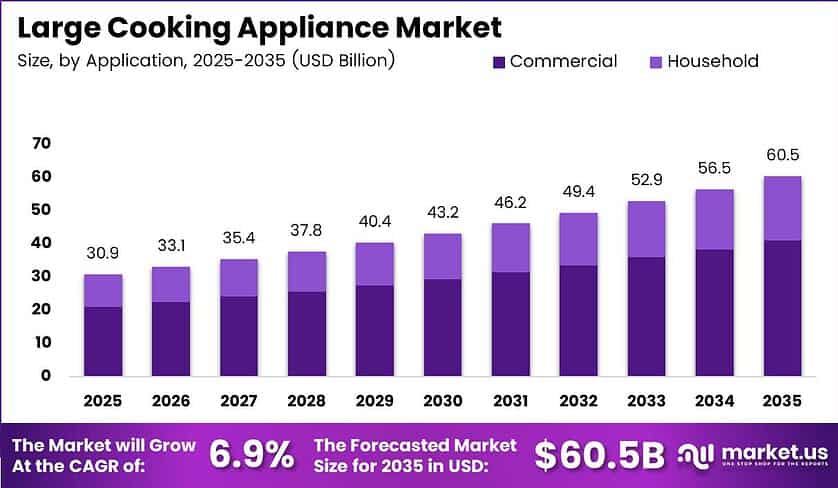
The global large cooking appliance market reaches USD 60.5 billion by 2035, up from USD 30.9 billion in 2025. Analysts project a 6.9% CAGR during the 2026 to 2035 forecast period. This growth reflects strong demand for efficient kitchen equipment in homes and restaurants.
Large cooking appliances include heavy-duty stoves, cooktops, range cookers, ovens, and fryers. These systems use thermal, electromagnetic, or steam energy to prepare food. Households, restaurants, hotels, and institutional caterers worldwide rely on them as durable food preparation infrastructure in residential and commercial kitchens.
Moreover, residential housing developers, commercial foodservice chains, and hospitality operators form the core buyer base. Restaurants buy combi-ovens and fryers, while hotels install high-capacity convection ovens. Homeowners replace aging stoves and upgrade to energy-saving induction cooktops that cut monthly utility bills.
Data-Driven Insights for Smarter Business Decisions: Explore the Full Report
Key Takeaways
- The market was valued at USD 30.9 billion in 2025 and will reach USD 60.5 billion by 2035.
- The market expands at a 6.9% CAGR from 2026 to 2035.
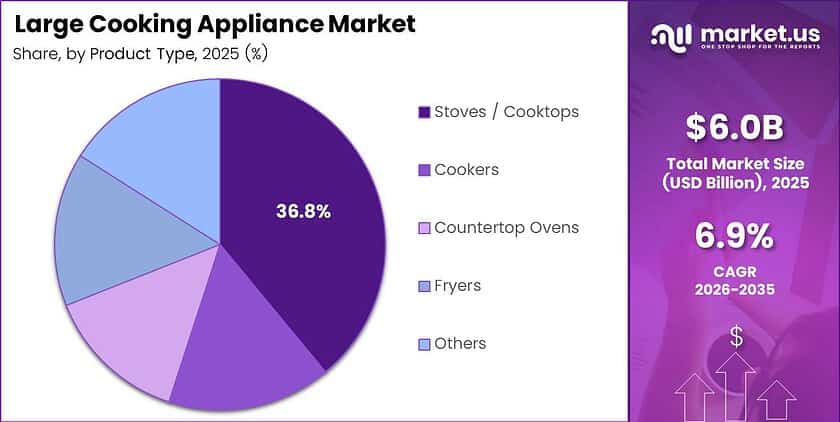
- Stoves / Cooktops lead product types with 36.89%, while Countertop Ovens grow fastest.
- Hypermarket & Supermarket dominates distribution with 45.77%, while Online grows fastest.
- Commercial leads applications with 67.90% and is the fastest-growing category.
- Asia-Pacific leads with 36.54%, worth USD 11.27 billion, while Middle East & Africa grows fastest.
Market Segmentation Overview
Stoves / Cooktops dominate the product type segment with 36.89% share in 2025 due to daily meal preparation. Electricity supplied 52.2% of EU residential cooking energy in 2024. Consequently, manufacturers shifting lines toward multi-zone electric cooktops secure higher average selling prices in urbanizing housing markets.
Moreover, Cookers pair surface burners with baking cavities, and 89% of U.S. households own a combined range cooker. Countertop Ovens grow fastest because built-in wall ovens need costly cabinetry and rewiring. Fryers and other products complete the mix, with high-recovery fryers serving restaurants.
Hypermarket & Supermarket dominates distribution with 45.77% share in 2025 because shoppers inspect appliances in person and use instant credit. Meanwhile, Online grows fastest as home delivery and old-unit haul-away remove logistics friction. Specialty Stores serve premium remodel buyers who need technical advice.
Commercial dominates the application segment with 67.90% share in 2025 and grows fastest. Multi-shift output and tight labor availability push restaurants toward programmable combi-ovens and fryers. Meanwhile, Household buyers add baseline demand through replacement of aging stoves and energy-saving upgrades.
Drivers
Efficiency-led induction substitution leads growth, adding 0.65 percentage points to the CAGR. ENERGY STAR reports induction reaches about 85% heat-transfer efficiency versus roughly one-third for gas. Therefore, buyers switch from gas stoves, and manufacturers compete on operating savings rather than unit price alone.
Essential end-of-life replacement adds 0.50 percentage points across established appliance markets. Moreover, first-time ownership among emerging middle classes adds 0.40 points in India, Southeast Asia, and Latin America. Consequently, brands that localize entry-level cooktops capture sustained volume expansion as clean cooking access reached 75% of the population in 2024.
Data-Driven Insights for Smarter Business Decisions: Explore the Full Report
Use Cases
Restaurants and foodservice chains use programmable combi-ovens, high-recovery fryers, and heavy-duty ranges for multi-shift meal output. The NRA projects U.S. restaurant sales of USD 1.55 trillion in 2026. Consequently, vendors offering automated cooking presets secure multi-unit chain rollout contracts across restaurant groups.
Moreover, hotels, resorts, and airport caterers install high-capacity convection ovens for banquets and all-day buffets. International arrivals rose 4% in 2025 to 1.52 billion visitors. Therefore, manufacturers bundling preventive maintenance agreements with commercial lines lock in recurring multi-year service revenue.
Major Challenges
Maritime routing volatility drags growth by 0.30 percentage points. Suez Canal tonnage fell roughly 70% by mid-2024, and longer routes tie up working capital. Consequently, a 50% freight hike adds 1.5% to 2.5% to unit cost, so brands regionalize final assembly and dual-source components.
However, housing-transaction purchase deferrals restrain growth by 0.45 percentage points. U.S. existing-home sales hit 4.06 million in 2024, the lowest since 1995. Therefore, non-moving households in mortgage-sensitive markets postpone upgrades, and manufacturers trim speculative inventory and prioritize mandatory replacement products.
Business Opportunities
Outcome-linked commercial cooking services offer the top opportunity, with 0.35 points of potential CAGR upside. Pilot programs targeting 2% to 4% lower cooking losses can reach service gross margins of 45% to 55%. Therefore, vendors can pair installed ovens with paid yield-optimization subscriptions.
Moreover, certified remanufactured appliance channels add 0.25 points of upside in Europe and North America. Accessible cooking systems for aging households add 0.20 points in Japan, Europe, and North America. Consequently, early movers can serve organized resale markets and older households with tailored products.
Data-Driven Insights for Smarter Business Decisions: Explore the Full Report
Regional Analysis
Asia-Pacific leads with 36.54% share, valued at USD 11.27 billion in 2025. The IMF projects Emerging and Developing Asia to grow 5.1% in 2026. Urban apartment construction and quick-service restaurant networks in China, India, and South Korea accelerate stove and oven installations, so brands localize component sourcing.
However, Middle East & Africa grows fastest as hospitality investment and local assembly expand across urban centers. The IMF projects African GDP growth of 4.6% in 2026. Gulf tourism projects and North African gas grids spur range cooker demand, so regional assembly plants bypass tariffs and shorten dealer lead times.
Recent Developments
- October 2026 — Electrolux started North American joint ventures with Midea and a SEK 4.0 billion savings program.
- September 2026 — LG advanced its USD 600 million Sri City plant, doubling capacity to 29 million units.
- June 2026 — Arçelik agreed to buy Whirlpool’s remaining 25% of Beko Europe for EUR 71.5 million.
- April 2026 — Whirlpool committed USD 60 million to convert Perrysburg, Ohio into its 11th U.S. plant.
- April 2026 — Hitachi agreed to buy Arçelik’s 60% stake in their appliance venture for USD 261 million.
- March 2026 — Philips launched OneChef with 33 cooking functions at INR 19,995.
- March 2026 — Haier’s Kitchen Appliances revenue reached RMB 41.54 billion within record RMB 302.35 billion group revenue.
- February 2026 — Haier completed the RMB 980 million Kwikot purchase from Electrolux South Africa.
- January 2026 — Electrolux Professional bought Royal Range, adding SEK 100 million in annual sales.
- September 2025 — Bajaj Electricals agreed to buy Morphy Richards brand rights across India and 5 neighbors for INR 146 crore.
- June 2025 — BSH opened a EUR 50 million Cairo factory with 1,000 jobs.
- April 2025 — Midea completed the EUR 175 million purchase of 97.38% of Teka Group.
Conclusion
The large cooking appliance market grows from USD 30.9 billion in 2025 at a 6.9% CAGR. Induction substitution and replacement demand power this momentum. Consequently, brands now compete on energy efficiency and smart features across residential and commercial kitchens worldwide.
Stoves / Cooktops, Hypermarket & Supermarket, and Commercial lead their segments with 36.89%, 45.77%, and 67.90% shares. Moreover, Asia-Pacific commands 36.54% of revenue, while Middle East & Africa grows fastest. Countertop Ovens and Online channels also grow fastest in their segments.
Companies must act on two priorities. First, manufacturers should invest in induction, power electronics, and regional assembly to meet efficiency rules and freight risks. Additionally, commercial vendors should add paid software and service contracts. Therefore, early movers can capture growth as the market reaches USD 60.5 billion by 2035.
Looking for data tailored to your specific market, region, or business need? Request a custom report or consultation — write to us at sales@market.us
Discuss your needs with our analyst
Please share your requirements with more details so our analyst can check if they can solve your problem(s)