Market Overview
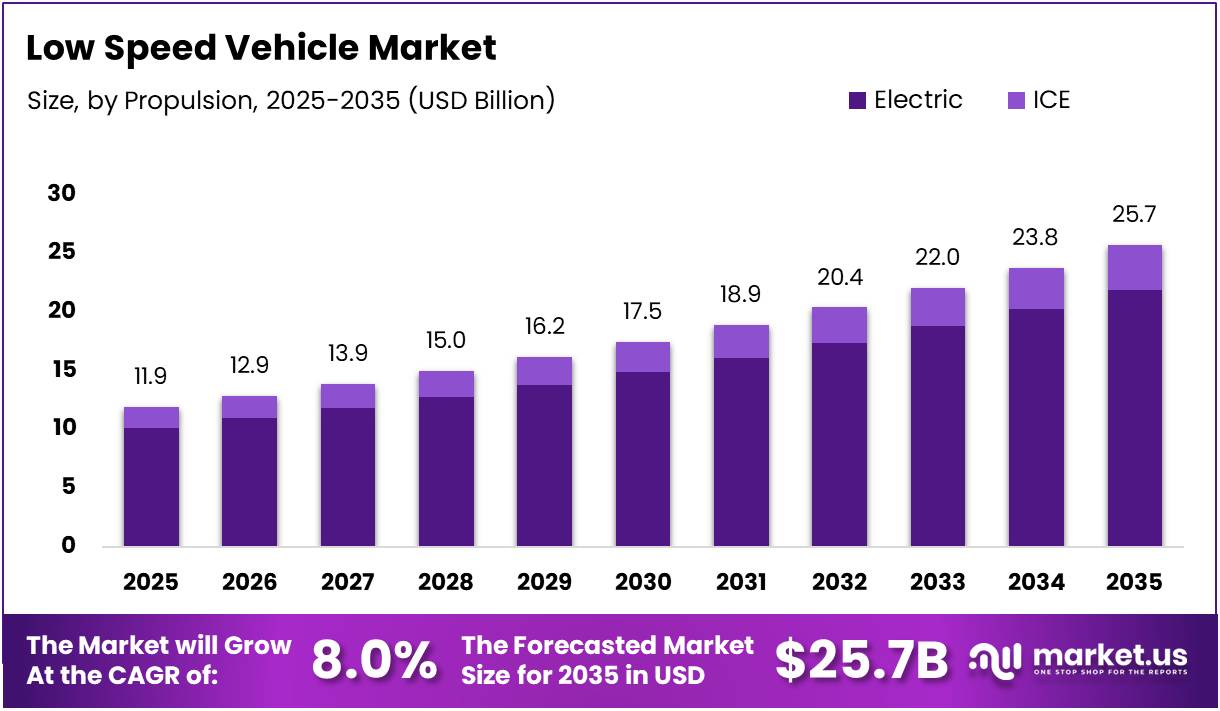
The global low speed vehicle market was valued at USD 11.9 Billion in 2025 and is projected to reach USD 25.7 Billion by 2035. The industry is expected to expand at a CAGR of 8.0% between 2026 and 2035. Rising demand for short-distance transportation and eco-friendly mobility solutions continues to drive adoption across multiple sectors.
Low speed vehicles (LSVs) are compact motorized vehicles designed to operate at speeds typically below 25 miles per hour. Organizations widely use them for short-range transport in controlled environments. Common users include golf courses, resorts, industrial facilities, airports, and gated communities seeking efficient internal mobility solutions.
Get further insight into the global trends shaping the future of the Low Speed Vehicle industry. Request Sample
Hospitality, tourism, logistics, and campus infrastructure sectors represent major demand sources. Golf courses rely on these vehicles for player transport and course operations. Airports deploy them for passenger assistance and baggage movement. Meanwhile, industrial facilities use them for internal logistics and workforce transportation across large production areas.
Manufacturers increasingly integrate electric powertrains, telematics systems, and connected fleet technologies. These innovations allow operators to monitor vehicle location, battery status, and maintenance requirements in real time. Consequently, improved operational efficiency and reduced maintenance costs encourage large organizations to deploy LSV fleets.
Government policies supporting electric mobility also accelerate industry expansion. Several countries permit street-legal LSVs on public roads with limited speed thresholds. Incentives for electric vehicles encourage organizations to transition from fuel-based models to battery-powered alternatives, which produce zero tailpipe emissions.
Industry data from WiTricity highlights strong real-world utilization patterns. The organization reports that 46% of neighborhood electric vehicle owners use their LSV daily for short trips. Additionally, 45% frequently travel distances between two and five miles. These figures demonstrate consistent usage and support stable long-term demand.
Key Takeaways
- The global low speed vehicle market was valued at USD 11.9 Billion in 2025 and is projected to reach USD 25.7 Billion by 2035.
- The market is expected to grow at a CAGR of 8.0% during the forecast period 2026–2035.
- By vehicle type, Golf Cart dominates the segment with a share of 47.8% in 2025.
- By propulsion, Electric vehicles lead the market with a share of 85.3% due to zero-emission mobility demand.
- By power output, the 6-15 KW segment holds the largest share of 49.6% in 2025.
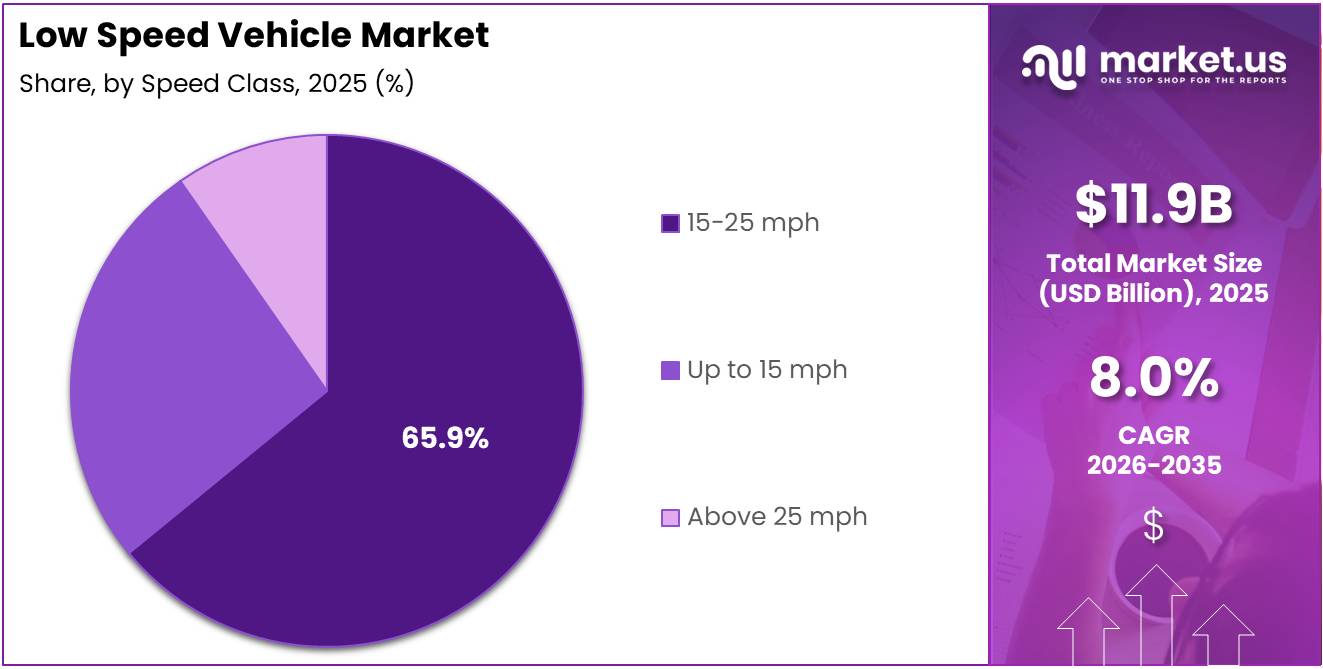
- By speed class, the 15-25 mph category dominates with a share of 65.9%.
- By application, Golf Courses account for the highest market share of 44.4%.
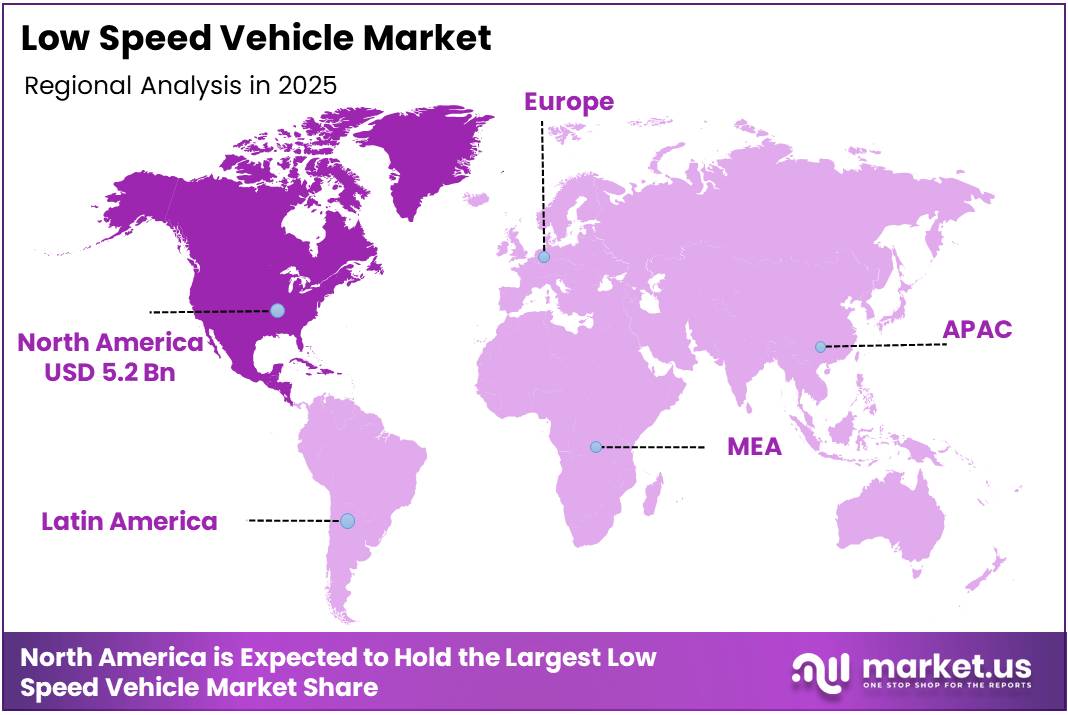
- North America leads the global market with a share of 43.70%, valued at USD 5.2 Billion in 2025.
Market Segmentation Overview
The Golf Cart segment dominates the vehicle category with a market share of 47.8% in 2025. This leadership reflects extensive adoption across golf courses, resorts, and hospitality facilities worldwide. These vehicles offer compact design, simple operation, and low maintenance costs, which encourages operators to maintain large fleet deployments.
Electric propulsion holds the leading position with a share of 85.3%. Organizations prefer electric models because they produce zero emissions and operate quietly. Consequently, airports, hotels, and campuses deploy electric variants in environmentally sensitive environments where noise and emissions restrictions apply.
The 6-15 KW power output segment accounts for 49.6% of the market. This power range provides sufficient performance for standard low-speed operations while maintaining high energy efficiency. Therefore, most golf carts and personal mobility vehicles operate within this output range.
The 15-25 mph speed class leads with a share of 65.9%. Vehicles within this range comply with neighborhood electric vehicle regulations that allow limited public road access. Consequently, this category offers greater operational flexibility for both commercial fleet operators and residential users.
Golf Courses dominate the application segment with a share of 44.4%. Golf facilities require large fleets for player transport, equipment movement, and course management. Regular fleet replacement cycles and global growth in golf participation continue to sustain strong demand in this segment.
Drivers
Growing urban congestion drives demand for compact mobility alternatives. Cities, campuses, and commercial properties increasingly adopt low speed vehicles for short-distance transport. Rising fuel costs strengthen this shift toward economical solutions. Consequently, organizations deploy LSV fleets to reduce operating expenses and environmental impact.
Electric mobility adoption significantly accelerates industry growth. Electric LSVs offer lower maintenance costs and zero tailpipe emissions compared with internal combustion models. Fleet operators benefit from reduced fuel expenses and quieter operation. Therefore, hospitality venues, airports, and industrial facilities increasingly transition to electric-powered vehicles.
Use Cases
Golf courses represent the most established application for low speed vehicles. Operators use these vehicles to transport players, staff, and equipment across large properties. Efficient mobility improves course management and customer experience. Consequently, golf facilities maintain substantial fleets and replace vehicles regularly.
Airports increasingly deploy low speed vehicles for passenger assistance and baggage transport. Ground crews use them to move efficiently between terminals and operational areas. Electric variants also reduce noise and emissions in sensitive environments. Therefore, airport authorities prioritize these vehicles in sustainable fleet programs.
Major Challenges
Speed limitations restrict broader adoption of low speed vehicles. Most models cannot operate on highways or high-speed roads. This restriction limits their use to campuses, resorts, and controlled environments. Consequently, organizations requiring versatile transportation solutions may choose conventional vehicles instead.
Regulatory differences across regions create compliance challenges for manufacturers. Each market applies different safety and road-use standards for low speed vehicles. Companies must adapt designs and certifications accordingly. Therefore, regulatory complexity increases development costs and slows international market expansion.
Business Opportunities
Smart city initiatives present significant opportunities for low speed vehicle deployment. Urban planners integrate dedicated lanes, charging infrastructure, and shared fleet programs into sustainable mobility strategies. Consequently, municipalities increasingly adopt electric LSV fleets to support low-emission transportation in urban communities.
Last-mile delivery services represent another emerging growth area. Logistics operators evaluate low speed vehicles as cost-effective alternatives for short-range parcel distribution. These vehicles reduce fuel consumption and operating expenses. Therefore, manufacturers are developing cargo-focused platforms tailored for urban delivery fleets.
Regional Analysis
North America dominates the global low speed vehicle market with a share of 43.70%, valued at USD 5.2 Billion in 2025. The region hosts a large number of golf courses, gated communities, and resort properties. Supportive regulations for street-legal LSVs further encourage commercial and residential adoption.
Asia Pacific represents the fastest-growing regional market due to rapid urbanization and expanding tourism infrastructure. Countries such as China and India are investing heavily in electric mobility initiatives. Consequently, demand for low speed vehicles continues rising across industrial campuses, airports, and hospitality facilities.
Recent Developments
- September 2025 — Waev Inc. launched the GEM eX electric utility vehicle meeting LSV standards for government and industrial fleets.
- August 2025 — ACG Inc. introduced the 2025 MOKE NEV electric vehicle targeting personal and resort mobility segments.
Conclusion
The global low speed vehicle market is expanding steadily as organizations adopt compact electric mobility solutions. Rising urban congestion, sustainability goals, and operational cost savings drive this transition. Consequently, industries including hospitality, logistics, and infrastructure increasingly integrate these vehicles into daily operations.
Golf carts remain the dominant vehicle category, while electric propulsion leads the powertrain segment. Golf courses continue to represent the largest application area. Meanwhile, North America maintains market leadership due to strong infrastructure and regulatory support for street-legal LSV deployment.
Manufacturers must invest in electric powertrains, connected fleet technologies, and specialized vehicle platforms. Companies that align products with smart city initiatives and commercial logistics demand will gain competitive advantage. These strategies position the market to reach USD 25.7 Billion by 2035.
Looking for data tailored to your specific market, region, or business need? Request a custom report or consultation — write to us at sales@market.us
Discuss your needs with our analyst
Please share your requirements with more details so our analyst can check if they can solve your problem(s)