
Market Overview
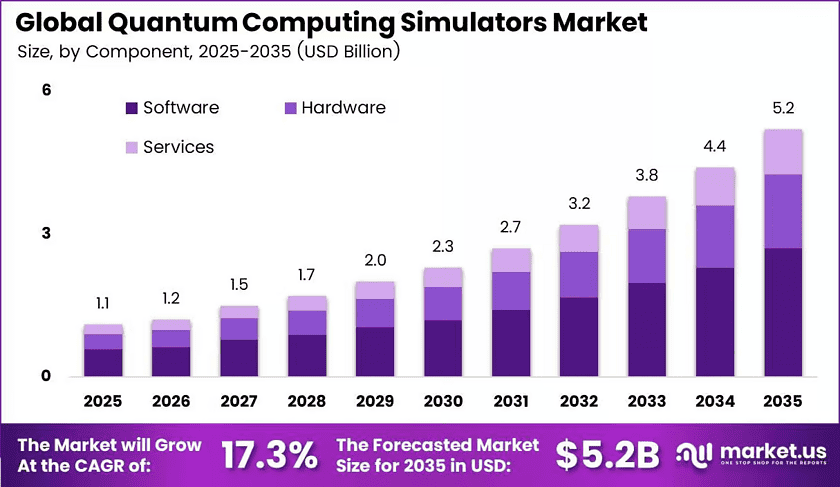
New York, NY – August 21, 2026 – The Quantum Computing Simulators Market reached USD 1.1 billion in 2025. The market will grow at a 17.3% CAGR through 2035. It should reach USD 5.2 billion, as companies test quantum programs before investing in physical quantum machines.
Moreover, quantum simulator software gives research teams a lower-cost route to build and debug quantum code. IBM reported more than USD 1 billion in cumulative quantum-related revenue. This milestone shows that commercial users increasingly pay for quantum tools before large-scale machines become broadly available.
Additionally, Asia Pacific held over 42.1% of global revenue in 2025. The region generated about USD 0.43 billion, according to the report data. Government-backed programs in China and Japan support laboratories, chip research, and software testing, which expand demand for virtual quantum environments.
Japan allocated JPY 1.05 trillion for next-generation chip and quantum research. This funding equals roughly USD 7.4 billion and strengthens national simulation capabilities. Consequently, universities and institutes can build more advanced testing programs without depending solely on experimental quantum hardware.
China also committed CNY 121.8 billion to regional quantum-focused venture funds. The amount equals about USD 17.5 billion and supports hardware and software infrastructure. Therefore, the Quantum Computing Simulators Market benefits from stronger regional demand for design, testing, and validation tools.
Key Takeaways
- The Quantum Computing Simulators Market stood at USD 1.1 billion in 2025 and should reach USD 5.2 billion by 2035.
- The market will expand at a 17.3% CAGR during 2026–2035, reflecting rising demand for lower-cost quantum software testing.
- Software leads the component segment with a 52.6% share because open tools simplify quantum program development.
- Cloud-based deployment leads with a 62.4% share because users can access computing resources without owning laboratory infrastructure.
- Digital quantum simulation holds a 46.3% share, supported by broad compatibility with familiar programming methods.
- Large enterprises account for a 68.8% share, as they fund specialized teams and longer research programs.
- Asia Pacific leads with a 42.1% share worth about USD 0.43 billion, supported by public quantum investment.
➤ Get Instant Access to the Premium Report Sample Before Purchase – https://market.us/report/quantum-computing-simulators-market/request-sample/
Market Segmentation
Software leads the component segment with a 52.6% share. IBM reported over 500,000 Qiskit downloads and more than 450,000 registered users. These figures show that developers favor simulator software because it supports program testing without expensive access to quantum hardware.
Additionally, the U.S. Department of Energy committed USD 625 million over five years to quantum information science centers. This funding supports national laboratories and associated research systems. Consequently, services and hardware tools should gain demand as laboratories connect simulator platforms with emerging quantum testbeds.
Cloud-based deployment holds a 62.4% share because organizations rent computing capacity rather than buy dedicated equipment. Eurostat reported that 45.2% of European Union businesses purchased cloud services in 2023. This adoption pattern lowers entry barriers for quantum simulation users and supports flexible project scaling.
However, on-premises systems remain important for sensitive projects that need direct data control. Hybrid deployment combines local security with external computing capacity. Therefore, hybrid platforms should attract regulated users that need scalable simulation resources while maintaining internal oversight of proprietary algorithms and research data.
Digital quantum simulation leads with a 46.3% share because developers understand gate-based programming methods. The U.S. National Science Foundation reported control of 6,100 neutral-atom qubits in 2025. This milestone supports wider simulator testing as researchers prepare algorithms for larger quantum systems.
Moreover, analog quantum simulation serves specialized scientific problems involving physical systems and materials. Hybrid or approximate simulation combines speed with useful accuracy for complex workloads. Consequently, organizations can match simulation methods to their budgets, algorithm needs, and available classical computing capacity.
Large enterprises hold a 68.8% share because they maintain larger research budgets and specialized teams. The United Kingdom quantum sector employed about 1,700 skilled workers. This concentration shows why major companies lead simulator adoption, as quantum expertise remains scarce and expensive.
Small and medium enterprises increasingly access quantum tools through shared cloud services and public programs. The U.S. National Science Foundation turned an initial USD 135 million investment into over USD 1 billion in private commitments. Therefore, smaller firms can expand participation without building full internal quantum laboratories.
Regional Analysis
Asia Pacific leads the market with a 42.1% share and about USD 0.43 billion in revenue. China’s quantum sector reached CNY 11.56 billion in 2025. This scale reflects strong state funding, which accelerates simulator demand across national laboratories, universities, and technology companies.
North America records the fastest regional growth through corporate cloud investment and federal research programs. IBM, Google, Microsoft, and Amazon support active quantum development across the region. Additionally, Europe maintains steady adoption, as Spain committed nearly USD 900 million for its 2025–2030 quantum strategy and research capacity.
Drivers
Cloud-based simulator access drives market growth by replacing costly on-site licensing models. Eurostat reported that 45.2% of European Union businesses bought cloud services in 2023. This broad adoption means firms already understand subscription computing, making quantum testing easier to purchase and scale.
National quantum research budgets also accelerate simulator adoption in public laboratories and universities. Japan allocated JPY 1.05 trillion for chip and quantum research. Consequently, public funding expands research capacity and creates demand for software tools that validate algorithms before hardware systems reach wider commercial use.
Use Cases
Pharmaceutical companies use quantum simulators to explore molecular behavior before running costly laboratory experiments. These platforms help research teams test algorithm designs and compare computational approaches. Moreover, virtual testing reduces early project risk because scientists can refine models before requesting access to limited quantum hardware.
Financial institutions use simulation tools to evaluate portfolio optimization, risk models, and fraud detection methods. These users need secure environments that handle complex calculations and protect sensitive data. Therefore, hybrid quantum workflows help banks connect experimental algorithms with established classical analytics and compliance systems.
Business Opportunities
Simulation providers can build tiered software services for small and medium enterprises. Flexible subscriptions can match limited budgets and changing project needs. Moreover, vendors can combine guided onboarding, training modules, and prebuilt templates to help new users begin quantum development without hiring large technical teams.
Technology vendors can integrate quantum simulation with enterprise cloud, analytics, and workflow platforms. These integrations help customers use quantum methods alongside familiar business systems. Consequently, providers can expand into finance, materials science, logistics, and life sciences where teams need practical ways to test advanced algorithms.
Major Challenges
Quantum software talent shortages limit customer onboarding and slow product development. Companies compete for engineers who understand quantum programming, classical computing, and scientific modeling. However, training programs and open software communities can widen the talent base by giving developers practical simulator access before they work with quantum hardware.
Simulator scaling creates high computing costs when users model larger quantum systems. Hardware-linked testbeds also face supply chain and export-control delays. Therefore, vendors must improve algorithms, use efficient cloud resources, and offer hybrid approaches that balance accuracy, runtime, and customer spending.
Top Key Players in the Market
- IBM
- Google Quantum
- Microsoft
- Amazon
- SpinQ
- Quantinuum
- Xanadu Quantum Technologies
- Atos
- Honeywell
- Infleqtion
- Intel
Conclusion
The Quantum Computing Simulators Market will expand as enterprises, laboratories, and developers seek practical ways to test quantum algorithms. Cloud delivery, open software, and public research funding support wider access. However, talent gaps, computing costs, and hardware trade restrictions remain important barriers. Market leaders can gain advantage by offering flexible simulation services, stronger developer tools, and secure hybrid workflows.
Discuss your needs with our analyst
Please share your requirements with more details so our analyst can check if they can solve your problem(s)