Market Overview
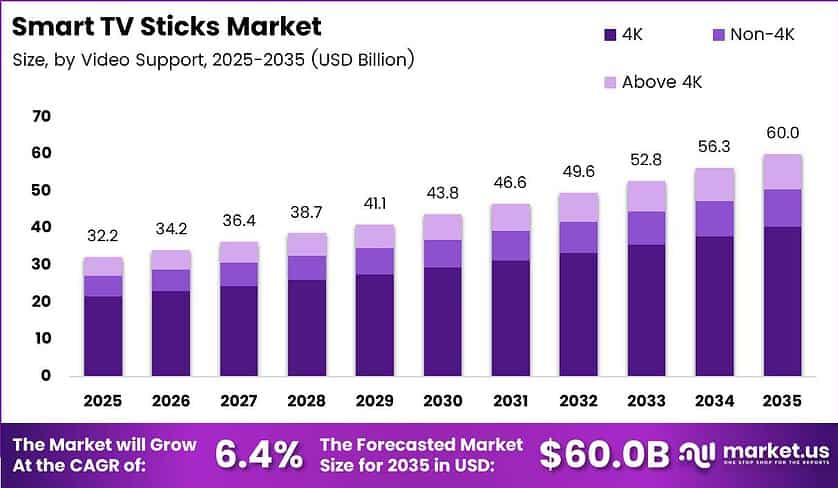
The global smart TV sticks market reaches USD 60.0 billion by 2035, up from USD 32.2 billion in 2025. Analysts project a 6.4% CAGR during the 2026 to 2035 forecast period. This growth shows strong household demand for low-cost television upgrades.
Smart television sticks are compact plug-and-play media receivers that connect to display ports and stream video over wireless networks. Households use them to turn older televisions into smart entertainment hubs. This approach avoids expensive new sets and lowers hardware replacement costs for price-sensitive consumers.
Moreover, the industry links hardware makers, operating system owners, and advertising networks across residential and hospitality sectors. Households stream video on retrofitted screens, while hotels, dormitories, and hospitals use managed sticks. Platform owners sell sticks near cost to capture subscription splits and recurring home-screen advertising budgets.
Key Takeaways
- The market stood at USD 32.2 billion in 2025.
- Total valuation will reach USD 60.0 billion by 2035.
- The market expands at a 6.4% CAGR from 2026 to 2035.
- 4K devices led video support with a 67.34% share in 2025.
- Online retail led distribution with a 46.89% share in 2025.
- Asia-Pacific dominated demand with 38.56%, valued at USD 12.39 billion.
Data-Driven Insights for Smarter Business Decisions: Explore the Full Report
Market Segmentation Overview
4K dominates the video support segment with 67.34% share in 2025 due to widespread ultra-high-definition display adoption. Fast fiber networks prevent buffering, so Amazon launched its Fire TV Stick 4K Select at USD 49.99 in the United States. Consequently, 4K becomes the baseline specification.
However, Non-4K sticks serve budget buyers upgrading older secondary screens in bandwidth-constrained regions, where 2.2 billion people remained offline in 2025. Roku sells an HD stick at USD 29.99. Meanwhile, Above 4K devices grow fastest as premium buyers adopt high-frame-rate displays, allowing chipmakers to charge higher prices.
Online dominates the distribution channel segment with 46.89% share in 2025 due to frequent promotional discounting. Digital storefronts let platform owners run flash sales without paying physical shelf fees. Consequently, brands focus marketing budgets on digital marketplaces. U.S. retail e-commerce sales reached USD 1,233.7 billion in 2025.
Hypermarket & Supermarket channels grow fastest by placing impulse electronics near checkout lanes. Walmart completed a USD 2.3 billion Vizio acquisition in December 2024, adding 19 million active accounts. Meanwhile, Specialty Stores attract home-theater buyers who want expert advice and bundled audio accessories.
Drivers
Connected TV ad-supported monetization leads growth, adding 2.4 percentage points to the CAGR. Ecosystem operators subsidize hardware bill-of-materials costs by 18% to 26% per unit. In return, platform owners capture ad-inventory splits of 30% to 50%, which turns hardware sales into customer acquisition channels.
Legacy non-smart display retrofit demand adds 1.8 percentage points across Asia-Pacific and Latin America. Households convert older televisions instead of buying new sets. Moreover, broadband expansion in India grew subscribers 12.90% to 1,065.88 million by March 2026, pushing families away from satellite television.
Data-Driven Insights for Smarter Business Decisions: Explore the Full Report
Use Cases
Households use smart sticks to turn older televisions into streaming hubs. TRAI data show active pay DTH subscribers in India fell from 52.78 million to 50.99 million. Consequently, retrofit sticks win families that cancel satellite television, at low hardware cost.
Moreover, hotels, student dormitories, and hospitals use managed streaming sticks for room entertainment. Over 65% of global hotel rooms still run legacy set-top boxes costing USD 180 to USD 320 per room to replace. By contrast, commercial dongles cost only USD 32 to USD 45 per screen.
Major Challenges
Integrated smart TV operating systems cannibalize sales, dragging growth by 2.1 percentage points. Built-in software exceeded 92% of global flat-panel shipments by late 2025. Therefore, buyers skip external sticks on new televisions, which cut primary-screen attach rates by 14.5% year over year.
However, memory cost volatility drags growth by another 1.4 percentage points. Memory chips represent 28% to 34% of dongle component costs, and contract prices jumped 22% to 35% in 2025. Consequently, brands cannot raise fixed retail prices without demand drops above 19%.
Business Opportunities
Hospitality and enterprise cast-to-room fleets offer the top opportunity, with 1.9 points of potential CAGR upside. Software licenses of USD 1.50 to USD 2.75 per screen each month lift gross margins by 1,100 to 1,450 basis points. Therefore, vendors avoid retail discounting and earn predictable recurring revenue.
Moreover, cloud gaming low-latency controller bundles add 1.5 points of upside across North America, Europe, and East Asia. In December 2025, Amazon and Xbox expanded Xbox Cloud Gaming to Fire TV 4K sticks in 29 countries. Consequently, gaming bundles turn simple streaming sticks into higher-value entertainment devices.
Data-Driven Insights for Smarter Business Decisions: Explore the Full Report
Regional Analysis
Asia-Pacific leads with 38.56% share, valued at USD 12.39 billion in 2025. GSMA reports that mobile technologies added USD 1 trillion to the regional economy, or 5.9% of GDP. Cheap data and expanding fiber push consumers to replace cable boxes, so device makers localize language interfaces.
However, Middle East & Africa grows fastest as telecom operators bundle streaming hardware with home internet plans. ITU found internet penetration reached 70% in the Arab States and 36% in Africa in 2025. Therefore, distributors partner with mobile carriers and use carrier billing to bypass banking barriers.
Recent Developments
- October 2026 — Apple launched the 4th-generation Apple TV 4K at USD 299 across 30 countries.
- September 2026 — Amazon launched the 2026 Fire TV Stick 4K at USD 59.99, with promotional pricing of USD 24.99.
- September 2026 — Best Buy, Amazon Fire TV, and Roku launched Best Buy CTV, backed by data from 200 million customers.
- April 2026 — Roku launched Roku Curate, combining data from 100 million households with 6 retail partners.
- March 2026 — Roku and Amazon Prime Video brought the USD 2.99 monthly Howdy service and 10,000 content hours onto Prime Video.
- December 2025 — Amazon and Xbox expanded Xbox Cloud Gaming to Fire TV 4K sticks in 29 countries from USD 9.99 monthly.
- August 2025 — Roku launched ad-free Howdy in the United States at USD 2.99 monthly.
- July 2025 — Xiaomi launched the TV Stick 4K 2nd Gen at INR 3,999.
- May 2025 — Dish TV India launched Watcho FLIQS on DishSMRT Hub with 300 live channels.
- March 2025 — CloudWalker and Dish TV integrated Watcho OTT across 200 smart television and device models.
- February 2025 — Sky launched Sky Glass Gen 2 from GBP 14 monthly or GBP 699 upfront.
Conclusion
The smart TV sticks market grows from USD 32.2 billion in 2025 at a 6.4% CAGR. Ad-supported monetization and retrofit demand power this momentum. Consequently, platform owners treat sticks as low-cost gateways to recurring advertising and subscription revenue from connected households.
4K devices lead video support with 67.34%, and Online leads distribution with 46.89%. Moreover, Asia-Pacific commands 38.56% of revenue, while Middle East & Africa grows fastest. Above 4K devices and Hypermarket & Supermarket channels also grow fastest in their respective segments.
Companies must act on two priorities. First, vendors should shift from hardware margins to software, advertising, and commercial fleet revenue. Additionally, they should secure memory supply through multi-year contracts. Therefore, early movers can capture growth as the market reaches USD 60.0 billion by 2035.
Looking for data tailored to your specific market, region, or business need? Request a custom report or consultation — write to us at sales@market.us
Discuss your needs with our analyst
Please share your requirements with more details so our analyst can check if they can solve your problem(s)