Introduction
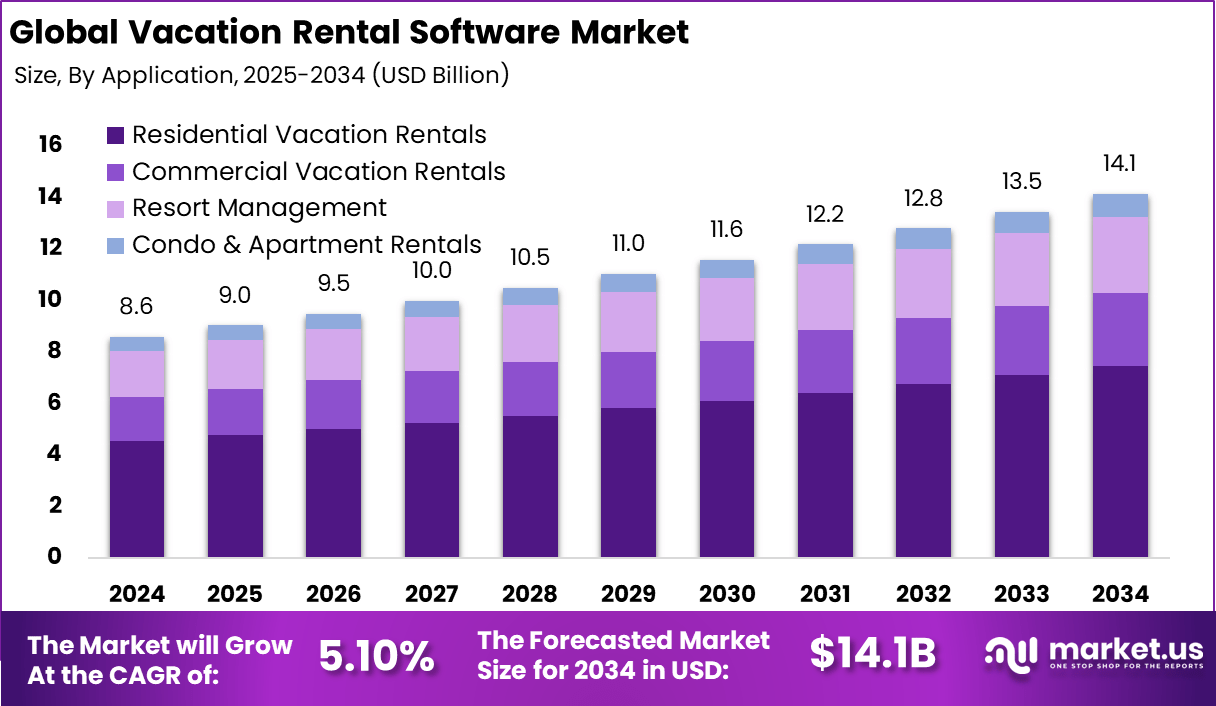
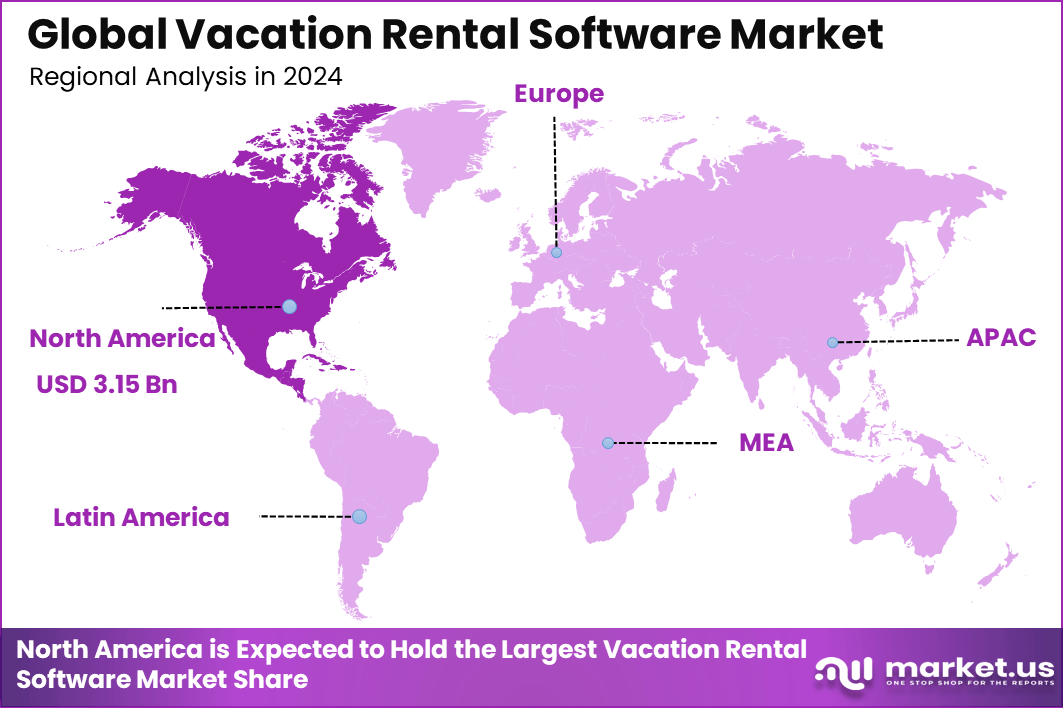
The Global Vacation Rental Software Market generated USD 8.6 billion in 2024 and is predicted to register growth from USD 9.0 billion in 2025 to about USD 14.1 billion by 2034, recording a CAGR of 5.10% throughout the forecast span. In 2024, North America held a dominan market position, capturing more than a 36.7% share, holding USD 3.15 Billion revenue.
Vacation rental software is used to manage short term property rentals through a single digital platform. It helps property owners, managers, and hosts handle reservations, calendar availability, guest communication, pricing, payments, and housekeeping operations. As travelers increasingly choose homes, apartments, and unique stays over traditional accommodation, the short term rental industry has become more operationally complex. Software solutions are helping users manage multiple listings efficiently while improving the guest experience and reducing manual workload.
One of the main driving factors is the continued growth of digital travel booking behavior. Travelers expect quick booking, instant confirmation, transparent pricing, and smooth communication, which encourages hosts and managers to adopt professional management tools. In addition, owners with multiple properties need centralized systems to manage calendars across different booking channels and avoid double bookings.
The rise of dynamic pricing strategies is also supporting demand, as users seek tools that can adjust rates based on seasonality, demand, and local events. Regulatory compliance, tax reporting, and identity verification requirements in many regions are further pushing the need for organized software systems.
Demand for vacation rental software is rising as property managers look for scalable and easy to use operational tools. There is a strong preference for platforms that integrate with online travel marketplaces, payment systems, and smart property devices such as locks and thermostats. Users are also seeking solutions that offer mobile access, automated messaging, and performance reporting.
The demand is particularly strong among professional hosts and management firms handling multiple properties, though independent hosts are also adopting simpler solutions. As the vacation rental sector becomes more competitive and service focused, the need for reliable and intelligent management software is expected to grow steadily.
Top Key Market Segment
- Cloud-based deployment dominates at 72.6%, delivering real-time synchronization, mobile access, and automatic updates without on-site servers.
- Residential vacation rentals capture 52.8% application share, powering urban apartments, beach homes, and family properties with dynamic pricing and guest self-check-in.
- Property management companies hold 34.2% end-user share, leveraging platforms for portfolio scaling, OTA integration, and performance analytics.
- North America drives 36.7% global value, with U.S. market at USD 2.84 billion and 4.37% CAGR, fueled by Florida/California property booms and tech-savvy hosts.
How AI is Reshaping the Future of this market?
AI is reshaping the future of the vacation rental software market by making property operations faster, smarter, and more automated. Traditional software mainly focused on bookings, calendars, and payments, but AI is helping platforms handle guest communication, pricing decisions, review analysis, and listing optimization with less manual effort. Property managers are using AI tools to answer common guest questions, send timely messages, adjust rental rates based on demand, and improve occupancy planning. This reduces workload, improves response time, and helps managers handle a larger number of properties more efficiently.
AI is also improving the guest experience, which is becoming an important factor in software selection. Vacation rental platforms are increasingly expected to offer personalized search results, smart recommendations, faster support, and smoother booking journeys. In the future, demand is likely to rise for software that combines automation, revenue intelligence, and customer engagement in one system. As competition grows in the vacation rental space, software providers that offer stronger AI-driven insights, better operational control, and more personalized service are expected to gain an advantage.
Regional Analysis
In 2024, North America held a dominant market position, capturing more than a 36.7% share, holding USD 3.15 Billion in revenue. This leadership was mainly supported by the region’s early and widespread adoption of digital tools across the vacation rental industry. Property managers and hosts in the US and Canada have shown strong interest in software platforms that help manage bookings, pricing, guest communication, channel distribution, and payment processing through a single system. The region also has a well-established short-term rental ecosystem, supported by high internet penetration, mature cloud infrastructure, and a large base of professional property management companies that actively invest in automation.
Another major reason North America remained ahead is the strong presence of technology-focused rental operators that prioritize operational efficiency and guest experience. The market in this region has moved beyond basic reservation tools and is increasingly centered on advanced features such as dynamic pricing, mobile access, contactless check-in, automated messaging, accounting integration, and performance analytics. These capabilities are especially important in a competitive rental environment where hosts and managers need to improve occupancy, respond faster to guests, and manage properties across multiple listing channels. This practical need for efficiency has kept software adoption high across both independent operators and enterprise-level users.
Europe continued to show steady growth, supported by a large tourism base and rising digital transformation among holiday property owners, although market fragmentation across countries and regulatory differences created a more varied adoption pattern. Latin America emerged as a developing market with growing interest in cloud-based rental tools, especially among urban and tourism-driven destinations, but budget sensitivity and uneven digital maturity limited faster expansion.
The Middle East and Africa also presented long-term opportunities as tourism investments and hospitality modernization increased, though the market remained comparatively smaller due to lower penetration of organized vacation rental software in several countries. Overall, North America led because it combined market maturity, stronger technology spending, and a more advanced vacation rental operating model than the other regional markets.
Driver
A key driver in the Vacation Rental Software Market is the growing need for centralized property and booking management. Property owners and managers often handle reservations from multiple channels, guest communication, calendar updates, pricing changes, and housekeeping tasks at the same time. Vacation rental software helps bring these functions into one system and reduces operational confusion.
This is becoming more important as short term rental businesses try to improve guest service while managing daily work more efficiently. A well-structured software platform helps reduce double bookings, supports faster responses to guests, and improves control over property operations across single or multiple listings.
Restraint
A major restraint in this market is the high dependence on platform integration and system compatibility. Many property managers already use separate tools for accounting, channel distribution, payment processing, and customer communication. When the software does not connect smoothly with these systems, the user may face delays, errors, and extra manual work.
This creates hesitation among smaller operators and traditional property owners who want simple solutions without technical complications. In some cases, the learning curve and setup effort also slow adoption, especially for users who are moving from manual management or basic booking tools.
Opportunity
A strong opportunity in the Vacation Rental Software Market lies in the rising demand from independent hosts and small property managers. Many of these users are moving from informal operations to more structured business models and now need better tools to manage reservations, guest reviews, maintenance schedules, and revenue tracking.
There is also room for growth in software that offers localized features, mobile access, and automation for routine tasks. As more hosts aim to improve guest experience and save time, demand is expected to rise for solutions that are easy to use, flexible, and suitable for both single-property and multi-property operations.
Challenge
One of the main challenges in this market is maintaining a balance between automation and personalized guest service. Vacation rentals are often chosen for their unique and more personal experience compared with traditional accommodation. If software-driven communication becomes too generic or rigid, it may reduce guest satisfaction and weaken host relationships.
Another challenge is managing changing booking patterns, cancellations, seasonal demand shifts, and property-specific needs within one system. Software providers need to support a wide range of property types and business models while keeping the platform simple, reliable, and easy for everyday users.
Key Market Segment
By Software
- Property Management Software (PMS)
- Channel Management Software
- Booking Engine Software
- Pricing & Revenue Management Software
- Others
By Deployment
- Cloud-based
- On-premise
By Application
- Residential Vacation Rentals
- Commercial Vacation Rentals
- Resort Management
- Condo & Apartment Rentals
By End-User
- Property Management Companies
- Vacation Rental Agencies
- Real Estate Companies
- Others
Competetive Analysis
The competitive landscape of the Vacation Rental Software Market is shaped by a mix of property management platform providers and booking automation specialists. Companies such as Guesty, Hostfully, Lodgify, Hostaway, and Streamline focus on comprehensive software solutions that help property owners and managers handle reservations, channel distribution, guest communication, and payment processing. These players emphasize automation, multi-property management, and integration with major booking platforms. Their strong product ecosystems and focus on operational efficiency help them maintain a leading position in the market.
At the same time, companies such as OwnerRez, MyVR, Smoobu, Uplisting, LiveRez, Bookerville, Rentals United, Sync, and Tokeet compete by offering flexible and cost-effective solutions for small and mid-sized rental operators. These players focus on easy setup, calendar synchronization, and direct booking website tools. Companies like TurnKey also contribute through managed service models supported by technology platforms. Competition in this market is driven by automation, ease of use, channel management capabilities, and the ability to improve occupancy rates and guest experience
Top Key Players
- Guesty
- Hostfully
- OwnerRez
- Lodgify
- Streamline
- MyVR
- TurnKey
- Hostaway
- Smoobu
- Uplisting
- LiveRez
- Bookerville
- Rentals United
- Sync
- Tokeet
- Others
Recent Development
- March, 2026 – Guesty launches AI GuestMatch matching travelers to properties using 50+ data points. Unified Inbox consolidates 15 channels while automation handles 90% routine tasks. Enterprise PMS leader.
- February, 2026 – Hostfully Digital Guide Builder adds interactive maps+AR tours boosting direct bookings 30%. Channel manager syncs 50 OTAs while guidebooks personalize via guest preferences. Guide-focused specialist.
Conclusion
The vacation rental software market is expected to remain on a strong growth path as property managers and hosts continue to focus on better booking control, smoother guest communication, automated pricing, channel management, and easier day to day operations. Demand is being supported by the rising use of short term rental platforms, growing competition among property owners, and the need to manage multiple listings with less manual work. Cloud based systems, mobile access, and integration with payment, marketing, and customer support tools are making these solutions more practical for both small hosts and large rental operators. As the market continues to mature, vendors that offer simple interfaces, reliable automation, flexible integration, and strong customer support are anticipated to strengthen their position.
Discuss your needs with our analyst
Please share your requirements with more details so our analyst can check if they can solve your problem(s)