
Market Overview
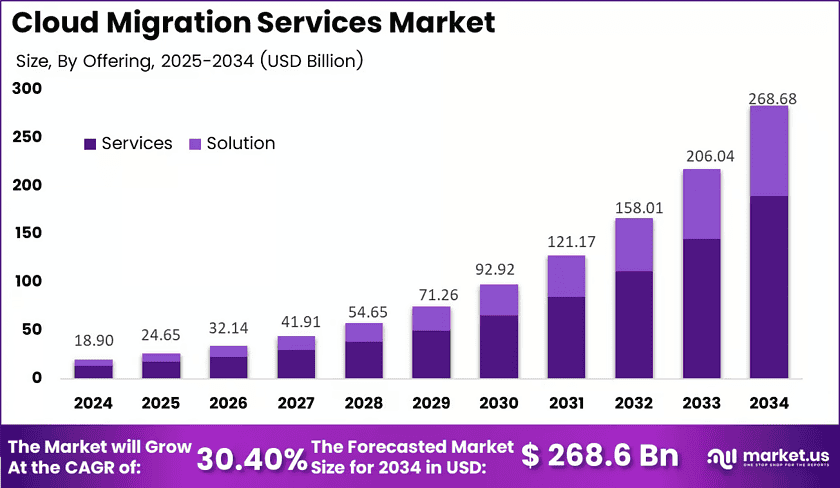
New York, NY – August 24, 2026 – The Global Cloud Migration Services Market reached USD 18.9 billion in 2024. The market could reach USD 268.6 billion by 2034, growing at a 30.4% CAGR. This expansion shows that companies increasingly need expert support to move applications, data, and systems into cloud environments.
Moreover, Eurostat reports that 52.7% of EU enterprises used paid cloud services in 2025, up from 45.2% in 2023. This increase signals broader business demand for cloud platforms. Companies now move beyond basic storage toward database hosting, security tools, and development services.
Additionally, the OECD found that an average of 49% of firms with at least 10 employees use cloud computing across member countries. This leaves a large group of businesses with unfinished modernization plans. Migration providers can help these firms assess workloads, redesign systems, transfer data, and manage risks.
North America led the market with more than 34% share and USD 7.1 billion in revenue during 2024. The region benefits from mature technology infrastructure and strong enterprise spending. Federal modernization also supports service demand, especially where agencies replace older systems and strengthen digital security.
Consequently, cloud migration specialists gain importance as organizations move critical workloads rather than isolated files. Providers combine infrastructure transfer, application modernization, security testing, and managed operations. This service mix helps clients reduce disruption, improve system performance, and create a practical path for continuous digital change.
Key Takeaways
- The market may grow from USD 18.9 billion in 2024 to USD 268.6 billion by 2034, reflecting a 30.4% CAGR.
- Solutions led offerings with a 70.5% share, covering infrastructure, platform, database, application, and storage migration.
- Public cloud deployment led with a 47.8% share because businesses value scalable capacity and lower upfront costs.
- Large enterprises represented 74.4% of market demand, driven by complex systems and efficiency goals.
- IT and telecommunications held a 32.7% share because operators need agile, scalable infrastructure for data and communication services.
- North America held more than 34% market share and generated about USD 7.10 billion in revenue during 2024.
➤ Evaluate the Report Quality with an Exclusive Sample Download – https://market.us/report/global-cloud-migration-services-market/request-sample/
Market Segmentation
Solutions held a 70.5% share of market offerings. This category includes infrastructure, platform, database, application, and storage migration. Businesses choose these services when they need structured technical work across core systems. Moreover, solution providers help clients plan transfers, redesign architecture, test performance, and protect operational continuity.
Services represented the remaining 29.5% of demand through professional and managed offerings. Professional teams guide planning, governance, and implementation. Managed service teams operate cloud environments after migration. Consequently, clients can access specialist skills without building every capability internally, which supports faster modernization and stronger daily control.
Public deployment led with a 47.8% share because organizations value flexible capacity and simpler access to cloud resources. Public platforms help companies start projects without major infrastructure investments. Additionally, providers can scale computing resources quickly, making this model useful for changing workloads, digital services, and innovation programs.
Hybrid deployment accounted for about 35.2% of the market, while private environments held around 17.0%. Hybrid models balance public cloud flexibility with greater control over selected data and applications. However, private cloud remains important for organizations that prioritize security, compliance, sovereignty, and dedicated operational governance.
Large enterprises accounted for a 74.4% share because they manage broad application portfolios and complex data estates. These organizations use migration partners to improve scalability, cost control, and operational efficiency. Therefore, providers that offer portfolio assessment, phased execution, and governance support can address major enterprise requirements.
Small and medium enterprises represented 25.6% of market demand. These businesses often manage tighter budgets and smaller technology teams. However, they increasingly use migration services to modernize operations, gain flexible technology access, and compete with larger firms. Packaged services can make cloud adoption more manageable for this customer group.
IT and telecommunications led end-use demand with a 32.7% market share. Operators and technology companies need scalable platforms to manage rising data volumes and service traffic. Moreover, migration partners help them improve application agility, strengthen network-related operations, and support faster delivery of digital customer experiences.
BFSI, healthcare, government, manufacturing, automotive, retail, media, and other sectors are also expanding cloud adoption. Each industry needs secure data handling and reliable system performance. Consequently, providers can create industry-focused migration plans that address compliance, operational processes, customer services, and long-term modernization goals.
Regional Analysis
North America led the market with USD 7.1 billion in revenue during 2024. Advanced technology infrastructure and high demand from enterprises and public agencies support regional activity. Additionally, the United States proposed about USD 74 billion for civilian federal IT in fiscal year 2024, including USD 12.7 billion for cyber activities. This funding supports modernization demand.
Europe and Asia-Pacific offer major expansion potential as businesses accelerate digital transformation. Europe faces strong compliance needs, while Asia-Pacific attracts growing cloud investment. Moreover, Latin America and the Middle East and Africa continue building cloud adoption. Local digital programs and improving service availability support long-term migration demand across these regions.
Drivers
Enterprise cloud adoption drives market demand because firms move business-critical applications into scalable environments. Eurostat found that 52.7% of EU enterprises used paid cloud services in 2025. This adoption level creates more need for assessment, migration, security, and modernization support as clients transfer larger and more complex workloads.
Legacy system modernization also increases demand for migration services. Older platforms often limit speed, integration, and security improvements. Therefore, organizations use migration partners to map applications, update architectures, and reduce dependence on outdated technology. These projects help businesses improve service delivery while creating a stronger base for future digital initiatives.
Use Cases
Financial institutions use cloud migration services to improve data access, strengthen security controls, and modernize customer platforms. Migration teams help banks move selected applications while managing regulatory requirements. Moreover, structured testing reduces operational risk. This approach supports faster digital services without forcing firms to replace every system at once.
Manufacturers use cloud transformation services to connect production data, supply chain information, and business applications. Cloud platforms help teams view operations across locations and respond faster to changing demand. Consequently, migration specialists support data transfer, application integration, and secure operating models that improve planning and business visibility.
Business Opportunities
Government legacy portfolio migration creates a strong opportunity for service providers. Public agencies often manage old systems that require careful planning, compliance reviews, and phased replacement. Additionally, providers can bundle discovery, migration, security, and managed operations. This integrated model helps agencies reduce project complexity and build stronger long-term technology operations.
Managed FinOps services offer another opportunity for cloud migration firms. Clients need clearer visibility into cloud spending after they move workloads. Therefore, providers can combine cost governance, usage monitoring, and optimization advice with migration programs. This service helps businesses control recurring expenses while improving accountability across multi-cloud environments.
Major Challenges
Cloud security skills shortages can slow delivery and raise project risk. Migration teams need expertise in identity management, data protection, automation, and cloud operations. However, many organizations lack these specialists internally. Providers must recruit, train, and retain skilled teams to maintain project quality and protect client workloads during major system changes.
Application dependency mapping creates another major challenge. Large organizations often run connected systems with hidden links between databases, interfaces, and business processes. Consequently, incomplete planning can cause delays or service disruption. Migration providers need thorough discovery, clear sequencing, and testing plans before transferring critical applications into new cloud environments.
Top Key Players in the Market
- Amazon Web Services
- Microsoft
- Google Cloud
- IBM
- Accenture
- DXC Technology
- NTT DATA
- Infosys
- Tata Consultancy Services
- Wipro
Conclusion
The cloud migration services market will expand as organizations modernize applications, improve security, and seek more flexible technology operations. North America leads current demand, while Europe, Asia-Pacific, Latin America, and the Middle East and Africa add future growth potential. Moreover, providers that combine technical migration, industry knowledge, cost management, and managed support can create stronger client value and durable business relationships.
Discuss your needs with our analyst
Please share your requirements with more details so our analyst can check if they can solve your problem(s)