
Market Overview
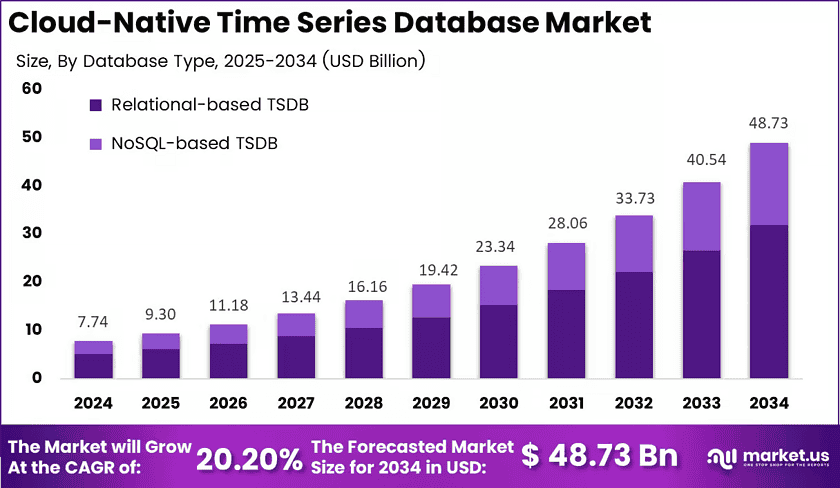
New York, NY – August 20, 2026 – The Global Cloud-Native Time Series Database Market reached USD 7.7 billion in 2024. The market could reach USD 48.7 billion by 2034, growing at a 20.2% CAGR. This growth reflects rising demand for fast, scalable storage of time-based business and machine data.
Moreover, industrial companies, telecom operators, retailers, and logistics firms generate large volumes of sensor readings, network events, transactions, and system logs. Cloud-native time series databases help these organizations monitor operations in real time. Consequently, teams can detect faults sooner, plan demand better, and automate business decisions without managing physical servers.
Additionally, the International Telecommunication Union estimated that 5.5 billion people used the internet in 2024, adding 227 million users from the prior year. This wider digital activity creates more application events and service logs. Database providers can therefore support businesses that need reliable storage and rapid analysis.
GSMA Intelligence expects global IoT connections to reach 38.7 billion by 2030. Enterprise connections could represent 63% of that total, showing that companies will generate much of the growth. Moreover, connected equipment creates continuous data streams that require efficient ingestion, retention, and query capabilities.
North America held more than 39.2% market share and generated USD 2.8 billion in revenue during 2024. The region benefits from strong cloud adoption, industrial digitization, and smart-grid investment. Therefore, database vendors can serve utilities, technology firms, and enterprises that need scalable monitoring and operational analytics platforms.
Key Takeaways
- The market could grow from USD 7.7 billion in 2024 to USD 48.7 billion by 2034, at a 20.2% CAGR.
- Public cloud led deployment with a 48.4% share because it offers scalable capacity and reduces infrastructure management demands.
- Sensor data led data sources with a 38.6% share, reflecting expanding connected devices and real-time monitoring needs.
- Relational-based time series databases held a 65.6% share because structured workloads need reliable queries and familiar SQL tools.
- BFSI remained a major industry segment, supported by fraud analytics and a 22.1% growth factor.
- Subscription-based pricing offers about 70.7% cost-saving potential, helping customers begin adoption with predictable spending.
- North America held more than 39.2% share and generated around USD 2.8 billion in revenue.
➤ Get Instant Access to the Premium Report Sample Before Purchase – https://market.us/report/cloud-native-time-series-database-market/request-sample/
Market Segmentation
Public cloud led deployment with a 48.4% share. Businesses select public platforms because they can scale data capacity without owning physical infrastructure. Moreover, this model supports IoT analytics, application monitoring, and broad data access. Providers benefit as clients seek faster deployments and lower system management workloads.
Private cloud held about a 25.0% share, while hybrid cloud accounted for 26.6%. Private environments support organizations that handle sensitive health, public-sector, or financial data. However, hybrid platforms combine public cloud scale with private control. This balance helps firms manage dynamic workloads while protecting selected information assets.
Sensor data led the data-source segment with a 38.6% share. Connected machines, smart devices, and industrial equipment produce continuous readings that support predictive maintenance. Consequently, businesses need databases that capture high-frequency records and quickly identify changes. This capability helps operators reduce disruption and improve asset performance.
Application performance data held a 22.0% share, while network and device metrics represented 18.5%. Development and operations teams use this information to track service reliability and user experience. Additionally, telecom operators use network metrics to monitor connectivity. These workloads increase demand for fast query performance and real-time visibility.
Relational-based time series databases led with a 65.6% share. These platforms support structured records and SQL-based analysis, which suits financial transactions and enterprise reporting. Moreover, familiar query tools help business teams work with time-stamped data. This strength supports reliable analysis where accuracy and auditability matter most.
NoSQL-based time series databases represented 34.4% of demand. These platforms handle flexible and high-velocity information, making them useful for IoT streams and varied device data. Therefore, businesses use NoSQL systems when data formats change often, or volumes rise quickly. Providers can position flexibility and scale as key advantages.
BFSI drives industry demand through fraud detection, transaction monitoring, and risk analysis. The segment carries a 22.1% growth factor, showing a strong need for rapid data review. Moreover, banks and insurers use time-series records to identify unusual patterns. Database platforms support quicker responses and more informed operational decisions.
Government, education, IT and telecommunications, manufacturing, healthcare, retail, media, and other industries also expand demand. These users track public services, digital activity, equipment performance, patient systems, and customer behavior. Consequently, vendors can tailor database tools to industry workflows, data rules, and reporting needs across different operational environments.
Subscription-based pricing led with a 70.7% share because customers value predictable costs and access to premium features. This model can offer around 70.7% cost-saving potential in the provided market assessment. Additionally, subscriptions help vendors build recurring revenue while allowing users to scale services as operational data grows.
Pay-as-you-go pricing supports experimentation and flexible spending. The model offers a 16.3% cost-saving potential and supports 29.3% initial adoption in the provided assessment. Therefore, smaller teams can start with limited workloads. Vendors can then convert successful projects into broader, longer-term data management commitments.
Regional Analysis
North America led the market with USD 2.8 billion in revenue during 2024. Strong digital infrastructure, cloud adoption, and utility modernization support this position. According to the U.S. Energy Information Administration, utilities installed about 119 million smart meters, equal to about 72% of electric meters. This installed base produces major time-based data needs.
Europe, Asia-Pacific, Latin America, and the Middle East and Africa create additional demand. European firms focus on regulated data management, while Asia-Pacific expands connected infrastructure and digital services. Moreover, Latin American and Middle Eastern organizations adopt scalable platforms as cloud access improves. Regional diversity gives vendors several routes for long-term growth.
Drivers
Connected device telemetry drives market growth because sensors, applications, and networks create constant time-stamped records. GSMA Intelligence projects 38.7 billion IoT connections by 2030. Enterprise connections could make up 63% of the total, increasing demand for platforms that capture and analyze operational data at scale.
Observability stack adoption also supports demand. Technology teams monitor applications, databases, infrastructure, and digital services to prevent outages. Consequently, time series platforms help teams detect abnormal performance patterns before customers face problems. This use strengthens demand among cloud-native businesses that need reliable services and faster problem resolution.
Use Cases
Utility companies use cloud-native time series databases to collect smart-meter readings and equipment signals. Operations teams can track energy use, identify faults, and improve grid planning. Moreover, real-time data platforms support digital-twin programs that connect field assets with operational models, helping utilities make faster and better-informed decisions.
Financial services firms use time-stamped databases to monitor transactions and detect unusual activity. Fraud teams can compare current events with historical patterns and respond quickly. Consequently, database systems strengthen risk monitoring while supporting secure customer services. These platforms also help analysts review market events, payment flows, and operational performance.
Business Opportunities
Utility digital-twin platforms offer a strong growth opportunity for database providers. Utilities collect data from meters, substations, and connected assets but often lack integrated operational models. Additionally, vendors can package data ingestion, anomaly detection, retention, and analytics. This approach creates recurring services that deliver more value than storage capacity alone.
Automotive fleet analytics creates another opportunity as vehicles generate performance, location, and maintenance data. Database providers can help fleet operators track vehicle health and service needs. Therefore, suppliers can combine time-series storage with monitoring tools and dashboards. These solutions help operators reduce unplanned downtime and improve fleet utilization.
Major Challenges
Cloud data skills shortages create delivery challenges for buyers and suppliers. Organizations need specialists who understand database engineering, security, distributed systems, and operational analytics. However, many teams lack this combined expertise. Vendors must provide training, managed support, and automation tools to help customers operate complex data environments effectively.
High ingest costs create another challenge for large-volume workloads. Sensors, devices, applications, and networks can produce data continuously. Consequently, businesses must control collection, storage, and retention expenses without losing valuable records. Providers need clear pricing, data lifecycle policies, and efficient compression tools to protect customer budgets and support wider adoption.
Top Key Players in the Market
- AWS
- Kyndryl
- Nutanix
- QuestDB
- Greptime
- Quix Analytics
- Intel
- Adobe
- CtrlS Datacenters
- Spyrosoft
Conclusion
The cloud-native time series database market grows as connected devices, digital services, industrial assets, and financial platforms create more time-based information. Public cloud platforms, sensor data, relational systems, and subscription models shape current demand. Moreover, vendors that deliver secure performance, industry-focused solutions, efficient cost controls, and managed expertise can help customers turn continuous data streams into faster decisions and stronger operational results.
Discuss your needs with our analyst
Please share your requirements with more details so our analyst can check if they can solve your problem(s)