
Market Overview
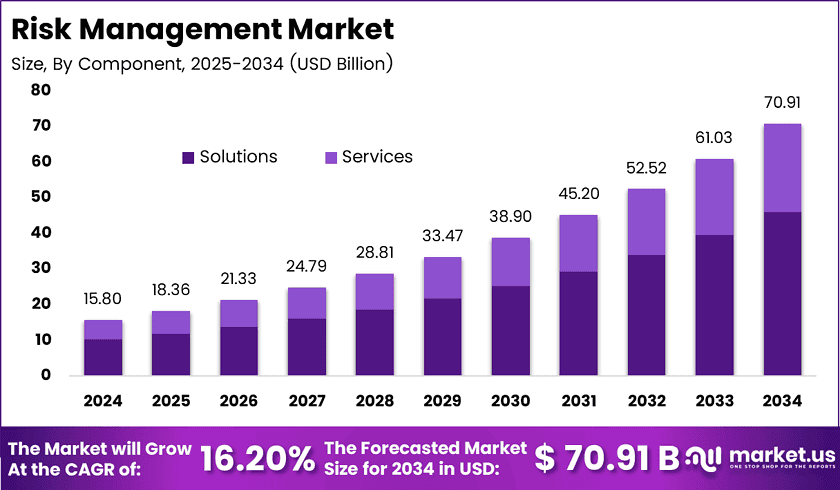
New York, NY – October 12, 2026 – The Global Risk Management Market reached USD 15.8 billion in 2024. Analysts expect it to reach USD 70.9 billion by 2034, growing at a CAGR of 16.2%. This steady growth shows that companies now treat risk control as a core business function rather than an optional tool.
Moreover, more people online means more risk for companies to track. According to the International Telecommunication Union, about 6 billion people used the internet in 2025, an increase of over 240 million users. Consequently, businesses are replacing spreadsheets with risk platforms to handle growing payment, cloud, and data activity.
Additionally, the banking system shows how much spending goes into risk controls. According to the Federal Deposit Insurance Corporation, the Deposit Insurance Fund held $153.9 billion at the end of 2025. Therefore, the large base of supervised assets keeps demand strong for risk assessment, monitoring, and reporting software.
However, computing growth adds a second source of demand. According to the International Energy Agency, data centre electricity use will grow from 485 TWh in 2025 to 950 TWh in 2030. Every new data centre brings new operational and supplier risks, which raises demand for strong enterprise risk tools.
Furthermore, North American financial firms carry a heavy compliance workload. According to the FDIC, 4,338 insured institutions reported quarterly net income of $77.7 billion in late 2025, while 60 banks sat on the Problem Bank List. Each bank must run credit, liquidity, and compliance controls, which keeps platform spending steady.
Key Takeaways
- The Risk Management Market stood at USD 15.8 billion in 2024 and will reach USD 70.9 billion by 2034. Revenue will grow at a CAGR of 16.2% from 2025 to 2034.
- Solutions lead the Component segment with a 64.8% share, and Services grow fastest.
- Cloud-Based deployment leads with a 62.4% share, and it also grows faster than On-Premises.
- Financial Risk Management leads the Risk Type segment with a 38.1% share, and Cybersecurity Risk Management grows fastest.
- Large Enterprises lead by Organization Size with a 71.6% share, and Small and Medium-Sized Enterprises grow fastest.
- BFSI leads End Use with a 27.3% share, and Healthcare and Life Sciences grow fastest.
- North America leads with a 43.1% share and USD 6.7 billion in revenue.
➤ Unlock the Sample Version of This Premium Report with Detailed Tables & Figures – https://market.us/report/global-risk-management-market/request-sample/
Risk Management Market Segmentation
By Component
Solutions hold a 64.8% share because risk teams need constant control testing and reporting. According to the ISO Survey 2024, valid ISO/IEC 27001 certificates rose to 96,709 from 36,362 in 2019. Consequently, more certified firms need central platforms to manage audits and evidence at scale.
However, Managed Services grow fastest as firms struggle to keep skilled staff in-house. According to the ITU Global Cybersecurity Index 2024, 194 countries faced review against a Tier 1 bar of 95 out of 100. Therefore, companies hire outside providers for monitoring, threat handling, and platform management.
By Deployment
Cloud-Based deployment leads with a 62.4% share because it rolls out quickly across many sites. According to Eurostat, 52.7% of EU enterprises paid for cloud services in 2025, up from 17.8% in 2014. Consequently, hosted risk tools gain ground through central access and automatic compliance updates.
Moreover, smaller firms drive the fastest cloud growth. In 2023, cloud use reached about 78% among large firms, 59% among medium firms, and 42% among small firms. Therefore, subscription pricing and low upfront costs help smaller businesses close this gap and adopt hosted risk platforms.
By Risk Type
Financial Risk Management leads with a 38.1% share because Basel rules require banks to hold capital against exposures. According to Basel studies, the output floor rises to 72.5%, and large banks may need about 18% more Tier 1 capital. Consequently, banks invest in modelling and stress-testing tools.
Meanwhile, Cybersecurity Risk Management grows fastest as reporting deadlines tighten. According to the SEC, public companies must report material cyber incidents on Form 8-K within 4 business days. Therefore, firms buy tools that detect incidents, assess impact, and prepare disclosures quickly.
By Organization Size
Large Enterprises hold a 71.6% share because complex operations need formal risk governance. According to EU data, firms with over 249 employees make up only 0.2% of enterprises but earn 51% of turnover. Consequently, these firms fund integrated platforms and dedicated risk teams.
However, SMEs grow fastest from a smaller base. According to the OECD, SMEs form about 99% of firms and add 50% to 60% of value. Additionally, affordable subscription tools now make compliance and risk tracking easier for smaller companies to adopt.
By End Use
BFSI leads with a 27.3% share because regulators make operational resilience mandatory. According to the European Union, the Digital Operational Resilience Act covers about 22,000 financial entities from 17 January 2025. Consequently, banks and insurers expand spending on resilience testing and supplier oversight.
Moreover, Healthcare and Life Sciences grow fastest due to rising data breaches. According to US records, 7,418 major healthcare breaches between 2009 and 2025 exposed over 1 billion records. Therefore, providers increase spending on monitoring, security, and incident response systems.
Regional Analysis of Risk Management
North America leads with a 43.1% share and USD 6.7 billion in revenue. According to the FDIC, 4,379 insured institutions earned $79.3 billion in Q3 2025. Consequently, strict supervision across this large banking base keeps regional demand for risk platforms strong.
Meanwhile, Asia Pacific grows fastest due to huge digital payment volumes. According to the National Payments Corporation of India, UPI handled 23.66 billion transactions in July 2026 across 741 banks. Therefore, banks need fraud and operational risk engines that run at very high volume.
Key Growth Drivers
Cyber-resilience mandates turn risk management into an ongoing business need. The SEC requires disclosure of material incidents within 4 business days, while DORA applies across Europe. Consequently, these rules may add about 2.4% to the 16.2% baseline CAGR through recurring software and service spending.
Additionally, third-party risk oversight drives strong demand worldwide. Companies now depend on many suppliers, cloud vendors, and partners for daily operations. Therefore, this driver may add about 1.9% to growth, as firms buy tools to screen, score, and monitor vendors in the short term.
Key Use Cases
Banks use risk platforms to monitor credit, liquidity, and fraud exposure in real time. These tools pull data from many systems into one dashboard. Consequently, risk officers spot problems early and report to regulators faster, which reduces penalties and improves trust with customers and supervisors.
Moreover, hospitals and healthcare groups use risk tools to protect patient data. These systems track access, flag unusual activity, and guide breach response steps. Therefore, providers meet reporting duties on time while reducing the damage, cost, and reputation loss that follow a serious data breach.
Business Opportunities in Risk Management
AI-native risk decisioning offers a strong untapped opportunity. Many firms still use AI only for narrow tasks rather than governed risk decisions. However, platforms that combine model tracking, audit trails, and human approval can speed case handling. Consequently, vendors can move into higher-value cyber, credit, and supplier risk work.
Additionally, embedded risk services for small businesses open a large new customer base. Many SMEs lack budgets for full platforms or dedicated risk staff. Therefore, vendors can bundle simple risk checks into accounting, payment, and cloud tools. This approach lowers entry barriers and builds steady recurring revenue.
Major Challenges
Poor risk data quality limits the value of new platforms. Companies often hold inconsistent asset records, supplier files, and incident labels. Consequently, teams spend time fixing data by hand and keep old spreadsheets running. This duplicate effort weakens risk scoring and slows full platform adoption across the business.
Moreover, the shortage of skilled cybersecurity staff slows progress. Many firms cannot hire enough experts to configure, run, and improve risk systems. Therefore, projects take longer and deliver less value. However, this gap also pushes companies toward managed services and simpler, automated tools with guided workflows.
Top Key Players in the Market
- NAVEX Global
- Riskonnect, Inc.
- ServiceNow
- Oracle Corporation
- MetricStream
- SAS Institute Inc.
- Qualys, Inc.
- BitSight
- FIS Global
- Fiserv
- IBM Corporation
- LogicGate, Inc.
- Microsoft Corporation
- Moody’s Corporation
Conclusion
The risk management market is growing steadily as digital activity, stricter rules, and cyber threats increase. Solutions, cloud deployment, financial risk, large enterprises, and BFSI lead today. Meanwhile, services, cybersecurity, SMEs, and healthcare grow fastest. North America leads, and Asia Pacific grows fastest. However, data quality gaps and staff shortages remain key hurdles, while AI-driven decisioning opens strong new opportunities for vendors.
Discuss your needs with our analyst
Please share your requirements with more details so our analyst can check if they can solve your problem(s)