
Market Overview
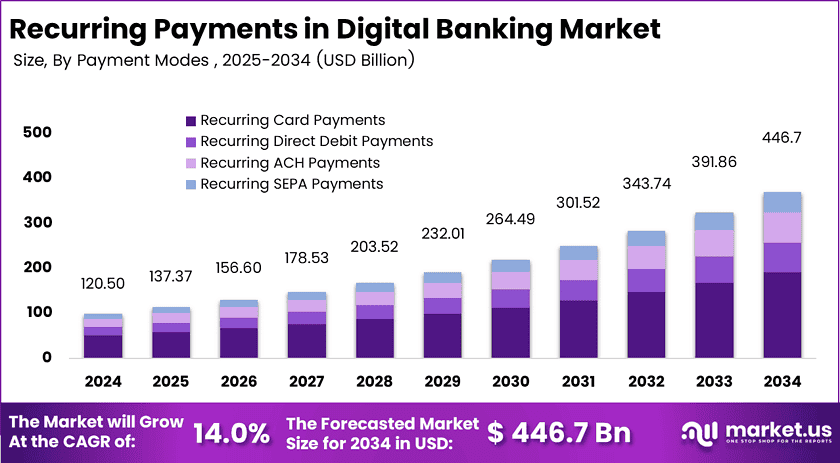
New York, NY – October 14, 2026 – The Global Recurring Payments in Digital Banking Market reached USD 120.5 billion in 2024. It will reach USD 446.7 billion by 2034, growing at a CAGR of 14.0% from 2025 to 2034. As a result, banks and billers now treat automated scheduled payments as a core revenue channel.
Moreover, bill payments keep this growth steady. The ACH Network processed 35.2 billion payments worth USD 93 trillion in 2025. Volume rose 4.9%, while value climbed 7.9%. These gains show that consumers and firms trust bank systems for mortgages, utilities, and insurance premiums.
Additionally, subscription commerce adds a strong growth engine. According to Stripe, businesses on its platform managed 200 million active subscriptions in 2025. Total payment volume reached USD 1.9 trillion, up 34%. Therefore, merchants need better mandate tools, payment retries, and dunning features to protect their recurring revenue.
Furthermore, wider account access expands the customer base. According to the World Bank Global Findex 2025, 79% of adults worldwide hold an account. This reach opens more room for direct debit services. Meanwhile, Nacha recorded nearly 8.1 billion business-to-business ACH payments, which points to more automation in corporate billing.
However, technology now shapes the next stage of growth. Generative AI predicts failed payments caused by expired cards or low balances and sends early reminders. AI fraud models also watch transaction patterns in real time. Consequently, banks cut manual work, improve success rates, and offer chatbots that help users manage subscriptions easily.
Key Takeaways
- The Recurring Payments in Digital Banking Market stands at USD 120.5 billion in 2024. The market will reach USD 446.7 billion by 2034. grows at a CAGR of 14.0% from 2025 to 2034.
- Recurring Card Payments lead the payment modes segment with a 42.7% share.
- Fixed Recurring Payments lead the usage segment with a 60.6% share.
- Flat-rate Pricing leads the pricing models segment with a 45.3% share.
- Banking, Financial Services, and Insurance (BFSI) leads the industry segment with a 36.8% share.
- North America dominates with a 35.6% share and USD 42.9 billion in revenue.
➤ Preview Key Insights with an Exclusive Sample Report Download – https://market.us/report/recurring-payments-in-digital-banking-market/request-sample/
Recurring Payments Market Segmentation
By Payment Modes
Recurring card payments lead with a 42.7% share because banks issue cards at scale and merchants accept them widely. According to the Federal Reserve, the US recorded 236.6 billion noncash payments in 2024, and cards made up most of them. Moreover, stored card tokens and automatic card updates keep long subscriptions running smoothly.
By Usage
Fixed recurring payments hold a 60.6% share because set amounts simplify billing and reduce disputes. According to Pay.UK, the Bacs system processed 5.03 billion Direct Debit items in 2025. This volume reflects heavy use for insurance and household bills. However, variable plans grow fast as energy and travel firms need flexible amounts.
By Pricing Models
Flat-rate pricing leads with a 45.3% share because one simple price helps keep subscribers. According to Netflix, its revenue reached USD 45.2 billion in 2025, up 16%. This result shows how fixed plans make revenue easier to predict. Meanwhile, usage-based pricing grows as cloud and AI workloads change each month.
By Industry
BFSI leads with a 36.8% share because banks and insurers control customer accounts and mandates. According to the European Central Bank, the euro area recorded 11.4 billion direct debits in the second half of 2024. Loan repayments and premiums keep this volume steady. Additionally, healthcare grows fastest as providers adopt automated instalment plans.
Regional Analysis of Digital Banking Payments
North America leads with a 35.6% share and USD 42.9 billion in revenue. According to Nacha, Same Day ACH handled 1.4 billion payments worth USD 3.9 trillion in 2025, and volume rose 16.7%. Therefore, mature banking systems and fast settlement keep the region ahead of others.
Asia Pacific grows fastest as users adopt automated digital mandates. According to industry data, UPI Autopay processed about 926 million transactions in November 2025, up from 530.5 million a year earlier. This jump shows strong trust in mobile mandates. Moreover, Europe holds a solid position through widely used direct debits.
Key Market Drivers
Instant-payment mandate expansion drives strong growth. According to Regulation (EU) 2024/886, euro-area providers must send instant transfers from 9 October 2025, with funds available within 10 seconds. Consequently, banks shift from card collections toward real-time account-to-account services. The report estimates this driver adds about 2.4% to the baseline CAGR.
Additionally, the move to digital subscription billing fuels demand across North America, Europe, and Asia Pacific. Merchants move manual invoices onto automated platforms with smart retries. Therefore, payment providers gain steady and predictable volumes. According to report estimates, this shift could add about 1.8% to the forecast CAGR in the short term.
Recurring Payment Use Cases
Insurance firms use recurring payments to collect premiums on fixed dates without manual follow-ups. Moreover, lenders schedule loan instalments through direct debit mandates. This approach cuts late payments and lowers collection costs. Consequently, customers miss fewer bills, while financial firms plan cash flow better and keep more customers.
Streaming services and software firms rely on automated billing to renew subscriptions each month. Additionally, healthcare providers set up patient payment plans and telehealth memberships through digital mandates. These tools reduce billing errors and make upgrades easy. Therefore, businesses build stable revenue while users manage plans through simple banking apps and chatbots.
Business Opportunities
Commercial variable recurring payment APIs offer a large untapped opportunity. Current bank APIs mainly support account sweeping rather than merchant subscriptions and utility bills. However, proposed legislation in the UK could widen access. Consequently, providers can move recurring payments toward low-cost account-to-account processing with better consent and retry controls.
Additionally, cash-flow automation for small businesses creates fresh demand, especially in emerging markets. Small firms need simple tools to collect dues and pay suppliers on schedule. Therefore, banks can bundle recurring payments with invoicing and lending services. Meanwhile, modern utility collection opens new paths across Latin America, Asia Pacific, and Africa.
Major Challenges
Real-time fraud control remains a key challenge for recurring account-to-account payments. Faster payment systems leave less time for fraud checks before settlement. Moreover, verification-of-payee rules raise the need for accurate identity checks. Consequently, banks must invest in behavior analytics, device intelligence, and case management systems to protect customer trust.
Mandate authentication rules also slow the adoption of high-value renewals. In India, extra security checks interrupt smooth payments for larger subscriptions and insurance plans. However, these checks can raise payment failures and unplanned customer losses. Therefore, banks and billers must build retry workflows, smart routing, and backup payment options, which raises renewal costs.
Top Key Players in the Market
- Cashfree Payments India Private Limited
- Worldline S.A.
- Paycorp Solutions Pvt. Ltd.
- Razorpay Software Limited
- Paytm Payments Services Limited, Inc.
- Stripe, Inc.
- Paytently
- Dateio
- Chargebee Inc.
- Instantpay
Conclusion
The recurring payments in the digital banking market show strong and steady growth. Card payments, fixed plans, flat-rate pricing, and BFSI lead their segments, while North America leads by region. Moreover, instant payment rules and digital subscription billing drive demand. However, fraud risks and authentication rules remain hurdles. Consequently, providers that invest in AI, open banking APIs, and flexible mandates will gain the most over time.
Discuss your needs with our analyst
Please share your requirements with more details so our analyst can check if they can solve your problem(s)