
Market Overview
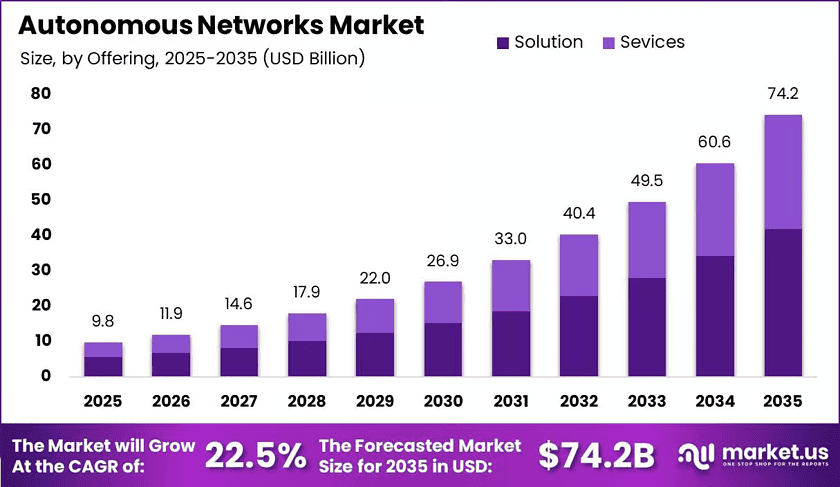
New York, NY – October 27, 2026 – The Global Autonomous Networks Market reached USD 9.8 billion in 2025. Analysts project it will hit about USD 74.2 billion by 2035, growing at a CAGR of 22.5%. This strong rise shows that telecom operators and enterprises now see self-running networks as core infrastructure.
Moreover, digital traffic, connected devices, and 5G services keep growing fast. According to the report data, global 5G connections passed 2.7 billion in 2025. This huge user base creates traffic that manual teams struggle to handle. Consequently, operators turn to automated network management to keep their services stable and fast.
Additionally, IoT connections will rise from 26.1 billion in 2025 to 38.5 billion by 2030. That adds more than 12.4 billion new endpoints that send data all the time. Therefore, networks need self-configuring and self-healing features. These tools help operators manage millions of devices without adding large support teams.
Furthermore, mobile technologies will add USD 11 trillion to global GDP by 2030, based on the report data. Mid-band 5G alone could add about USD 610 billion. These figures show how much economic value depends on reliable networks. As a result, governments and businesses invest more in intelligent network operations.
However, rising traffic also brings new security threats and more complex systems. Private 5G networks, fixed wireless access, and industrial IoT projects all add pressure. Consequently, buyers want AI-based traffic control, automated security response, and closed-loop network checks. These needs keep self-driving network platforms at the center of telecom spending plans.
Key Takeaways
- The Autonomous Networks Market reached USD 9.8 billion in 2025 and will reach USD 74.2 billion by 2035, growing at a CAGR of 22.5% during 2026–2035.
- The Solution segment led the offering category with a 56.5% share.
- IT and telecommunications led the end-user category with a 26.7% share.
- North America led the market in 2025 with a 38.7% share, worth USD 3.7 billion.
➤ Grab the Exclusive Preview of This Premium Research Report Now – https://market.us/report/autonomous-networks-market/request-sample/
Autonomous Networks Market Segmentation
By Offering
The Solution segment led the autonomous networks market with a 56.5% share. Spending keeps moving from traditional hardware to smart software platforms. Moreover, these platforms manage complex networks that use equipment from many vendors. Consequently, operators get more value from software than from extra boxes and cables.
Additionally, global software spending will exceed USD 1.3 trillion in 2025. Total IT spending will pass USD 5.6 trillion. This means a growing share of budgets now goes to analytics, AI, and automation tools. Therefore, network software providers gain a larger and steadier pool of customer demand.
By End-User
The IT and Telecommunications segment led with a 26.7% share. About 8.9 billion mobile-cellular subscriptions run worldwide, which is more than the global population. This volume creates nonstop traffic across carrier networks. Consequently, telecom firms need fast, automated tools to keep service quality high for every user.
Moreover, global telecom capital spending reached nearly USD 315–330 billion in 2023, based on the report data. About 61% of that went to network infrastructure, such as radio, transport, and core systems. Therefore, operators build more software-defined and cloud-based networks. Healthcare, retail, banking and finance, and other sectors also adopt these tools steadily.
Regional Analysis of Autonomous Networks
North America held 38.7% of global revenue, worth about USD 3.7 billion in 2025. The region adopted standalone 5G early and runs large cloud and data-centre systems. Moreover, local firms invest heavily in AI-based network automation. Consequently, North America remains the main buyer of self-running network platforms.
However, Asia Pacific will grow the fastest over the forecast period. China, South Korea, Japan, and India roll out large 5G and fibre networks. Additionally, rising data use and city growth create traffic that manual teams cannot handle. Therefore, private 5G and smart-city projects push strong demand across the region.
Growth Drivers
Standalone 5G core rollouts add about 4.2% to the market CAGR. These networks use cloud-native and containerised functions that are hard to run by hand. Moreover, TM Forum surveyed 141 service providers and found that 23% plan to reach Level 4 autonomy by 2026. This shows a clear shift toward closed-loop automation.
Additionally, operators want lower operating costs, which adds about 2.1% to growth. According to operator disclosures from 2024 and 2025, automated domains cut fault-fix times by around 30% to 40%. Consequently, operators spend less to serve each subscriber. Therefore, budgets move away from hardware upgrades and toward automation software.
Key Use Cases
Telecom operators use autonomous networks to detect and fix faults on their own. These systems spot problems early, find the root cause, and restore service quickly. Moreover, predictive tools help teams avoid sending technicians for issues that software can solve. Consequently, customers enjoy fewer outages and operators save time and money.
Additionally, enterprises use self-running networks to manage private 5G and industrial IoT systems. Factories and logistics hubs depend on stable links between machines and sensors. Therefore, automated slicing and AI-based security keep these links safe and fast. This support helps businesses run smart operations without large in-house network teams.
Business Opportunities
Enterprise private networks offer a large untapped opportunity for advanced autonomy. Most service providers still operate below the highest automation levels today. Moreover, factories and logistics zones want reliable networks that fix themselves. Consequently, vendors can license full closed-loop features to enterprises and earn better margins than current managed-service models.
Additionally, AI-driven energy savings create new ways to earn revenue. Operators face rising power bills and pressure to cut emissions. Therefore, software that lowers energy use across base stations and data centres has strong appeal. Vendors can also offer network-as-a-service licensing models that reduce upfront costs for buyers.
Major Challenges
High borrowing costs slow new network investments. Operators face larger debt payments and delay large automation projects. Moreover, many companies choose basic maintenance over new platform licences. Consequently, vendors deal with slower contract approvals and longer sales cycles. This pressure squeezes short-term margins across the autonomous networks supply chain.
However, the biggest long-term challenge comes from a shortage of skilled talent. Operators struggle to hire engineers who understand closed-loop automation and intent modelling. Additionally, firms must spend more on training existing teams. Therefore, project timelines grow longer, and the move to the highest levels of autonomy happens more slowly than planned.
Top Key Players in the Market
- Cisco Systems, Inc.
- Juniper Networks, Inc.
- Huawei Technologies Co., Ltd.
- Nokia Corporation
- Ericsson AB
- Ciena Corporation
- NEC Corporation
- Extreme Networks, Inc.
- Hewlett Packard Enterprise Development LP
- Arista Networks, Inc.
- Fujitsu Limited
- IBM Corporation
Conclusion
The Autonomous Networks Market keeps growing as 5G, IoT, and cloud services make networks more complex. Software solutions and telecom operators lead adoption. Meanwhile, North America holds the top position and Asia Pacific grows fastest. Moreover, cost savings and private networks create strong opportunities. However, high borrowing costs and talent gaps slow progress. Overall, self-running networks are becoming key infrastructure for digital businesses.
Discuss your needs with our analyst
Please share your requirements with more details so our analyst can check if they can solve your problem(s)