
Market Overview
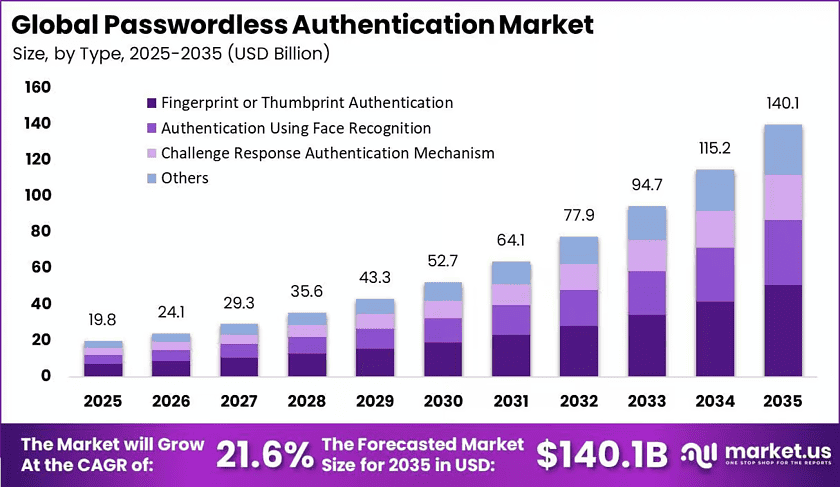
New York, NY – October 30, 2026 – The Global Passwordless Authentication Market reached USD 19.8 billion in 2025. Analysts expect it to reach about USD 140.1 billion by 2035, growing at a CAGR of 21.6%. This steady rise shows that businesses now treat password-free login as a core security need, not a side project.
Moreover, internet growth keeps adding new users to digital services. According to the ITU, nearly 6 billion people used the internet in 2025, up from 5.8 billion in 2024. Each new user opens more accounts and login points. Consequently, companies need secure sign-in tools that do not rely on old passwords.
However, cybercrime keeps raising the stakes for identity security. According to the FBI Internet Crime Complaint Center, U.S. cybercrime losses hit USD 16.6 billion in 2024. Losses then climbed to USD 20.9 billion in 2025, a 26% yearly jump. These growing losses push firms to spend more on stronger login protection.
Additionally, business email compromise remains a costly threat for companies. According to the FBI, this fraud caused USD 2.7 billion in losses in 2024 and USD 3.04 billion in 2025. Attackers often steal passwords to break into email accounts. Therefore, firms now choose biometrics and security keys to block these attacks.
Consequently, banks, hospitals, enterprises, and government agencies are moving toward device-based identity checks. North America led in 2025 with a 37.8% share and about USD 7.4 billion in revenue. Strong security budgets and early zero-trust adoption explain this lead. Meanwhile, other regions are quickly catching up through mobile banking growth.
Key Takeaways
- The Passwordless Authentication Market was valued at USD 19.8 billion in 2025 and should reach USD 140.1 billion by 2035, growing at a CAGR of 21.6%.
- Fingerprint or Thumbprint Authentication led the Type segment with more than 36.3% share in 2025.
- Single Factor Authentication led the Authentication Type segment with more than 63.4% share in 2025.
- IT and Telecom led the Industry Vertical segment with more than 27.6% share in 2025.
- North America led the market in 2025 with more than 37.8% share, generating about USD 7.4 billion in revenue.
➤ See the Full TOC, Market Tables & Figures in Your Sample Copy – https://market.us/reportpas/swordless-authentication-market/request-sample/
Market Segmentation
By Type
Fingerprint or Thumbprint Authentication held more than 36.3% share in 2025. According to GSMA, global mobile connections reached 8.8 billion, and about 91% ran on smartphones. Most of these phones already have fingerprint sensors. Therefore, banks and telecom firms can launch fingerprint login without buying extra hardware.
Moreover, government programs show how well fingerprint checks can scale. India’s Aadhaar system captures 10 fingerprints per person and covers over a billion residents. This scale proves the method works for very large groups. Additionally, modern sensors confirm a fingerprint in under 1 second, which keeps the login fast for users.
By Authentication Type
Single Factor Authentication captured more than a 63.4% share in 2025. According to GSMA, mobile money services handled 108 billion transactions worth about USD 1.6 trillion in 2024. Volumes grew 20% year-on-year. Consequently, payment providers prefer quick one-step checks that keep these high-volume transactions moving smoothly.
Additionally, online shopping growth supports simple login methods. According to UNCTAD, business e-commerce sales reached about USD 28 trillion across 45 economies in 2024. Extra checks slow down checkout and frustrate buyers. Therefore, merchants use fingerprint and PIN access for routine, lower-risk tasks. Meanwhile, multi-factor methods serve higher-risk use cases.
By Industry Vertical
IT and Telecom held more than 27.6% share in 2025. Telecom operators manage huge numbers of user identities and network access points. According to CISA and the FBI, the Salt Typhoon campaign hit at least 9 major U.S. carriers. Consequently, operators now face strong pressure to tighten their access controls.
Moreover, global telecom revenues are near USD 1.7 trillion per year, according to industry estimates. This income gives operators the budget to invest in biometrics and device-based login. Additionally, BFSI, government, healthcare, retail, aerospace and defence, and transportation and logistics firms adopt these tools to protect sensitive data and meet stricter rules.
Regional Analysis
North America led the market in 2025 with more than 37.8% share and about USD 7.4 billion in revenue. The region benefits from strong cloud networks and high security spending. Moreover, CISA recommends passwordless methods such as FIDO2 and PIV credentials. Consequently, federal agencies speed up the adoption of phishing-resistant login tools.
However, Asia Pacific should grow the fastest during the forecast period. According to the World Bank, 89% of adults in China had a financial account, and 82% paid merchants digitally. This shows heavy daily use of digital payments. Therefore, banks and payment apps in the region need fast and secure login methods.
Key Market Drivers
Passkey growth stands as the strongest market driver. According to the FIDO Alliance, about 5 billion passkeys were active worldwide by May 2026. Moreover, 68% of organizations had deployed or were deploying passkeys for staff. This large base lowers setup costs and adds about 3.2 percentage points to growth.
Additionally, rising fraud pushes firms toward safer login methods. According to Visa, biometric checks produce about 50% lower fraud rates than SMS passcodes. Lower fraud means fewer losses for banks and merchants. Consequently, government purchasing rules in North America and Europe also favor phishing-resistant tools, adding about 2.4 percentage points to growth.
Use Cases
Banks and payment apps use passwordless login to protect customer accounts. Users confirm payments with a fingerprint or face scan instead of typing codes. Moreover, this approach blocks many phishing attempts because attackers cannot steal a fingerprint through fake emails. Consequently, customers enjoy faster checkout while banks reduce fraud costs and support calls.
Additionally, enterprises use passkeys and security keys to secure employee access. Staff sign in to cloud apps, email, and internal tools without remembering complex passwords. Therefore, IT teams handle fewer password reset requests. Meanwhile, managers can set different access rules for different worker groups, which improves both control and daily workflow.
Business Opportunities
Consumer identity offers a large untapped opportunity for vendors. Many shoppers know about passkeys but do not use them regularly yet. Moreover, retail, travel, healthcare, and subscription services can close this gap with smoother sign-in. Consequently, providers can earn new income through transaction-based pricing, fraud-loss sharing, and premium account recovery services.
Additionally, small and mid-sized businesses present strong growth potential. These firms often lack security staff and large budgets. Therefore, managed passwordless services delivered through the cloud fit their needs well. Meanwhile, cross-border digital identity and machine-to-machine access open long-term paths for vendors that build flexible and standards-based platforms.
Major Challenges
Account recovery remains a key hurdle for passwordless systems. Users still lose devices, fail face scans, or change phones. However, companies must restore access without opening new security gaps. Consequently, many firms keep passwords as a backup option, which slows the full shift to password-free login across their workforce.
Moreover, older IT systems create costly upgrade problems. Legacy apps, VPNs, and directory services often do not support modern login standards. Additionally, many firms lack skilled security staff to manage complex projects. Therefore, testing and running old and new systems side by side raises costs and delays buying decisions for many organizations.
Top Key Players in the Market
- Fujitsu
- NEC Corporation
- HID Global Corporation
- M2SYS Technology
- Thales
- Safran
- DERMALOG Identification Systems GmbH
- East Shore Technology, LLC
- ASSA ABLOY
- Microsoft
Conclusion
The Global Passwordless Authentication Market is growing fast as cybercrime rises and more people go online. Fingerprint login, single-factor methods, and the IT and Telecom sector lead current demand. Moreover, North America holds the top position, while Asia Pacific grows quickly through mobile payments. However, account recovery and older systems still slow adoption. Therefore, vendors offering simple, secure, and scalable identity solutions will capture strong future growth.
Discuss your needs with our analyst
Please share your requirements with more details so our analyst can check if they can solve your problem(s)