
Market Overview
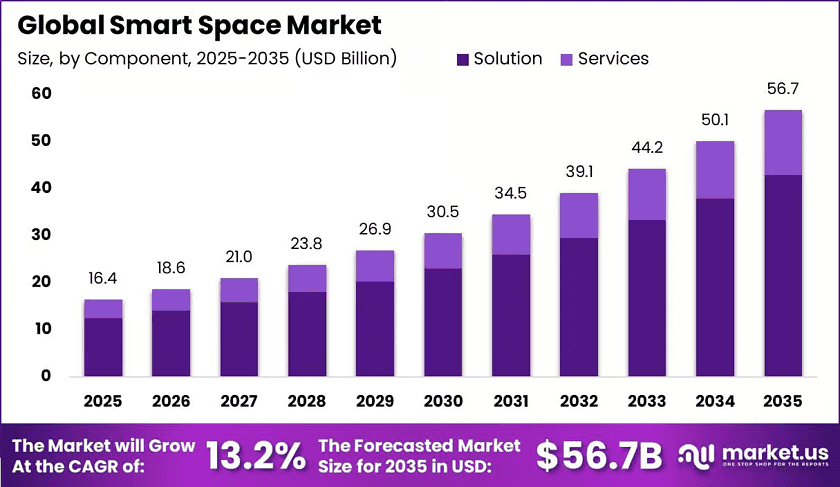
New York, NY – October 30, 2026 – The Global Smart Space Market reached USD 16.4 billion in 2025, analysts expect it to grow at a 13.2% CAGR from 2026 to 2035. Consequently, the market should reach nearly USD 56.7 billion by 2035, as building owners invest in connected and efficient facilities. North America led the market in 2025 with a more than 39.2% share and about USD 6.4 billion in revenue.
However, urban growth also fuels demand. According to the United Nations, cities will add nearly 2.5 billion people by 2050. This shift means more offices, hospitals, transport hubs, and public buildings. Consequently, city planners and property owners need smart workplace technologies that cut manual work and improve daily building performance.
Additionally, energy use shapes buying decisions. According to the International Energy Agency, building operations caused 26% of global energy-system emissions in 2022. This figure shows why owners want better control over power use. Therefore, occupancy sensors, smart lighting, and real-time energy monitoring tools gain strong attention from facility managers.
Furthermore, the U.S. Department of Energy reports that commercial buildings cover 93 billion square feet and use 18% of national primary energy. These buildings cost nearly USD 190 billion in energy each year. However, around 30% of that energy goes to waste. Consequently, owners adopt sensors, automated controls, and analytics to save money.
Key Takeaways
- The Smart Space Market was valued at USD 16.4 billion in 2025 and should reach USD 56.7 billion by 2035, growing at a 13.2% CAGR.
- The Solution segment was dominated by Component with a 75.5% market share.
- Security Management led by Application with a 34.6% share, driven by demand across transport and public infrastructure.
- Commercial Premises led by Premises Type with a 42.5% share, supported by global services-sector growth.
- North America led the market in 2025 with a 39.2% revenue share, worth about USD 6.4 billion.
➤ See the Full TOC, Market Tables & Figures in Your Sample Copy – https://market.us/report/smart-space-market/request-sample/
Market Segmentation
By Component
The Solution segment dominated the component category with a 75.5% share. Buyers focus spending on tools that directly improve building operations. Moreover, these solutions include sensors, connected controllers, building-management platforms, access-control software, and analytics tools. Meanwhile, the Services segment supports installation, integration, and maintenance work.
According to the U.S. Energy Information Administration, buildings over 100,000 square feet make up less than 3% of commercial buildings. However, they hold about 34% of total commercial floor space. Consequently, these large sites need single platforms to manage HVAC, lighting, security, and occupancy data.
By Application
The Security Management segment led the application category with a 34.6% share. Busy commercial, transport, and public sites need strong protection. Moreover, smart security systems speed up access decisions and keep clear digital records of people and incidents. Meanwhile, energy management and emergency management applications also gain steady demand.
Additionally, transport hubs show this need clearly. According to the U.S. Transportation Security Administration, it screened about 904 million passengers and 494 million checked bags in 2024. This huge volume makes manual checks too slow. Consequently, airports adopt identity verification, video surveillance, and event-management platforms for real-time oversight.
By Premises Type
The Commercial Premises segment led the premises category with a 42.5% share, while residential and other premises follow. Moreover, according to the World Bank, services make up about 66.2% of global GDP. Therefore, service-based businesses need modern offices, shops, and hotels with connected building systems.
Additionally, emerging economies add new commercial space quickly. According to Knight Frank, India’s office stock reached nearly 1 billion square feet in 2025. This stock grew at an 8.6% CAGR since 2005. Consequently, each new building creates demand for HVAC control, lighting, energy monitoring, and tenant security.
Regional Analysis
North America led the smart building market in 2025 with a 39.2% share. The U.S. construction spending reached an annualized USD 2.14 trillion in May 2025, including USD 753.3 billion in non-residential work. This spending shows a large base of buildings needing automation upgrades. Therefore, the region should keep its revenue lead.
However, Asia Pacific should record the fastest growth during the forecast period. China, India, Southeast Asia, Japan, and South Korea invest heavily in smart cities and digital infrastructure. Additionally, new projects include sensors, surveillance, and HVAC management at the design stage. Consequently, developers in the region build connected spaces from day one.
Market Growth Drivers
Building energy-performance mandates lead the growth drivers. According to the European Commission, the worst-performing 16% of non-residential buildings must be renovated by 2030, rising to 26% by 2033. Consequently, owners treat sensors, controls, and energy software as compliance investments. This driver adds an estimated 2.2% to the baseline CAGR.
Moreover, connected-security upgrades drive strong demand across global commercial hubs. According to Claroty, 75% of organizations ran building-management devices with known exploited vulnerabilities in 2025. This risk pushes owners to replace weak systems quickly. Therefore, security upgrades could add about 1.6% to market growth in the short term.
Smart Space Use Cases
Commercial offices use smart space systems to manage HVAC, lighting, and occupancy from one platform. Moreover, model predictive controls adjust cooling based on real-time demand and energy prices. Consequently, facility managers cut power costs and reduce peak loads. These tools also help teams plan space use and meeting room bookings.
Universities and hospitals also adopt smart building platforms to improve daily operations. Additionally, AI tools spot unusual equipment behaviour and predict maintenance needs early. Therefore, maintenance teams fix problems before costly breakdowns occur. Moreover, location tracking and biometric access control improve safety for students, patients, and staff.
Business Opportunities
Grid-interactive building services offer a strong untapped opportunity. Most connected buildings still use automation only for internal efficiency. However, new digital-twin points, batteries, and on-site solar create flexible electrical loads. Consequently, vendors can help owners share energy value through partnerships with utilities, fleet operators, and property firms.
Additionally, outcome-based retrofit contracts open new revenue paths for solution providers. Owners pay from verified energy savings instead of large upfront budgets. Therefore, these contracts reduce financial risk for building owners. Moreover, digital-twin subscriptions and healthy-building service bundles let vendors earn steady recurring income across multi-site portfolios.
Major Challenges
Interoperability across legacy estates remains a key challenge. Many buildings hold equipment from different renovation cycles with incompatible protocols and proprietary controls. Consequently, integration takes more engineering work and longer commissioning time. Therefore, owners need open protocols, standard data models, and strong asset records to unlock full value.
Moreover, operational technology cyber risk slows adoption. Many building-management devices carry known weaknesses and unsafe internet connections. Additionally, ransomware groups target these systems to disrupt operations. Consequently, owners must invest in secure setup, regular patching, and lifecycle maintenance, which raises total project costs and delays some deployments.
Top Key Players in the Market
- ABB
- Adappt Intelligence
- Cisco Systems, Inc.
- Hitachi Vantara LLC
- Huawei Technologies Co., Ltd.
- ICONICS, Inc.
- Smart Spaces
- Spacewell International NV
- Siemens
- Schneider Electric
Conclusion
The global smart space market shows strong long-term growth as owners seek efficient, safe, and connected buildings. Moreover, energy mandates, security upgrades, and AI adoption push steady demand across regions. However, retrofit costs, cyber risk, and legacy systems still slow some projects. Consequently, vendors that offer open, secure, and outcome-based platforms will gain the strongest position in this evolving intelligent building industry.
Discuss your needs with our analyst
Please share your requirements with more details so our analyst can check if they can solve your problem(s)