
Market Overview
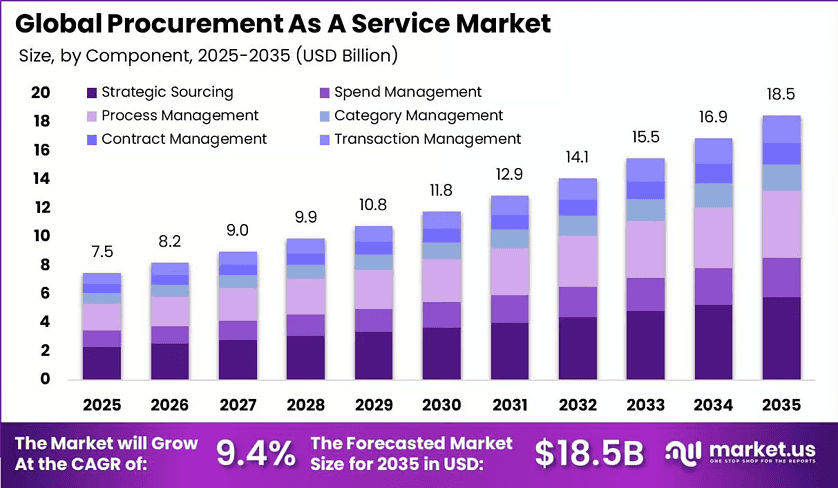
New York, NY – November 02, 2026 – The Global Procurement As A Service Market reached USD 7.5 billion in 2025; the market will grow at a CAGR of 9.4% from 2026 to 2035. Consequently, it should reach about USD 18.5 billion by 2035, which shows steady demand for outsourced purchasing support. North America led the global market in 2025 with more than a 35.1% share. The region earned about USD 2.6 billion in revenue.
Additionally, global business activity supports market growth. According to the report, global GDP grew 2.7% in 2025 and should grow 2.6% in 2026. Global trade in goods and services rose 8% to USD 34.8 trillion. Consequently, companies handle more cross-border purchases and need better supplier management.
Furthermore, manufacturing growth increases demand for sourcing services. China grew 4.9% in 2025, while India expanded 7%. These gains mean factories buy more raw materials, parts, and equipment. Therefore, manufacturers in both countries need stronger supplier networks and faster purchasing support from managed service providers.
However, slower economies also push outsourcing demand. U.S. real GDP rose 2.1% in 2025, while the euro area grew 1.4% and Japan grew 1.3%. Slower growth puts pressure on budgets. Consequently, companies outsource procurement work to cut costs, improve supplier efficiency, and strengthen buying performance.
Key Takeaways
- The Procurement As A Service Market reached USD 7.5 billion in 2025 and should reach USD 18.5 billion by 2035 at a CAGR of 9.4%.
- Strategic Sourcing held the largest component share at 31.3%, driven by unstable commodity and energy prices.
- Large Enterprises accounted for 68.2% of the market due to complex global supplier networks.
- Manufacturing led end-use segments with a 27.9% share, supported by rising global vehicle production.
- North America led the market in 2025 with a 35.1% share and about USD 2.6 billion in revenue.
➤ Evaluate the Report Quality with an Exclusive Sample Download – https://market.us/report/procurement-as-a-service-market/request-sample/
Market Segmentation
By Component
Strategic Sourcing led the component segment with a 31.3% share. According to the World Bank, the metals and minerals price index reached 109.8 in 2025. That figure was 13.6 points above earlier forecasts. Consequently, businesses rely on sourcing experts to manage rising input costs and supplier risks.
Moreover, public buying adds demand for structured sourcing. According to OECD data, public procurement equaled 12.7% of GDP across member countries in 2023. This large contract value needs fair bidding and careful supplier checks. Therefore, governments and suppliers both depend on strategic sourcing support to manage these contracts well.
By Organization Size
Large Enterprises held a 68.2% share of the market. According to Fortune, the Global 500 companies earned about USD 43.1 trillion in revenue in 2025. These firms buy in huge volumes across many countries. Consequently, they need standard sourcing processes, digital tools, contract control, and strong supplier tracking systems.
By End-Use
Manufacturing-led end-use segments with a 27.9% share. According to OICA, global vehicle production rose from 92.7 million units in 2024 to 96.4 million in 2025. Each vehicle needs steel, chips, plastics, and electronics. Therefore, automakers manage more suppliers, orders, and delivery schedules than before.
Regional Analysis
North America held a 35.1% share and earned about USD 2.6 billion in 2025. According to ISM, the Services PMI stood at 50.8% in June 2025, marking steady expansion. However, rising service costs squeeze margins. Consequently, U.S. and Canadian firms adopt digital procurement platforms for spend visibility and cost control.
Asia Pacific is the fastest-growing region in the market. According to UNCTAD, developing Asia attracted about USD 644 billion in FDI in 2025, nearly 40% of global inflows. Moreover, India’s FDI rose 44%. This investment builds new factories. Therefore, regional manufacturers need more sourcing and supplier management support.
Drivers
Procurement spend digitization drives strong market growth. Companies move source-to-pay tasks from internal teams to technology-based managed services. According to the report, this trend could add about 2.0% to the baseline CAGR. Consequently, providers in North America and Europe gain more recurring service contracts in the short term.
Additionally, trade policy changes make sourcing harder. According to the WTO, members introduced 644 goods-trade measures between mid-2024 and mid-2025. These rules raise compliance and sourcing work for buyers. Therefore, companies turn to procurement service providers for updated trade data and flexible supplier options.
Use Cases
Manufacturers use procurement services to manage large supplier networks. Service providers compare vendors, negotiate prices, and track delivery schedules for raw materials and parts. Moreover, these providers help factories avoid supply gaps during shipping delays. Consequently, manufacturers keep production lines running smoothly while lowering purchasing costs and reducing manual buying work for internal teams.
Additionally, banks and financial firms use managed procurement to control indirect spending. Providers handle software, office services, and vendor contracts under strict compliance rules. Therefore, financial institutions gain better spend visibility and stronger audit trails. Furthermore, these firms free internal staff to focus on core business tasks instead of routine purchasing and contract reviews.
Business Opportunities
Outcome-based procurement models offer a strong growth opportunity. Most contracts still use pricing based on headcount or transaction volume. However, buyers increasingly want to pay for real savings and measured results. Consequently, providers that link fees to performance can win trust, build longer client relationships, and stand out in a crowded service market.
Moreover, mid-sized companies present a large untapped market. Many smaller firms lack skilled buying teams and modern sourcing tools. Therefore, managed sourcing providers can offer simple, flexible service packages for these businesses. Additionally, providers in Asia Pacific and Europe can grow quickly by serving this group with affordable digital procurement solutions.
Major Challenges
Supplier data quality remains a major operational challenge. Providers must clean supplier records, product categories, tax details, and payment information before automation works well. However, poor data leads to wrong supplier matches and weak spend visibility. Consequently, companies face more manual reviews and slower results until data rules and audit controls improve.
Additionally, cross-border compliance creates ongoing pressure for service providers. Each country applies different tariffs, trade rules, and reporting standards. Therefore, providers must track frequent policy changes across many markets. Moreover, talent shortages in North America and Europe make it harder to find skilled staff who can handle these complex compliance tasks.
Top Key Players in the Market
- Accenture plc
- Capgemini
- Corbus LLC
- Genpact
- GEP
- HCL Technologies Ltd
- IBM Corporation
- Infosys Limited
- Proxima Group
- Tata Consultancy Services Limited
- Wipro Limited
- WNS (Holdings) Ltd
- Simfoni Limited
- Pcura Consulting Pvt Ltd
- Sastrify
- Vizient Inc.
Conclusion
The Procurement As A Service Market shows strong long-term growth potential. Rising trade complexity, price swings, and digital adoption push companies toward managed sourcing services. Moreover, large enterprises and manufacturers lead demand, while North America holds the top regional position. However, data quality and compliance issues remain key hurdles. Consequently, providers offering outcome-based models and mid-market services can capture new growth opportunities.
Discuss your needs with our analyst
Please share your requirements with more details so our analyst can check if they can solve your problem(s)