
Market Overview
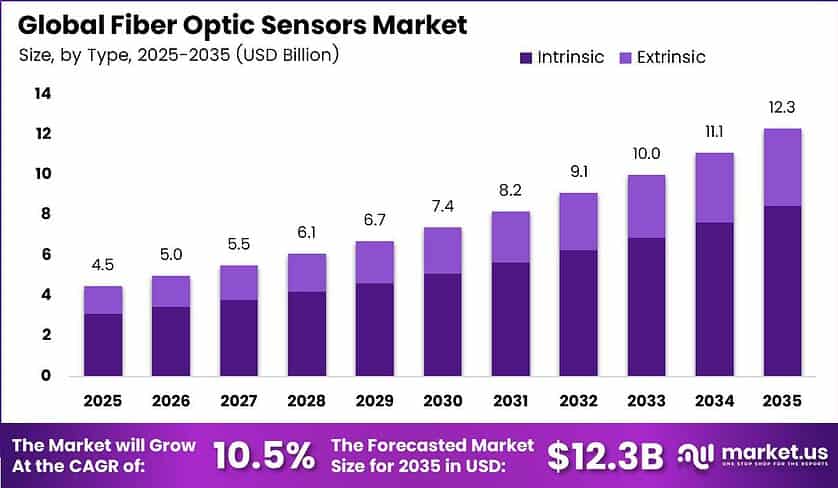
New York, NY – November 02, 2026 – The Global Fiber Optic Sensors Market reached USD 4.5 billion in 2025. Analysts expect it to hit USD 12.3 billion by 2035, growing at a 10.5% CAGR. This steady rise shows that utilities, factories, and network operators now treat optical sensing as core infrastructure. Moreover, buyers value its accuracy over long distances.
Digital infrastructure drives much of this growth. According to the International Telecommunication Union, 6.0 billion people were online in 2025, which is 74% of the world population. Consequently, operators keep building fiber networks to carry heavier data loads. These networks give optical sensing and remote asset monitoring a natural base to grow on.
Energy networks add strong demand. Global investment in electricity grids reached USD 375 billion in 2024 and is rising by nearly 9% each year. Therefore, utilities need better tools to track cable heat, faults, and strain. Fiber optic sensors meet this need because they monitor grids and pipelines continuously without electrical interference.
Factory automation creates another growth path. According to the International Federation of Robotics, factories installed 542,000 industrial robots in 2024. Additionally, Asia accounted for 74% of these installations, so automated plants need constant checks on heat, vibration, and machine health. As a result, manufacturers adopt optical sensing to reduce downtime.
Data centres also push the market forward. According to industry data, data centre electricity use rose about 17% in 2025. However, AI-focused sites grew even faster, with power use jumping 50%. These dense facilities need close monitoring of temperature, power cables, and vibration, which increases demand for Fiber-based sensing solutions.
Key Takeaways
- The Fiber Optic Sensors Market was valued at USD 4.5 billion in 2025 and is projected to reach USD 12.3 billion by 2035.
- The market is expected to grow at a CAGR of 10.5% between 2026 and 2035.
- The intrinsic segment led the By Type category with a 68.8% share.
- The Fiber optic cable segment led the By Component category with a 32.4% share.
- The industrial segment led the By End-User category with a 29.4% share.
- North America led the market in 2025 with a 43.6% share and about USD 1.9 billion in revenue.
➤ See the Full TOC, Market Tables & Figures in Your Sample Copy – https://market.us/report/global-fiber-optic-sensors-market/request-sample/
Market Segmentation
By Type
Intrinsic sensors led the By Type segment with a 68.8% share in 2025. These sensors use the fiber itself as the sensing element. Consequently, one cable can track strain, heat, and vibration over long distances. According to the U.S. Federal Highway Administration, the country had over 623,000 highway bridges in 2024, and these bridges need continuous structural checks.
Extrinsic sensors hold the remaining share and handle point-based tasks. Moreover, they suit applications where an external device converts light signals. According to the International Organization of Motor Vehicle Manufacturers, global vehicle output reached 92.5 million units in 2024. Therefore, busy auto plants keep demand steady for both sensor types.
By Component
Fiber optic cable led the By Component segment with a 32.4% share. Cables carry light signals and measure strain, heat, and pressure without electrical noise. According to the National Telecommunications and Information Administration, the BEAD program allocated USD 42.4 billion for broadband, which lifts cable orders. Additionally, demand for receivers, transmitters, and optical amplifiers grows as new fiber routes expand.
By End-User
Industrial users led the By End-User segment with a 29.4% share. Factories, mines, and process plants rely on these sensors because light-based systems resist heat, corrosion, and high voltage. According to UNIDO, global manufacturing output grew 1.0% quarter-on-quarter in late 2024. Consequently, this steady output growth raises the need for early fault detection.
Transportation, medical, defense, and oil and gas users make up the rest of the demand. Moreover, rail operators monitor tracks and tunnels, while hospitals use optical probes in patient care. Defense agencies value secure, interference-free sensing. Similarly, oil and gas firms deploy fiber lines to monitor leaks and pressure along long pipelines.
Regional Analysis of Optical Sensing
North America led the fiber optic sensors market in 2025 with a 43.6% share and about USD 1.9 billion in revenue. According to PHMSA, the U.S. regulates nearly 3.3 million miles of pipelines. Consequently, operators need long-distance sensing to spot leaks, intrusion, and pressure changes early.
Asia Pacific is the fastest-growing region, driven by industry, power use, and new infrastructure. According to the International Energy Agency, electricity demand will rise 5.7% in China and 6.6% in India in 2026. Therefore, grids, factories, and tunnels in both countries need more optical monitoring. Meanwhile, Europe benefits from rail and offshore wind projects.
Key Market Drivers
Grid asset monitoring is the strongest growth driver, adding about 2.0% to the baseline CAGR. According to the IEA, the world built around 1.5 million km of transmission lines over the past decade. Consequently, utilities need constant checks on cable heat, strain, and faults. This demand also supports recurring revenue from monitoring services.
Industrial predictive maintenance adds about 1.6% to market growth over the short term. According to the International Federation of Robotics, the global robot stock reached 4.664 million units in 2024, up 9%. Additionally, larger robot fleets need early warnings on vibration and heat. Therefore, plant managers install optical sensors to prevent costly breakdowns.
Use Cases
Pipeline operators use distributed fiber sensing to watch long routes in real time. The sensors detect leaks, ground movement, and third-party intrusion along the full cable length. Consequently, operators respond faster and avoid costly spills. Moreover, this approach reduces the need for frequent manual patrols across remote and hard-to-reach terrain.
Bridge and tunnel owners embed optical sensors inside concrete and steel structures. These sensors track strain, cracks, and temperature shifts as they happen. Therefore, engineers spot weak points before they become safety risks. Additionally, data centre operators use the same technology to monitor power cables and server heat, which protects uptime for cloud and AI workloads.
Business Opportunities
Sensing analytics subscriptions are a major untapped opportunity. Most suppliers still sell hardware and one-time project work. However, multi-year monitoring contracts can create steady income and stronger customer loyalty. Consequently, vendors that bundle software, alerts, and expert support can raise lifetime margins and lower inspection costs for asset owners.
Carbon storage and hydrogen projects open fresh demand for optical monitoring. Storage sites need constant checks on well integrity, pressure, and possible gas leaks. Moreover, hydrogen pipelines and tanks need safe, spark-free sensing. Therefore, suppliers that validate products for these new energy assets can win early contracts across North America, Europe, and the Middle East.
Major Challenges
Optical supply chain volatility creates real friction for sensor makers. Shipping detours around the Cape of Good Hope stretch delivery times and raise freight costs. Additionally, trade duties on optical fiber make sourcing decisions harder. Consequently, suppliers hold larger inventories and build dual sourcing plans, which ties up working capital and delays some customer projects.
High interrogator costs slow adoption among smaller asset owners. Interrogators, rugged cables, installation, and system setup demand heavy upfront spending. However, many operators still rely on cheaper point sensors and manual checks. Moreover, a shortage of skilled installers adds delays, so buyers often limit spending to pilot projects instead of full deployments.
Top Key Players in the Market
- Finisar Corporation
- Yokogawa Electric Corporation
- Althen
- Luna Innovations Incorporated
- OmniSens S.A.
- Sumitomo Electric Industries Ltd.
- ABB Ltd.
Conclusion
The fiber optic sensors market shows strong, steady growth as grid upgrades, pipeline safety, factory automation, and data centre expansion drive demand across major regions. Moreover, North America leads today, while Asia Pacific grows fastest. However, supply chain risks and high upfront costs remain key hurdles. Therefore, suppliers that offer analytics services and local production will capture the best long-term value.
Discuss your needs with our analyst
Please share your requirements with more details so our analyst can check if they can solve your problem(s)