
Market Overview
New York, NY – November 05, 2026 – The Global Soft Robotics Market reached USD 1.9 billion in 2025. Analysts project it will reach about USD 31.6 billion by 2035, growing at a CAGR of 32.3%. This pace shows that companies are moving quickly toward flexible automation that handles delicate items safely.
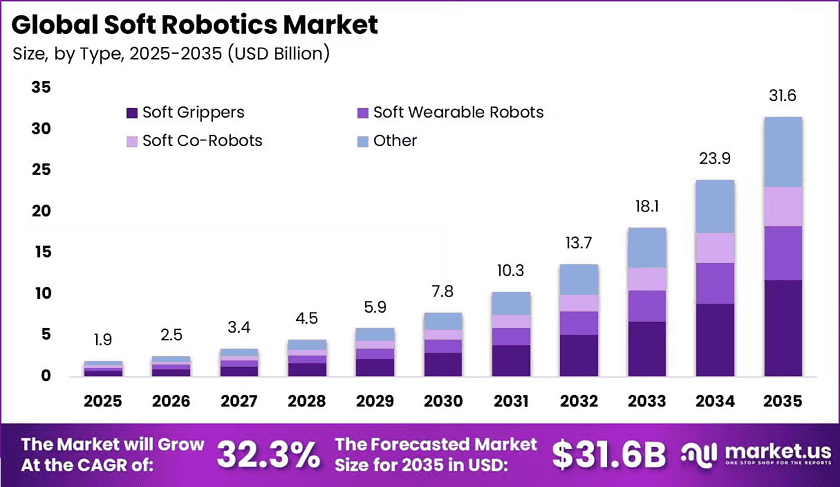
North America led the industry in 2025 with a share of more than 38% and about USD 0.72 billion in revenue. Moreover, factories, warehouses, hospitals, food processors, and farms keep adding automation. Consequently, buyers want soft grippers and compliant robotic arms that can work with fragile, irregular, and mixed products.
According to the International Federation of Robotics, global industrial robot installations reached 542,076 units in 2024. That level is more than 2 times the figure from ten years earlier. Additionally, installations stayed above 500,000 units for 4 straight years. This steady base creates a large pool of systems for soft end-effectors.
Professional service robot sales reached nearly 199,000 units in 2024, rising 9%, according to IFR. Logistics robots made up 102,900 units, up 14%. Therefore, more than half of service robots now move goods. Agricultural robot sales reached about 19,500 units, which points to future demand for gentle crop handling.
Healthcare and online retail also support growth. According to IFR, medical robot sales rose 91% to about 16,700 units in 2024. Meanwhile, U.S. retail e-commerce sales hit USD 340.2 billion in Q2 2026. Higher order volumes increase the need for automated picking and packing that avoids product damage.
Key Takeaways
- The soft robotics market reached USD 1.9 billion in 2025 and should reach USD 31.6 billion by 2035, growing at a CAGR of 32.3%.
- Soft grippers led the type segment with a 37.2% share because buyers need safe handling of fragile and irregular products.
- Healthcare led the end-user segment with a 31.7% share, backed by demand for rehabilitation and mobility-assistance devices.
- North America led in 2025 with more than 38% share and about USD 0.72 billion in revenue.
➤ Preview Key Insights with an Exclusive Sample Report Download – https://market.us/report/soft-robotics-market/request-sample/
Market Segmentation
By Type
Soft grippers hold a 37.2% share of the type segment. Their flexible fingers spread force across a wider surface, so they crush, scratch, and drop fewer items than rigid grippers. Consequently, manufacturers use them in food processing, agriculture, electronics, consumer goods, and medical work.
According to the Food and Agriculture Organization, global fruit and vegetable output reached about 2.1 billion tonnes in 2023. These crops vary in shape, size, and ripeness, so they need gentle handling. Moreover, other product types include soft wearable robots and soft co-robots, which support human assistance and safe shared workspaces.
By End-User Industry
Healthcare leads end-user demand with a 31.7% share. Soft robotic devices use flexible materials and controlled force, so they suit rehabilitation wearables, prosthetics, and therapy tools. According to the World Health Organization, about 2.4 billion people could benefit from rehabilitation. This large patient base creates steady demand for comfortable assistive technology.
Additionally, manufacturing, food and beverage, agriculture, logistics and warehousing, and defense use soft robots in specialized ways. Food and beverage operations made up about 4% of global industrial robot installations in 2024, according to IFR. These users handle trays, pouches, and bottles, so compliant gripping reduces waste and protects product quality.
Regional Analysis
North America held more than 38% of 2025 revenue. According to IFR, U.S. factories operated about 393,700 industrial robots in 2024, up 3%. Moreover, the region reached 204 robots per 10,000 factory workers. This dense automation base helps American firms adopt soft grippers early and at scale.
Asia Pacific should grow the fastest because of rising labor costs and large electronics and automotive industries. According to IFR, Asia accounted for 74% of global robot deployments in 2024. China alone installed about 295,000 units. Consequently, the region offers strong openings in battery handling, food packing, and precision assembly.
Growth Drivers
Adaptive warehouse automation adds about 4.2% to the market CAGR. Mixed-SKU fulfillment needs robots that grab bags, clothing, and fragile goods without custom tooling. According to the U.S. Census Bureau, e-commerce made up 15.5% of U.S. retail sales in Q1 2026. Therefore, retailers invest in compliant grippers to keep up with orders.
Medical rehabilitation demand adds about 3.8% to the CAGR. According to the WHO, people aged 60 and above are expected to rise to 1.4 billion by 2030. Additionally, mobility limits and long-term care needs increase as populations age. Consquently, hospietals and clinics adopt soft exosuits because these devices weigh less than rigid systems.
Use Cases
Warehouse operators use soft grippers to pick, pack, and sort products of many shapes. These grippers combine suction with flexible fingers, so they handle boxes, pouches, and loose items safely. Moreover, retailers use them in returns handling, where unknown items arrive each day. Consequently, fulfillment centers reduce damage and keep order flow steady.
Rehabilitation clinics use soft exosuits and robotic gloves to help patients regain movement. These wearables give gentle support to hips, legs, and hands during therapy. Additionally, older adults use them to stand, walk, and do daily tasks with less effort. Therefore, care providers improve patient comfort while supporting recovery goals.
Business Opportunities
Rehabilitation robotics-as-a-service offers a strong future opening. Many clinics still buy equipment through tight capital budgets. However, subscription models lower upfront costs and spread equipment use across sites. Moreover, providers can earn recurring revenue from software, maintenance, and remote monitoring. Consequently, vendors that bundle service with hardware can win more healthcare customers.
Soft gripper retrofit programs create another clear opportunity. Factories already run large fleets of industrial robots that use rigid tools. Therefore, suppliers can sell soft end-effectors that upgrade existing machines without full replacement. Additionally, automated produce harvesting opens long-term demand, as farms seek gentle tools for picking delicate crops.
Major Challenges
Component supply volatility remains a major challenge. Soft robots depend on elastomers, valves, sensors, and microcontrollers sourced from many countries. However, shipping detours and trade tariffs raise costs and delay deliveries. Consequently, manufacturers adopt dual sourcing, safety stock, and regional assembly to protect installation schedules and customer trust.
High system acquisition costs also slow adoption. Buyers must pay for grippers, sensors, machine vision, integration, and staff training. Moreover, smaller manufacturers often lack the budget for these projects. Therefore, early adoption tends to cluster among larger firms. Additionally, durability testing and safety certification add further cost and time before launch.
Top Key Players in the Market
- Soft Robotics Inc.
- RightHand Robotics Inc.
- Ekso Bionics Holdings Inc.
- Rewalk Robotics Ltd
- Yaskawa Electric Corporation
- Bioservo Technologies AB
- Festo AG
- Roam Robotics
- ABB Ltd.
- Pneubotics Inc.
Conclusion
The soft robotics industry is growing fast as warehouses, factories, farms, and hospitals look for safer and more flexible automation. Soft grippers lead product demand, while healthcare leads end-user adoption. North America leads today, and Asia Pacific is gaining quickly. However, high costs and supply risks remain. Therefore, vendors that offer retrofit tools, service models, and strong regional supply chains will be best placed to grow.
Discuss your needs with our analyst
Please share your requirements with more details so our analyst can check if they can solve your problem(s)