
Market Overview
New York, NY – November 11, 2026 – The Global Robot Operating System Market reached USD 626.5 million in 2025. Analysts expect it to reach about USD 1,843.9 million by 2035, growing at a CAGR of 11.4%. This steady growth shows that more companies now depend on shared robot software to run automation at scale.
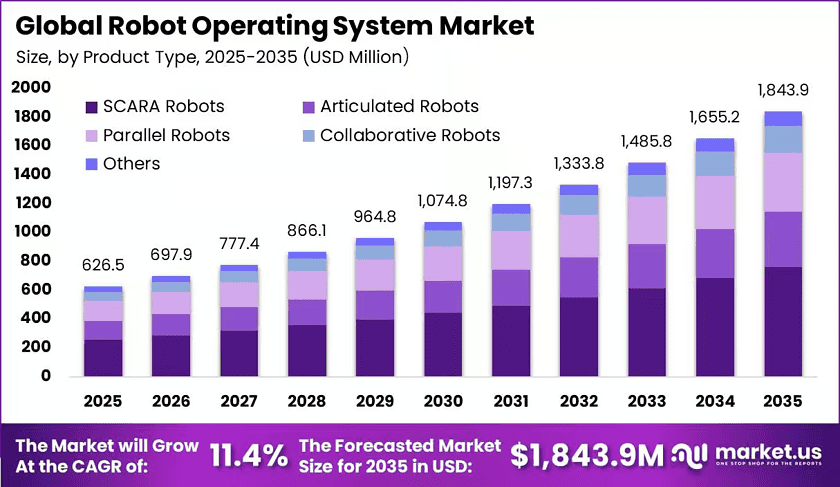
Moreover, the market should add nearly USD 1,217.4 million in new value during the forecast period. Manufacturers, warehouses, hospitals, and research labs keep adding robots to their operations. Consequently, demand is rising for ROS-based tools that handle motion control, navigation, machine vision, simulation, and communication across robot fleets.
According to the International Federation of Robotics, factories installed 542,076 industrial robots worldwide in 2024. That figure is more than double the level of ten years earlier. Therefore, robot software providers now serve a much larger installed base, and each new unit creates fresh demand for programming and integration platforms.
Additionally, the IFR reported that the global operating robot stock reached 4.664 million units, up 9% year on year. Transportation and logistics robots reached 102,900 units, rising 14%. This trend shows that goods handling now makes up more than half of professional service robot sales, which widens the market for robot software.
However, North America holds the top position, with U.S. automakers installing about 13,700 robots, up 10.7%. According to the IFR, U.S. installations then rose 11% to about 38,000 units in 2025. As a result, strong vehicle and e-commerce activity keeps pushing demand for warehouse automation and factory automation.
Key Takeaways
- The Robot Operating System Market was valued at USD 626.5 million in 2025 and should reach USD 1,843.9 million by 2035, growing at a CAGR of 11.4%.
- The SCARA robot segment led the robot type category with a 41.3% share, driven by demand in electronics and semiconductor assembly.
- The automotive segment led the end-use industry category with a 30.4% share, supported by rising vehicle and EV production.
- North America led the market in 2025 with a 32.6% share and about USD 204.6 million in revenue.
➤ Preview Key Insights with an Exclusive Sample Report Download – https://market.us/report/robot-operating-system-market/request-sample/
Market Segmentation
By Robot Type
SCARA robots held a leading 41.3% share of the robot type segment. These machines use 4 controlled axes and a rigid horizontal arm. Consequently, electronics makers use them for fast pick-and-place, screwdriving, dispensing, and precision assembly. Their small footprint also suits crowded production floors where space is limited.
Moreover, according to the Semiconductor Industry Association, global chip sales reached USD 630.5 billion in 2024, up 19.1%. This growth means manufacturers must handle more tiny parts quickly and accurately. Therefore, ROS software helps link SCARA arms with cameras, sensors, conveyors, and plant systems. Articulated, parallel, and collaborative robots complete the segment.
By End-Use Industry
The automotive segment held a 30.4% share of the end-use industry category. Car plants use robots for welding, painting, battery assembly, inspection, and material handling. According to OICA, global vehicle production rose from 92.7 million to 96.4 million units in 2025. Consequently, higher output requires more flexible and connected factory automation.
Additionally, the International Energy Agency reported that factories produced 17.3 million electric cars in 2024, about 25% more than in 2023. This shift increases demand for battery handling and high-voltage quality checks. Meanwhile, electronics, metal and machinery, plastics, chemicals, food and beverages, and healthcare also adopt ROS-based robot control tools.
Regional Analysis of Robot Software Demand
North America led the market in 2025 with a 32.6% share and about USD 204.6 million in revenue. According to the IFR, the United States had 307 robots per 10,000 manufacturing workers. This high robot density shows mature automation. Therefore, regional buyers need ROS platforms that connect arms, mobile robots, sensors, and factory systems.
However, Asia Pacific is the fastest-growing region. According to the IFR, Asia accounted for 74% of global robot installations in 2024. China alone installed 295,000 robots, equal to 54% of the world total. Consequently, strong electronics, battery, and automotive production across the region drives demand for scalable robot software platforms.
Key Growth Drivers
Factory robot fleet growth remains the strongest market driver. Every new robot needs software for motion, vision, safety, and plant integration. According to the IFR, the operating robot stock rose 9% to about 4.6 million units. As a result, this expansion could add an estimated 2.4% to the baseline growth rate.
Moreover, developer activity confirms rising use of open robotics software. According to Open Robotics, users downloaded ROS packages 984,135,185 times in 2025, up 85.18%. Companies using ROS rose 26% to 1,579. Therefore, the growing user base shows strong commercial trust and supports faster product development across the market.
Key Use Cases
Automakers use ROS to run battery handling, adhesive dispensing, welding, and inspection tasks. The software connects robots with cameras, sensors, and production controls on one platform. Consequently, plant managers can change product lines faster and reduce downtime. This flexibility matters as vehicle makers shift more production toward electric models.
Additionally, warehouses and logistics operators deploy ROS on autonomous mobile robots for picking, sorting, and moving goods. Hospitals also use robot platforms for surgery, rehabilitation, and laboratory analysis. Therefore, the same open software base supports many industries. Developers can reuse proven navigation and vision tools instead of building each system from scratch.
Business Opportunities
Robotics software subscriptions offer a strong growth path for vendors. Many ROS projects still rely on one-time engineering work. However, subscription models can bundle simulation, fleet management, remote diagnostics, and security updates. Consequently, customers pay lower upfront costs, while software providers build steady recurring revenue and stronger long-term client relationships.
Moreover, small factories in India, Southeast Asia, and Latin America present a large untapped market. These firms need simple, low-cost automation tools that install quickly. Therefore, vendors that offer ready-made ROS packages and support services can win new customers. Healthcare, construction, and farming robots also open fresh revenue streams for software providers.
Major Challenges
Mixed robot fleets create serious interoperability problems for manufacturers. Plants often run older controllers, proprietary robots, and mobile units that use different software interfaces. Consequently, companies must invest in middleware, APIs, digital twins, and safety testing. These extra costs slow project timelines and reduce the full growth potential of the market.
Additionally, high integration costs limit adoption, especially among smaller manufacturers. Buyers must pay for robots, sensors, edge computers, training, and commissioning. Moreover, shipping disruptions and concentrated rare-earth supply raise hardware prices. Therefore, many companies delay automation plans. A shortage of skilled robotics software engineers also makes deployment harder in emerging markets.
Top Key Players in the Market
- Microsoft Corporation
- KUKA AG
- Wind River Systems Inc.
- Clearpath Robotics
- Husarion Inc.
- Brain Corporation
- Neobotix GmbH
- Universal Robotics
- ABB Ltd.
- FANUC
- Yaskawa Electric Corporation
- Denso
- Omron Corporation
- iRobot Corporation
Conclusion
The Robot Operating System Market shows strong long-term growth as factories, warehouses, and hospitals expand their robot fleets. SCARA robots and automotive users lead demand, while North America holds the top share and Asia Pacific grows fastest. However, integration costs and interoperability gaps still slow adoption. Therefore, vendors offering subscriptions, small factory tools, and strong support services can capture the next wave of automation growth.
Discuss your needs with our analyst
Please share your requirements with more details so our analyst can check if they can solve your problem(s)