Market Overview
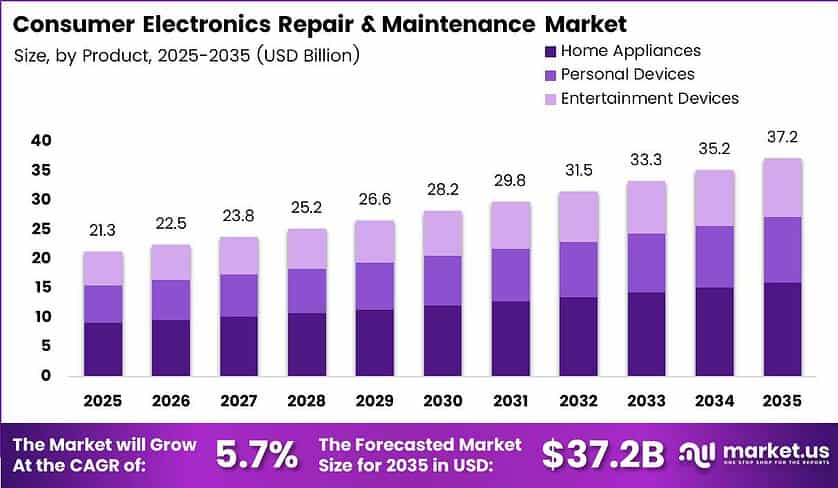
The global consumer electronics repair and maintenance market reached USD 21.3 billion in 2025. Analysts expect it to hit USD 37.2 billion by 2035, growing at a 5.7% CAGR from 2026 to 2035. Longer device lifecycles and repair laws support this rise.
Repair services restore broken appliances, televisions, phones, and laptops. Technicians diagnose faults, replace parts, fix circuit boards, and update firmware. Households, offices, and factories use brand service centers, retail counters, and local workshops. Consequently, owners keep devices longer and avoid replacements.
Moreover, right-to-repair laws push owners toward fixing devices. ITU data shows global e-waste reached 62 billion kg in 2022, yet only 22.3% was formally collected. Regulators now require brands to release parts and manuals. Consequently, repair chains gain steady post-warranty revenue.
Data-Driven Insights for Smarter Business Decisions: Explore the Full Report
Key Takeaways
- Market value reached USD 21.3 billion in 2025.
- Revenue will hit USD 37.2 billion by 2035.
- Growth will run at a 5.7% CAGR.
- Home Appliances held 43.00%; Personal Devices grow fastest.
- Authorized Service Centers held 71.23%; Independent Repair Shops grow fastest.
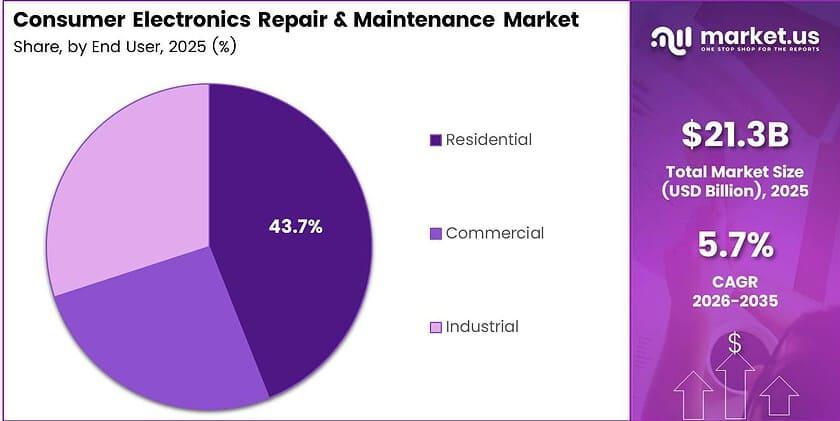
- Residential held 43.78% and grows fastest.
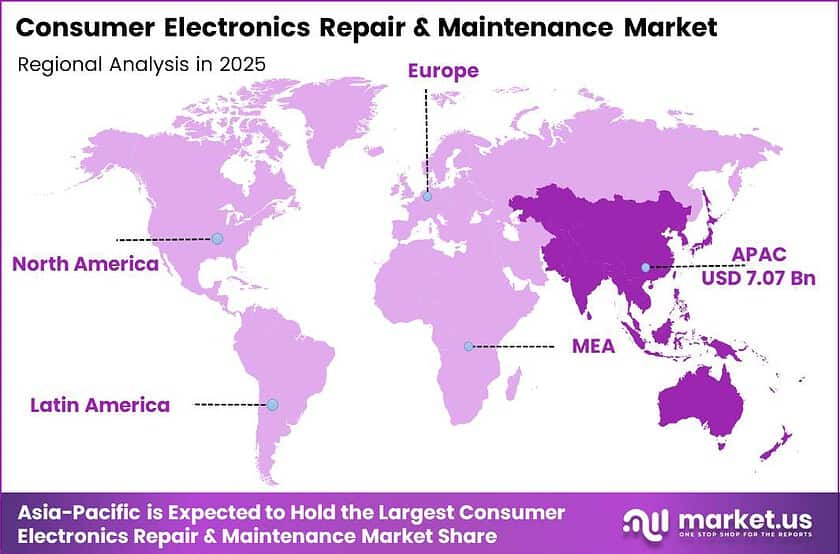
- Asia-Pacific held 33.23%, worth USD 7.07 billion; MEA grows fastest.
- Forecast period: 2026 to 2035.
Market Segmentation Overview
Home Appliances led the product segment with a 43.00% share in 2025. Refrigerators and washers suffer heavy compressor wear, and replacing them costs more than fixing them. Meanwhile, Personal Devices grow fastest, as daily drops and battery wear drive screen replacements.
Moreover, Authorized Service Centers captured 71.23% of the service provider segment. Big retailers bundle brand warranties and factory tools at checkout, locking in steady, predictable repair volume. However, Independent Repair Shops grow fastest, serving out-of-warranty owners who want quick fixes.
Additionally, Residential users held 43.78% of end-user demand and also grow fastest. Households own more devices each year, which raises repair and protection plan needs. Commercial clients use fleet maintenance contracts, while industrial sites need specialized care for control boards.
Drivers
Right-to-repair laws drive growth most strongly. California SB 244 requires 3 to 7 years of parts access, while Oregon and Colorado banned parts pairing. These rules end brand control over spare parts. Consequently, repair shops gain fair access to genuine components.
Moreover, the European Union enforced Directive 2024/1799 across all 27 member states in July 2026. The law mandates spare-part availability and 12-month warranty extensions. Repair shops now join brand networks. This shift cuts customer acquisition costs by 14% to 19%.
Use Cases
Home appliance repair remains a core application. Technicians swap compressors and parts on refrigerators and washing machines at customer homes. U.S. appliance repair counted 5,595 businesses employing 24,600 workers in 2023. This scale shows strong demand for keeping appliances running.
Additionally, fleet maintenance supports offices, schools, and retail stores. Providers keep laptops, payment terminals, and AI workstations running under multi-year contracts. Eurostat shows 19.95% of EU enterprises used AI in 2025. Consequently, depot operators earn stable, recurring revenue from business clients.
Data-Driven Insights for Smarter Business Decisions: Explore the Full Report
Major Challenges
High part prices discourage many repairs. Foldable inner screens cost USD 419 to USD 999 to replace in the U.S., or 45% to 50% of launch prices. Consumers often choose trade-ins. Consequently, shop conversion drops below 24% once quotes pass 35% of resale value.
Moreover, repair networks lack skilled board-level technicians. Depots in North America and Western Europe report 18% to 24% vacancy rates. Board backlogs stretch from 48 hours to 7 to 11 business days. Therefore, operators raise senior wages by 12% to 16%.
Business Opportunities
Predictive maintenance subscriptions offer strong potential. Smart devices now track battery health, heat, and motor strain in real time. Providers can fix parts before failures spread. Home plans priced at USD 14 to USD 22 monthly can lift gross margins by 900 to 1,300 basis points.
Additionally, consolidation builds scale across categories. Asurion completed a USD 2.8 billion acquisition of Domestic and General in October 2026. The deal added 22 million protected appliances and 2.6 million annual repairs. Consequently, investors favor unified platforms covering both phones and appliances.
Regional Analysis
Asia-Pacific led the market with a 33.23% share, worth USD 7.07 billion in 2025. China, India, Japan, and South Korea host huge smartphone and appliance user bases. Dense factory hubs speed parts supply. Moreover, India’s repair portal moves more repairs into organized networks.
However, the Middle East and Africa region grows fastest. The World Bank reports MENA growth of 3.1% in 2025, projected at 3.6% in 2026. Rising incomes boost appliance adoption. Additionally, extreme heat strains air conditioners and phone batteries, lifting demand for service hubs.
Key Players Analysis
Leading companies compete through acquisitions, retail networks, and digital after-sales platforms. Best Buy runs Geek Squad repair services across 1,068 stores. Redington stages spare parts through 160 warehouses. Meanwhile, Servify secured a USD 12.21 million IFC investment in January 2026.
- The Cableshoppe Inc.
- Redington Limited
- Electronix Services
- B2X Care Solutions GmbH
- Encompass Supply Chain Solutions, Inc.
- uBreakiFix by Asurion
- Asurion, LLC
- Best Buy Co., Inc.
- American Home Shield Corporation
- Servify Technologies Pvt. Ltd.
- Other Key Players
Recent Developments
- November 2026 — Assurant acquired Protection Point to expand B2B repair coverage.
- November 2026 — Fairphone launched the USD 649.99 Gen 6 Plus with Boost Mobile.
- October 2026 — Apple expanded Self Service Repair with USD 49 tool kits.
- July 2026 — uBreakiFix opened stores, passing 700 locations.
- May 2026 — Asurion opened a Cebu hub, creating 2,000 jobs.
- May 2026 — Currys became Microsoft’s first UK Surface repair partner.
- March 2026 — Lenovo and iFixit launched ThinkPads scoring 10 out of 10 on repairability.
- February 2026 — Back Market reported USD 3.5 billion refurbished GMV, up 32%.
- October 2025 — Refurbed raised EUR 50 million to enter 12 markets.
- October 2025 — Assurant acquired OptoFidelity’s mobile testing portfolio.
Conclusion
The consumer electronics repair and maintenance market shows steady growth through 2035. Right-to-repair laws, longer device lifecycles, and protection subscriptions drive this expansion. A growing global device base keeps service demand rising. Consequently, repair now forms a core part of the electronics value chain.
Therefore, companies must invest in skilled technicians, predictive diagnostics, and genuine parts supply. Home Appliances, Authorized Service Centers, and Residential users lead their segments, while Asia-Pacific dominates. Firms blending scale with digital tools will win as the market reaches USD 37.2 billion by 2035.
Looking for data tailored to your specific market, region, or business need? Request a custom report or consultation — write to us at sales@market.us
Discuss your needs with our analyst
Please share your requirements with more details so our analyst can check if they can solve your problem(s)