Market Overview
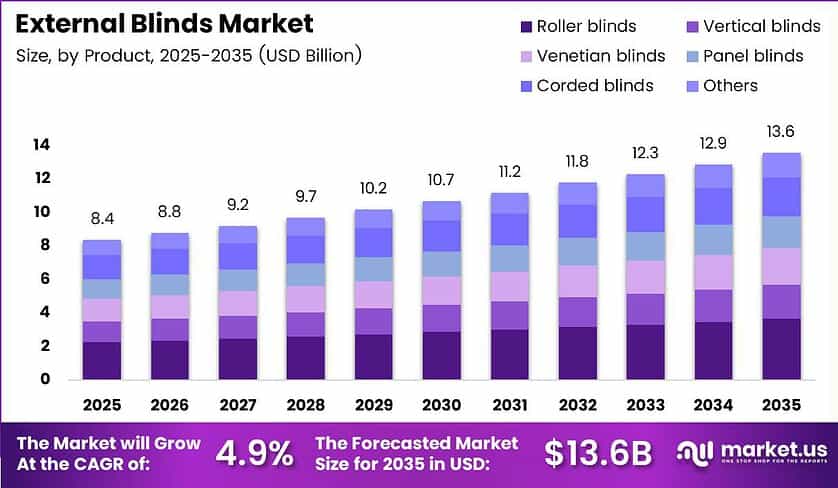
The global external blinds market reached USD 8.4 billion in 2025. Analysts expect it to hit USD 13.6 billion by 2035, growing at a 4.9% CAGR from 2026 to 2035. Rising building heat and cooling costs push owners toward exterior shading.
External blinds mount outside windows and facades to block solar heat and glare before sunlight reaches the glass. Offices, hotels, campuses, and homes buy them to keep interiors comfortable. Consequently, developers can downsize air conditioning systems and lower peak cooling loads.
Cooling demand keeps climbing worldwide. The IEA expects cooled building floor area to grow from 105 billion square meters in 2022 to 140 billion by 2030. More cooled space strains power grids. Therefore, builders specify exterior shading early in design.
Green building rules strengthen the case. UNEP says passive cooling and exterior shading can protect 3.5 billion people from heat stress and save USD 1 trillion yearly by 2050. Consequently, municipal codes reward facade solar control, which turns blinds into compliance assets.
Get further insight into the global trends shaping the future of the external blinds industry. Request Sample
Key Takeaways
- USD 8.4 billion in 2025, rising to USD 13.6 billion by 2035.
- The market will grow at a 4.9% CAGR from 2026 to 2035.
- Roller blinds lead with 26.56%; vertical blinds grow fastest.
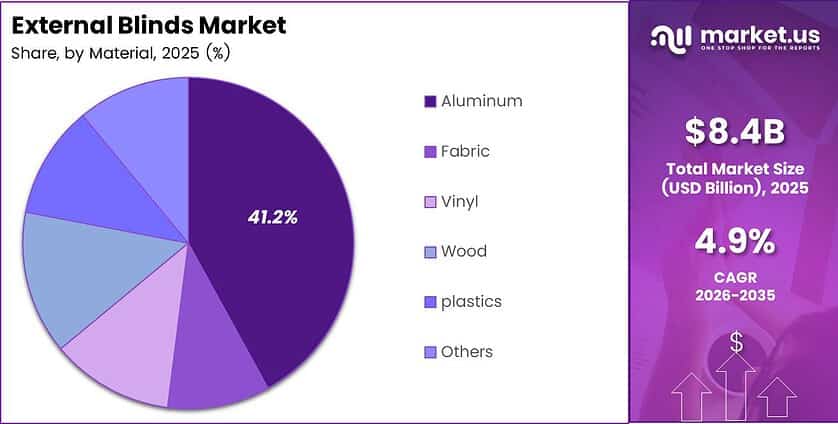
- Aluminum holds 41.23% and also grows fastest.
- Manual systems hold 54.34%; automatic systems grow fastest.
- Retro-fit projects hold 56.34%; new construction grows fastest.
- Residential holds 46.34%; commercial grows fastest.
- Offline channels hold 63.78%; online grows fastest.
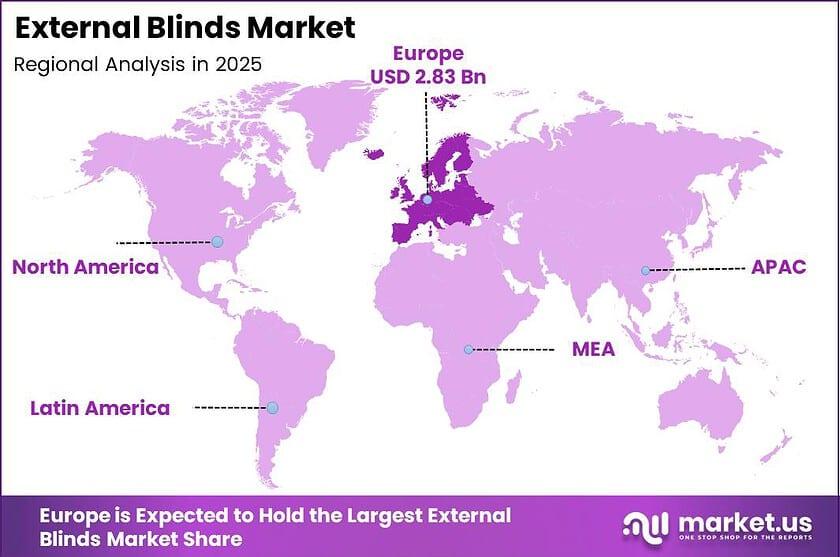
- Europe leads with 33.89%, worth USD 2.83 billion; Asia-Pacific grows fastest.
Market Segmentation Overview
Roller blinds lead products with a 26.56% share. Compact wind-guided cassettes suit apartment and office facades. Aluminum dominates materials at 41.23% because it resists corrosion and wind. Therefore, makers secure aluminum supply to protect margins.
Moreover, manual systems hold 54.34% of operation modes because they need no wiring. Retro-fit projects capture 56.34% of installations, since many older buildings lack shading. However, automatic systems and new construction grow fastest.
Additionally, residential users hold 46.34% of end use as heatwaves raise comfort needs. Offline channels generate 63.78% of revenue, because custom blinds need on-site measurement and fitting. Meanwhile, commercial buyers and online sales expand fastest.
Drivers
Rising summer heat makes external blinds essential cooling equipment. Europe recorded its hottest year in 2024. Closed external venetian blinds block up to 98% of solar radiation before it hits the glass. This benefit adds roughly 0.45 percentage points to market growth.
Moreover, building energy policies push owners to shade facades. The European Commission requires renovation of the 16% worst-performing non-residential buildings by 2030. Consequently, landlords treat dynamic exterior shading as asset protection. This policy support adds about 0.30 percentage points to growth.
Get further insight into the global trends shaping the future of the external blinds industry. Request Sample
Use Cases
Homeowners install exterior blinds on south-facing bedrooms and patios. They block heat before it enters the room. The IEA reports residential dwellings hold nearly 70% of installed cooling units. Therefore, blinds help households cut summer electricity bills.
Additionally, hotels use exterior shading on balconies, poolside cabanas, and dining terraces. Blackout-capable blinds block morning sun and street noise. UNWTO counted 1.52 billion tourist arrivals in 2025. Consequently, hospitality contractors favor durable, quiet-motor systems.
Major Challenges
High upfront costs make buyers defer or cancel quotes. Custom sizing, facade work, and motors raise turnkey prices beyond renovation budgets. Buyers also expect payback within 3 to 5 years. This barrier trims about 0.35 percentage points from growth.
However, installer shortages slow order conversion. The European Labour Authority found electrician shortages in 22 countries and sheet-metal worker shortages in 19. Longer crew times cut capacity by roughly 9.1%. Therefore, manufacturers invest in pre-wired cassettes and apprenticeships.
Business Opportunities
Certified remanufactured blinds create a circular revenue stream. A refurbished blind sold at an 80 price index earns 42.5% gross margin, versus 35% for a new one. Early movers that build take-back networks can win sustainability-driven commercial tenders.
Additionally, solar-generating blind slats offer long-term upside. This innovation could add 0.22 percentage points to growth in Europe and Asia. Meanwhile, dealer consolidation adds 0.15 points. Therefore, innovative suppliers with scale can gain share.
Get further insight into the global trends shaping the future of the external blinds industry. Request Sample
Regional Analysis
Europe leads with a 33.89% share, worth USD 2.83 billion in 2025. Low residential air conditioning use and strict overheating codes make exterior shading standard. Dense installer networks in Germany, Switzerland, Austria, France, and Benelux turn renovation subsidies into motorized orders.
However, Asia-Pacific grows fastest through 2035. The World Bank expects East Asia and Pacific GDP to expand 4.5% in 2026. High-rise apartments and glass districts need heat control. Moreover, Chinese motor manufacturing scale supports wind-rated screens across tropical cities.
Key Players Analysis
Leading companies compete through smart controls, acquisitions, and factory expansion. Hunter Douglas earned USD 4.7 billion in 2025 revenue. Somfy reported EUR 1,513 million in 2024 sales across 59 countries. Both push automation.
- Hunter Douglas
- Somfy
- Warema
- Renson
- Griesser
- Lutron
- Markilux
- Dooya
- Alulux
- Soltec
- Other Key Players
Recent Developments
- October 2026 — Somfy opened a 25,000 square meter factory in Portugal.
- October 2026 — Somfy and VoltR partnered on remanufactured batteries, cutting emissions 68%.
- June 2026 — Griesser launched the Soloscreen IV facade awning.
- May 2026 — WAREMA agreed to acquire Tarasola, adding about EUR 30 million revenue.
- March 2026 — Nice and elero launched the elero Son control series.
- February 2026 — Lutron acquired coatings specialist Tanury Industries.
- February 2026 — markilux launched FineLine fabrics with 10 designs.
- February 2026 — Schlotterer planned a EUR 8 million plant investment.
- December 2025 — WAREMA secured Matter-over-Thread certification.
- October 2025 — Griesser moved shutter production to green aluminum.
Conclusion
The external blinds market shows steady growth through 2035. Heatwaves, rising cooling demand, and green building codes drive adoption. Smart motors add value beyond basic shading. Consequently, exterior blinds become essential climate equipment.
Roller blinds, aluminum, manual systems, retro-fit projects, and residential buyers lead their segments. Europe dominates revenue, while Asia-Pacific grows fastest. Therefore, suppliers should balance mature European demand with expansion in hot Asian cities.
Companies must simplify installation, build installer networks, and offer open-protocol smart controls. These steps position firms for a market worth USD 13.6 billion by 2035.
Looking for data tailored to your specific market, region, or business need? Request a custom report or consultation — write to us at sales@market.us
Discuss your needs with our analyst
Please share your requirements with more details so our analyst can check if they can solve your problem(s)