Market Overview
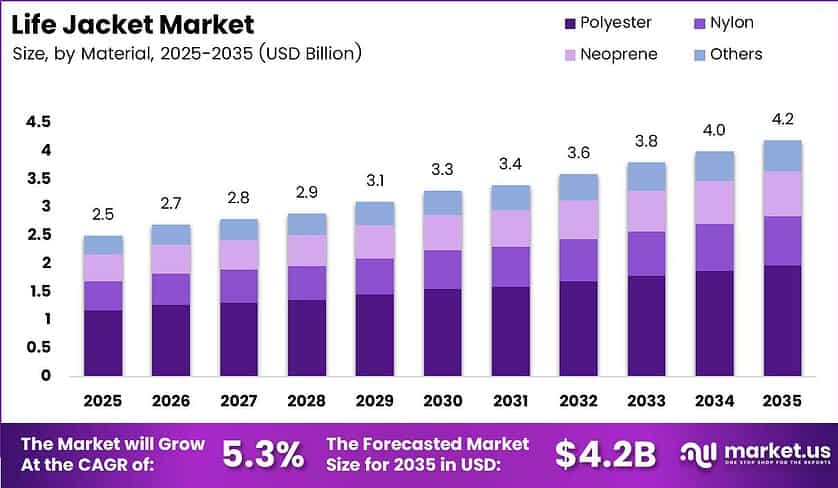
The global life jacket market reached USD 2.5 billion in 2025. Analysts expect it to climb to USD 4.2 billion by 2035, growing at a 5.3% CAGR from 2026 to 2035. Stricter safety rules and rising water activity support this steady growth.
Life jackets use foam or gas-filled chambers to keep people afloat with clear airways. Recreational boaters, ferry operators, airlines, offshore wind crews, and navies all buy them. Consequently, manufacturers earn steady replacement and servicing revenue from certified vests across many different user groups.
Drowning remains a major public safety problem. The WHO reports about 300,000 drowning deaths yearly, and 92% occur in low and middle income nations. Therefore, agencies, schools, and ferry regulators enforce stricter flotation rules. This pressure opens steady tender pipelines for low cost foam vest producers.
Get further insight into the global trends shaping the future of the life jacket industry. Request Sample
Key Takeaways
- The market was USD 2.5 billion in 2025 and will reach USD 4.2 billion by 2035.
- Growth runs at a 5.3% CAGR from 2026 to 2035.
- Inherently Buoyant vests lead with 63.45%; Hybrid vests grow fastest.
- Polyester leads materials with 46.78%; Nylon grows fastest.
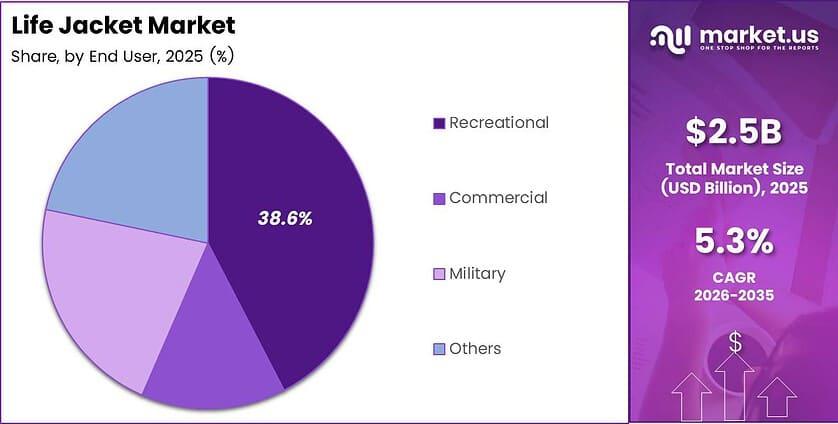
- Recreational users lead with 38.67% and grow fastest.
- Offline channels hold 81.23%; Online Retail grows fastest.
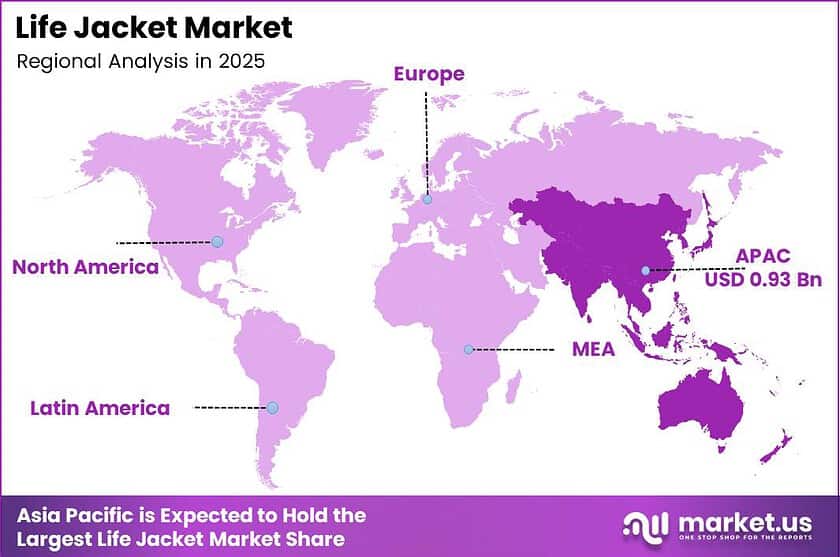
- Asia-Pacific leads with 37.54%, worth USD 0.93 billion; Middle East and Africa grows fastest.
Market Segmentation Overview
Inherently Buoyant vests lead products with a 63.45% share. Foam cores need no gas cylinders or annual servicing, so ownership costs stay low. Consequently, ferries, rental fleets, and budget boaters prefer them. Meanwhile, Hybrid vests grow fastest among offshore wind technicians.
Moreover, Polyester dominates materials at 46.78% because it resists sunlight and costs less. Recreational users hold 38.67% of end use, driven by boating participation. However, Nylon and Hybrid products expand faster through premium demand.
Additionally, offline stores generate 81.23% of sales because buyers want to test fit in person. Specialty stores add expert advice. Meanwhile, Online Retail grows fastest through sizing tools and rearming reminders.
Drivers
Harmonized safety standards drive demand strongly. U.S. Coast Guard rules now align with Level 50, Level 70, and Level 100 vest classes. Shared testing cuts product variants by 30% to 40%. Consequently, makers save USD 18,000 to USD 32,000 per product family.
Moreover, fleet compliance contracts raise supplier revenue. Ferry, tug, and charter operators now sign multi-year servicing agreements. This shift lowers customer acquisition costs by 14% to 19%. Recurring servicing also lifts gross margins by 220 to 340 basis points.
Use Cases
Recreational boaters use life jackets on kayaks, pontoons, and personal watercraft. The U.S. Coast Guard recorded 556 boating deaths in 2024, and 87% of victims wore no vest. Therefore, brands push slim, comfortable designs that people wear willingly.
Additionally, offshore wind crews rely on hybrid work vests during boat transfers. GWEC reports global offshore wind capacity reached 92.5 GW by late 2025. Technicians need instant foam buoyancy plus inflatable turning power. Consequently, suppliers win multi-year offshore safety contracts.
Get further insight into the global trends shaping the future of the life jacket industry. Request Sample
Major Challenges
Raw material costs squeeze producers. Foam cores and coated shells make up 48% to 56% of unit material cost. Duties of 6.5% to 25.0% stretched fabric lead times to 75 to 95 days. Consequently, makers hold larger polymer stocks and audit backup mills.
However, high boat loan rates reduce new vest sales. U.S. powerboat sales fell 8.8% to 215,237 units in 2025. Each new boat triggers 4 to 8 vest sales. Therefore, retailers hold stock longer and discount mid-tier vests by 15% to 25%.
Business Opportunities
Subscription safety services offer major white space. Fewer than 8% of workboat and fishing fleets rent flotation today. Monthly fees of USD 14 to USD 28 per crew member fund tracking and servicing. Early movers can lift five-year profit per vest by 45% to 65%.
Moreover, bio-based foam serves eco-conscious buyers in Western Europe and North America. This opportunity adds about 1.1 percentage points to potential growth. Flood-response stockpiling adds 0.9 points. Consequently, suppliers with sustainable and low-cost lines can gain share.
Get further insight into the global trends shaping the future of the life jacket industry. Request Sample
Regional Analysis
Asia-Pacific leads with a 37.54% share, worth USD 0.93 billion in 2025. Asian yards built 91% of global ship tonnage in 2025. Every new vessel needs full lifejacket outfitting. Consequently, producers near shipyards win export and fleet contracts.
Meanwhile, Middle East and Africa grows fastest. The World Bank projects Sub-Saharan growth of 4.4% across 2026 and 2027. Offshore energy projects and Red Sea port expansions raise demand. Therefore, suppliers building Gulf servicing hubs can capture new contracts.
Key Players Analysis
Leading companies compete through servicing networks, retail reach, and certified products. Survitec runs over 400 service stations and sold its Beaufort defense unit in December 2025. Coleman’s parent Newell Brands earned USD 7.20 billion in 2025 sales through big retailers.
- Survitec Group Limited
- The Coleman Company, Inc.
- VIKING Life-Saving Equipment A/S
- Hansen Protection AS
- Johnson Outdoors Inc.
- Kent Sporting Goods Company, Inc.
- Mustang Survival ULC
- Stormy Lifejackets Pty Ltd.
- Spinlock Ltd.
- Stearns Inc.
- Wuxi Xingtai Shipping Equipment Co., Ltd.
- Lalizas Hellas S.A.
- Other Key Players
Recent Developments
- November 2026 — VIKING won a EUR 23.8 million Greek coast guard vessel contract.
- November 2026 — LALIZAS won a BAE Systems Royal Navy lifejacket supply deal.
- August 2026 — Johnson Outdoors launched the USD 2,500 ePDL+ kit.
- June 2026 — NRS launched the Vector PFD with 2 RECCO reflectors.
- May 2026 — Spinlock and Harken updated the 170 Newton Deckvest VITO.
- February 2026 — Mustang Survival launched the USD 324.99 Elite 190 vest.
- January 2026 — Beaufort won a GBP 12.6 million Royal Navy escape suit contract.
- January 2026 — Hansen Protection signed a 3 year Lufttransport partnership.
- October 2025 — VIKING secured a USD 4.3 million Norwegian Customs contract.
- June 2025 — Survitec earned Bureau Veritas approval for Seahaven.
- May 2025 — Survitec added 1,350 square meters at its Fujairah station.
Conclusion
The life jacket market grows steadily through 2035. Safety rules, drowning prevention, shipping growth, and offshore energy projects drive demand. Foam vests, recurring servicing, and certified products keep revenue stable. Consequently, the industry offers durable opportunities for established and new suppliers.
Therefore, companies must secure raw material supply, meet harmonized standards, and expand servicing networks. Subscription models offer extra margin. Firms acting early can capture a market worth USD 4.2 billion by 2035.
Looking for data tailored to your specific market, region, or business need? Request a custom report or consultation — write to us at sales@market.us
Discuss your needs with our analyst
Please share your requirements with more details so our analyst can check if they can solve your problem(s)