Market Overview
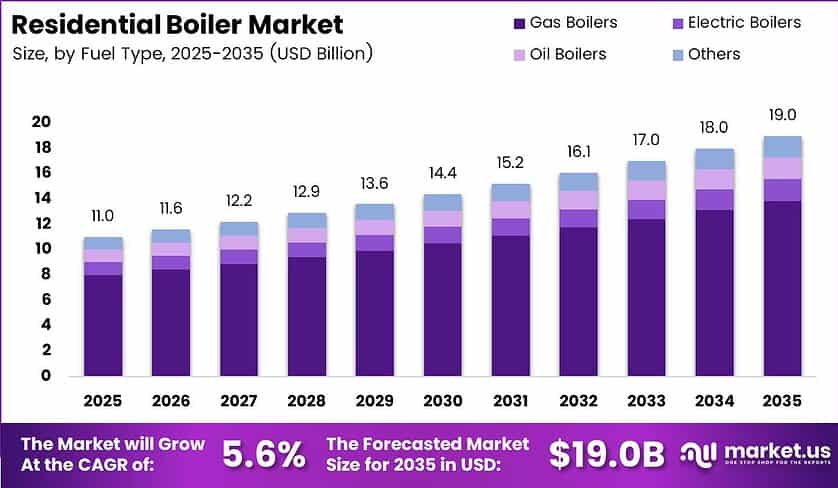
The global residential boiler market reached USD 11.0 billion in 2025. Analysts expect it to hit USD 19.0 billion by 2035, growing at a 5.6% CAGR from 2026 to 2035. Aging heating systems and efficiency rules keep replacement demand strong.
A residential boiler heats water in a closed system and warms homes through radiators or underfloor pipes. It also supplies hot water for daily use. Single-family houses, apartment blocks, and housing estates form the core buyer base for manufacturers.
Heating drives household energy bills. The IEA says buildings use 30% of global energy, and heating takes 70% of home energy use in advanced economies. Consequently, efficiency upgrades directly cut utility costs. Building efficiency investment reached USD 380 billion in 2024.
Get further insight into the global trends shaping the future of the residential boiler industry. Request Sample
Key Takeaways
- USD 11.0 billion in 2025, rising to USD 19.0 billion by 2035.
- Growth runs at a 5.6% CAGR from 2026 to 2035.
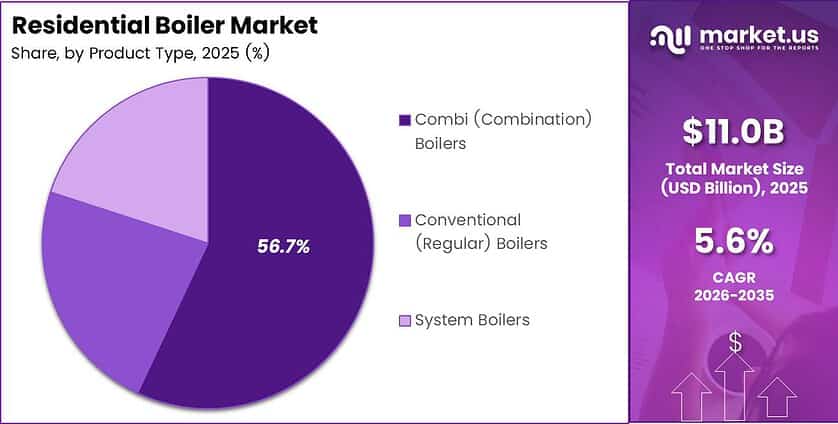
- Combi boilers lead with 56.78% and grow fastest.
- Gas boilers hold 78.56%; electric boilers grow fastest.
- Condensing boilers hold 74.89% and grow fastest.
- Wall mounted units hold 64.78% and grow fastest.
- Combined heating and boiling holds 64.67%.
- Offline channels hold 67.45%; online grows fastest.
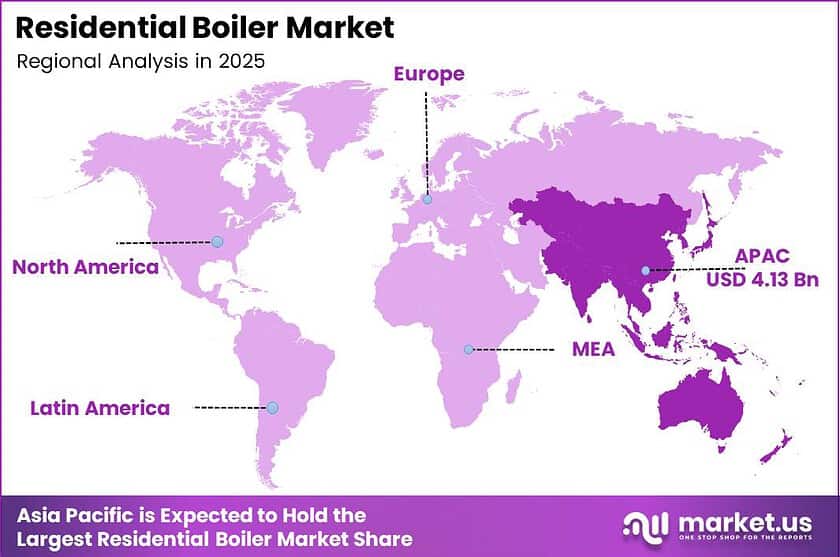
- Europe leads with 37.67%, worth USD 4.13 billion; North America grows fastest.
Market Segmentation Overview
Combi boilers lead products with a 56.78% share. Apartments lack space for storage tanks, so compact tankless units fit best. Europe shows this clearly, with 48% of residents living in apartments. Consequently, makers focus on quiet, compact designs for urban renovations.
Moreover, gas boilers hold 78.56% of fuel demand thanks to wide gas grid access. Condensing boilers capture 74.89% of technology because they recover heat from exhaust. Meanwhile, electric boilers grow fastest as codes restrict fossil hookups.
Additionally, wall mounted units hold 64.78% of installations because new homes are smaller. Offline channels generate 67.45% of revenue, since licensed installers rely on local trade counters. However, online sales expand fastest through digital sizing tools and fixed-price bundles.
Drivers
Aging boilers drive replacement demand. Units installed between 2008 and 2012 now reach the end of their 12 to 15 year lifespan. Broken gas boilers also remain exempt from forced removal in Europe. Consequently, emergency swaps account for over 72% of regional sales.
Moreover, emergency replacements change distribution. Homeowners must replace failed winter units immediately, so contractor acquisition costs fall by 18% to 24%. Manufacturers also earn 350 to 480 basis points more margin on heat exchangers and pump kits. Therefore, suppliers with deep regional parts stock benefit.
Use Cases
Apartment dwellers use combi boilers for instant hot water and heating from one cabinet. These units suit tight kitchens and utility closets. Eurostat shows apartments house 65% of Spanish residents. Therefore, urban multi-family renovation tenders favor compact combi chassis.
Additionally, large detached homes use system boilers with indirect storage tanks. Many new U.S. homes have 4 or more bedrooms, and 31% have 3 or more bathrooms. Simultaneous showers exceed tankless flow rates. Consequently, bundled boiler and tank packages raise order values.
Get further insight into the global trends shaping the future of the residential boiler industry. Request Sample
Major Challenges
Installer shortages limit growth. U.S. projections show 40,600 annual openings for installers from 2025 to 2035, mostly to replace retirees. Winter booking waits stretch from 5 to 21 days. Therefore, households delay repairs.
However, subsidy cuts also hurt demand. European rules ended public grants for standalone fossil boilers from January 1, 2025. Rebates worth EUR 1,200 to EUR 3,500 disappeared, stretching payback from 4.5 to 8.2 years. Consequently, households defer non-emergency upgrades.
Get further insight into the global trends shaping the future of the residential boiler industry. Request Sample
Business Opportunities
Hybrid packages pair a condensing boiler with a heat pump. Fewer than 9% of installers quote these systems today. European guidance exempted hybrids from the subsidy ban, unlocking grants. This opportunity could add 1.9 percentage points to growth without costly radiator replacement.
Additionally, heating-as-a-service subscriptions use telemetry to predict failures. Standardized hybrid modules lift factory revenue per system by 65% to 90%. Therefore, early movers that combine smart controls with predictive servicing can expand gross margins by 450 to 650 basis points.
Regional Analysis
Europe leads with a 37.67% share, worth USD 4.13 billion in 2025. Cold winters and radiator-equipped housing keep homeowners dependent on boilers. Space and water heating make up 77.1% of EU residential energy demand. Consequently, condensing swaps remain the lowest-cost choice.
Meanwhile, North America grows fastest through cold-climate hydronic replacements in the Northeast, Midwest, and Canada. Colder 2025 winters raised residential heating emissions by 9%. Severe thermal stress accelerates cast-iron boiler failures. Therefore, wholesalers shift toward high-efficiency condensing inventory.
Key Players Analysis
Leading companies compete through acquisitions, local manufacturing, and smart controls. Bosch reported EUR 4.4 billion from Home Comfort in 2025. Vaillant opened a GBP 40 million Derby plant in March 2025. Meanwhile, Ariston acquired Riello for EUR 370 million in July 2026.
- Robert Bosch GmbH
- Vaillant Group
- BDR Thermea Group
- Ariston Group
- A. O. Smith Corporation
- Navien, Inc.
- Ferroli S.p.A.
- Weil-McLain
- Carrier Corporation
- Daikin Industries Ltd.
- Other Key Players
Recent Developments
- October 2026 — Navien launched the NCB700 combi series.
- October 2026 — A. O. Smith agreed to sell 81% of its China business.
- October 2026 — Ideal Heating opened a GBP 20 million UK technology centre.
- September 2026 — Rheem launched its FT Series combi boiler.
- July 2026 — BDR Thermea acquired 100% of G.I. Industrial Holding.
- June 2026 — Daikin unveiled its residential X Series hybrid system.
- May 2026 — Daikin opened a EUR 300 million Polish plant.
- May 2026 — Ferroli released Omnia Life M R290 units.
- April 2026 — Rinnai commissioned a Toronto high-rise boiler system.
- December 2025 — Ariston opened a EUR 75 million Serbian factory.
- February 2025 — Weil-McLain introduced its ECO HP hybrid line.
Conclusion
The residential boiler market grows steadily through 2035. Aging installed boilers, condensing upgrades, and hybrid systems drive demand. Efficiency rules push owners toward cleaner heating, while emergency replacements protect volumes. Consequently, the industry offers resilient opportunities despite subsidy cuts and installer shortages.
Combi, gas, condensing, and wall mounted boilers dominate their segments, and Europe leads regionally. Therefore, companies must back hybrid products, simplify installation, and hold deep parts inventory. Firms that act early can capture a market worth USD 19.0 billion by 2035.
Looking for data tailored to your specific market, region, or business need? Request a custom report or consultation — write to us at sales@market.us
Discuss your needs with our analyst
Please share your requirements with more details so our analyst can check if they can solve your problem(s)