Market Overview
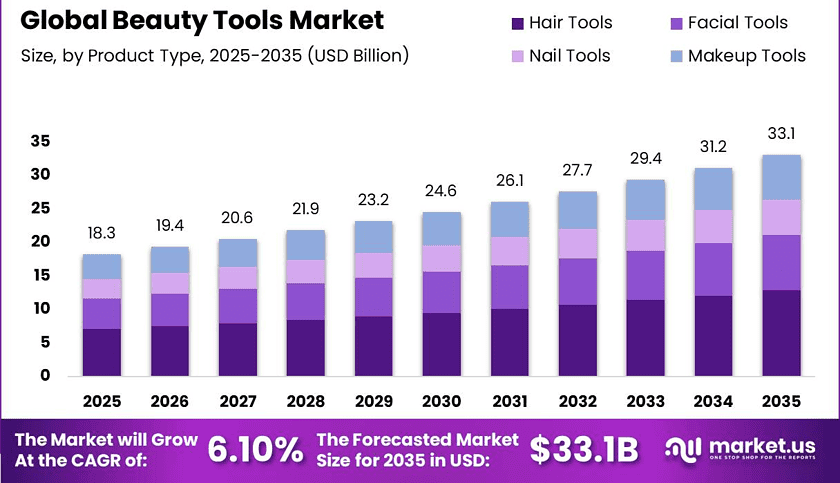
The global beauty tools market reached USD 18.3 billion in 2025. Analysts expect it to hit USD 33.1 billion by 2035, growing at a 6.1% CAGR from 2026 to 2035. Clinical-grade home devices and social commerce fuel this steady growth.
Beauty tools include devices and implements for hair, face, nail, and makeup care. They come in electric and manual forms and sell through stores and online. Household users and professional salons buy them, so brands reach a broad customer base.
The category spans hair, facial, nail, and makeup tools. Hair dryers, straighteners, and curling irons anchor styling routines. Cleansing brushes, face massagers, and derma rollers serve skincare needs. Consequently, buyers can build full personal care kits across price points and use occasions.
Regulators now watch skin-contact and electric devices more closely. MoCRA in the United States and the EU packaging regulation from August 2026 raise compliance standards. Consequently, compliant brands gain an advantage in export markets and premium retail channels.
Clinical evidence also changes buying behavior. CurrentBody trials showed skin elasticity improved by 57.1% after 56 days of LED mask use. Hydration rose 36.0%. Therefore, beauty tools shift from cosmetic accessories to outcome-driven wellness devices.
Data-Driven Insights for Smarter Business Decisions: Explore the Full Report
Key Takeaways
- Beauty tools market size USD 18.3 billion in 2025, rising to USD 33.1 billion by 2035.
- Growth runs at a 6.1% CAGR from 2026 to 2035.
- Hair Tools lead with 38.9%.
- Electric and battery-operated tools hold 61.6%.
- Offline channels hold 73.2%.
- Asia-Pacific leads with 42.3%, worth USD 7.74 billion.
Market Segmentation Overview
Hair Tools lead product types with a 38.9% share. Hair dryers reach households across all income levels and need frequent replacement. Consequently, the segment offers an accessible entry point for new brands. Meanwhile, facial tools grow quickly through clinical-grade device adoption.
Moreover, electric and battery-operated tools hold 61.6% of operation modes. Consumers believe powered devices deliver faster, more consistent results. Therefore, manufacturers earn higher selling prices and stronger differentiation. Manual tools remain a low-cost gateway for first-time buyers.
Additionally, offline channels hold 73.2% of distribution because shoppers want to test ergonomics and finish quality in person. However, online channels grow faster. Medicube generated USD 102.9 million in TikTok Shop sales, which proves digital-first brands can scale quickly.
Drivers
Generative AI now shapes how shoppers find beauty tools. Surveys show 49% of consumers received beauty recommendations from AI tools. Only 10% of beauty executives use AI regularly. Consequently, early adopters gain visibility, and this driver adds 2.1 percentage points to growth.
Moreover, at-home professional treatments gain ground as device costs compare well with salon visits. CurrentBody trials showed 100% of participants improved elasticity and hydration. This evidence reduces buyer hesitation. Therefore, premium pricing becomes easier to justify, and this driver adds 1.8 percentage points.
Use Cases
Consumers use LED masks and facial devices at home for anti-aging care. Trials showed forehead wrinkle volume fell 29.8% after 56 days. These results give brands clinical proof. Consequently, shoppers who once visited clinics now buy devices for daily routines.
Additionally, shoppers buy beauty devices through live social commerce. TikTok Shop reported a 400% jump in facial device sales. About 26% of red-light mask purchases came through live sessions. Therefore, digital brands win customers without heavy retail infrastructure.
Major Challenges
Trade friction squeezes margins. About 55% to 60% of electric beauty tools come from China, while over 35% of demand sits in North America. Tariffs of 17% to 25% cut gross margins by 280 to 350 basis points. Consequently, brands risk volume loss if they raise prices.
However, AI and device rules add cost. Meeting FDA and EU AI Act requirements costs USD 150,000 to USD 500,000 per product. Development stretches by 12 to 24 months. Therefore, mid-tier indie brands struggle more than large incumbents.
Data-Driven Insights for Smarter Business Decisions: Explore the Full Report
Business Opportunities
The longevity economy offers major potential. UBS projects annual revenues will reach USD 8 trillion by 2030. Brands that position devices as preventive health tools can charge higher prices. Meanwhile, dermatologist co-prescribing pathways add 2.3 percentage points to growth.
Additionally, population aging creates a lasting buyer base. The UN says people over 60 will double to surpass 2 billion by 2050. Early investors in aging-skin research gain a durable advantage. Consequently, device-as-a-service models, adding 1.5 points, can turn sales into recurring revenue.
Regional Analysis
Asia-Pacific leads with a 42.3% share, worth USD 7.74 billion in 2025. Large manufacturing capacity, embedded beauty routines, and rising incomes in China, South Korea, Japan, and India drive demand. Moreover, K-Beauty innovation cycles flow into Western markets.
Meanwhile, North America stays structurally important through strong consumer spending and mature at-home beauty culture. TikTok Shop beauty sales in the UK rose 60% in 2025. Therefore, platform-native purchasing shortens the path from discovery to sale across Western markets.
Key Players Analysis
Leading companies compete through distribution reach and digital-first models. Procter and Gamble offers broad mass-market and professional coverage. Medicube launched the Booster Pro X2 in March 2026 and works with over 34,000 creators. It also earned USD 22 million on Amazon Prime Day.
- The Procter and Gamble Company
- PPI Beauty
- e.l.f. Cosmetics, Inc.
- Avon Products, Inc.
- Edgewell Personal Care
- Louis Vuitton
- Coty, Inc.
- Loreal SA
- Shiseido Co. Ltd.
- TRIA BEAUTY
Recent Developments
- March 2026 — Medicube AGE-R unveiled the Booster Pro X2 globally.
- January 2025 — NuFACE launched the FIX MicroWand with 3 treatment modes.
- January 2025 — Nanoleaf entered beauty tech with an LED mask offering 7 treatment modes.
Conclusion
The beauty tools market grows steadily through 2035. Clinical evidence, AI discovery, and social commerce drive demand. Tariffs and regulation raise costs but favor prepared brands. Consequently, the industry rewards companies that combine proven results with strong digital reach.
Therefore, companies must document clinical outcomes, diversify manufacturing, and optimize for AI search. Hair tools, electric devices, offline stores, and Asia-Pacific lead today. Firms that act early can capture a market worth USD 33.1 billion by 2035.
Looking for data tailored to your specific market, region, or business need? Request a custom report or consultation — write to us at sales@market.us
Discuss your needs with our analyst
Please share your requirements with more details so our analyst can check if they can solve your problem(s)